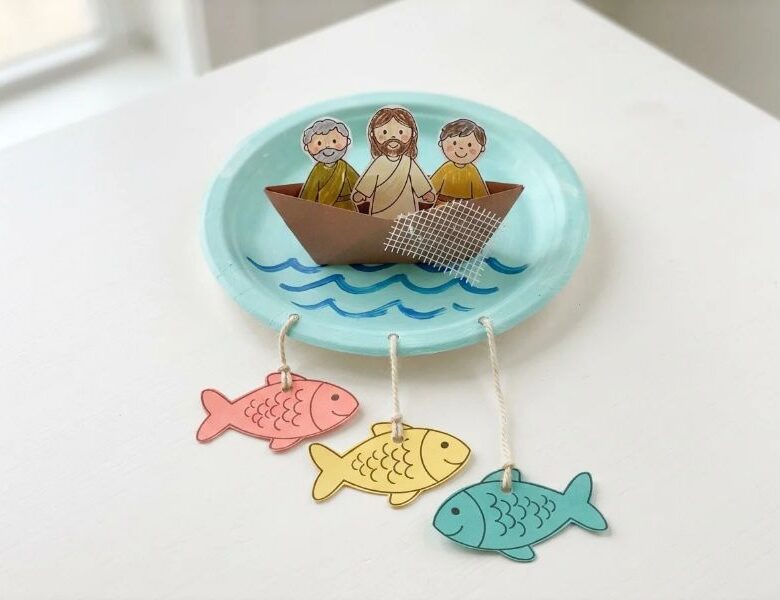
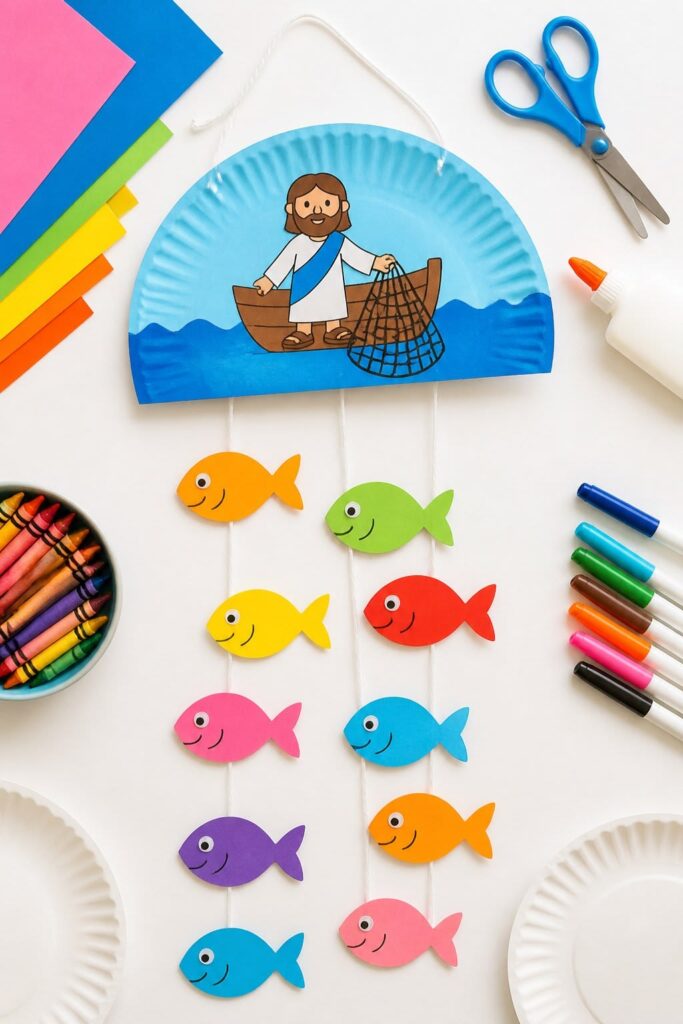
Can a simple craft help children understand why the fishermen followed Jesus? See fishers of men crafts for Sunday school, Bible study and home learning.
Simon was a working fisherman, and Jesus told him to do something no working fisherman would do: let down his nets in daylight, in deep water.
Fishermen on the Sea of Galilee worked at night, because the nets of that time were easy for fish to see by day. Simon had been out all night and caught nothing.
He was washing his nets when Jesus asked him to go back out. He told Jesus it would be pointless, then did it anyway. The nets filled until they began to tear.
These 9 fishers of men crafts follow that morning one moment at a time, from the empty nets to the day Simon, James and John left everything and followed Jesus.
Help children picture the miracle of Jesus feeding the crowd with Five Loaves and Two Fish Crafts for Kids: 7 Easy Ideas From the Feeding of the 5,000.
1. Jesus Teaches From Simon’s Boat (Luke 5:1-3)
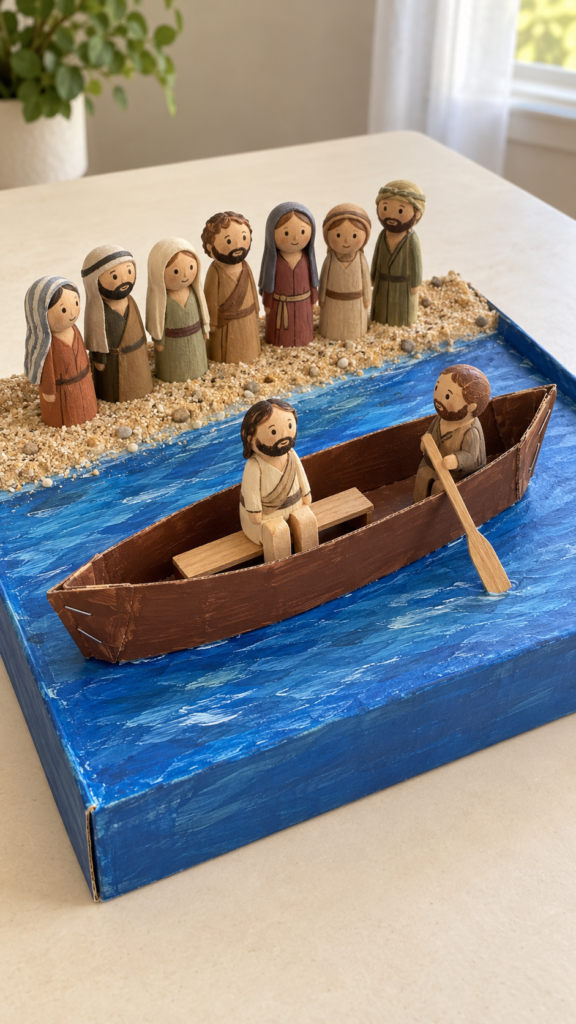
Before Jesus says a word about fishers of men, he asks Simon for something small: can I borrow your boat?
Simon had just come in from a night of catching nothing. The fishermen were washing their nets at the water’s edge, two boats were pulled up beside them, and a crowd was pushing toward Jesus so hard that he had nowhere to stand.
So he stepped into Simon’s boat, asked him to push out a little from the land, and sat down to teach.
Simon wasn’t helping a stranger. In Luke 4, Jesus had healed Simon’s mother-in-law in Simon’s own house.
Even so, it was a lot to ask of a man who was worn out and still had nets to clean. Simon said yes. That small yes comes first, and “follow me” comes a few verses later.
Two details are worth getting right when kids build this Bible craft. Jesus is sitting, because that is how a teacher taught (Luke 4:20 shows the same). And the boat stays close to shore. Luke says “a little,” so the whole crowd could still hear him.
You’ll need
- A strip of cereal box cardboard, about 12 x 4 inches
- A shoebox lid, and blue and brown paint
- Coarse sand or craft sand, and white glue
- 9 wooden clothespin dolls (the round-head kind with two legs)
- 2 craft sticks, a stapler, and fine markers
Steps
- Paint the plain gray side of the cardboard brown. The shiny printed side makes paint bead up, so keep that side on the inside.
Paint the lid blue and let both dry. - Bend the strip into a shallow U and pinch both ends into points for the front and back of the boat. An adult staples each end twice.
- Run a line of glue along one long edge of the lid and press sand into it. After a few minutes, tip off the extra. This is the shore.
- Glue one craft stick across the middle of the boat as a bench, and hold both ends for a minute.
Draw a face on a doll and sit it on the bench with a leg on each side. This is Jesus, sitting. - Glue a second doll at the back of the boat, with the other craft stick as an oar. This is Simon.
- Set the boat on the lid about a hand’s width from the sand. That gap is the “little” from Luke 5:3. Stand the other seven dolls on the sand shoulder to shoulder, like a crowd pushing in. If they tip, press a bit of sticky tack under their feet.
The real boat found in the Sea of Galilee in 1986 was about 3½ times as long as it was wide. If yours comes out too wide, pinch the ends in a little more.
Ask the kids: “Why do you think Jesus got into the boat instead of asking the crowd to move back?” For older kids, add: “Simon was tired. Would you have said yes?”
This Simon’s boat craft works for ages 4 to 10. For the younger ones, an adult bends and staples the boat and the kids place the dolls. In a Sunday school class with mixed ages, let the older kids make the boats and the younger ones build the crowd.
Bring the story of Jesus’ birth into craft time with 12 Nativity Crafts That Walk Kids Through the Story of Jesus’ Birth, at Home or Sunday School.
2. A Night of Empty Nets (Luke 5:4-5)
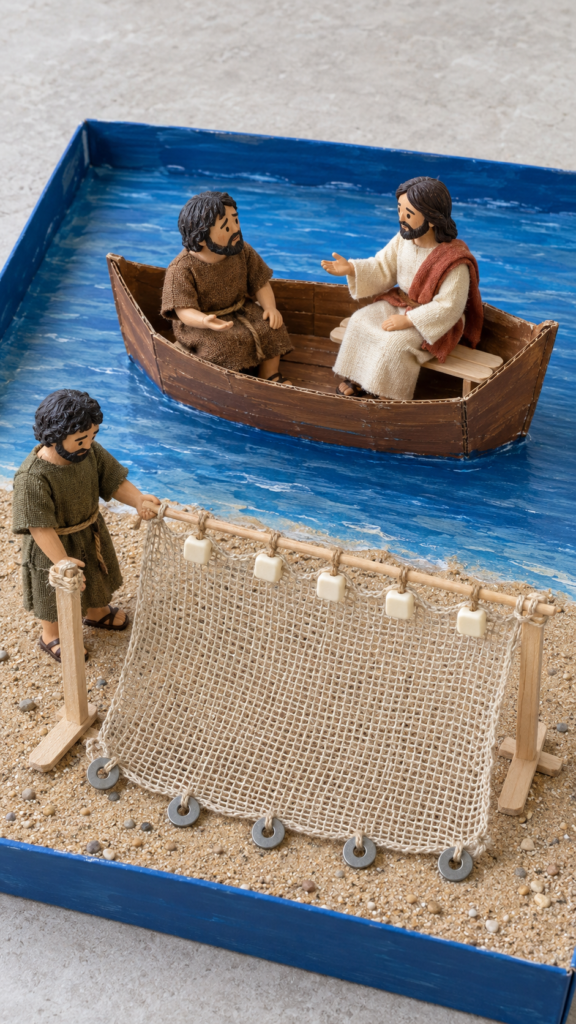
Simon doesn’t say yes right away. He tells Jesus exactly why it won’t work: they worked all night and caught nothing. Only then does he say he’ll let the nets down, because Jesus asked.
He had good reason to doubt. Simon knew this lake better than anyone on the shore.
Mendel Nun, a Galilee fisherman who spent his life studying how these men fished, argues that Simon and his partners used a trammel net. It had three walls: two outer nets with wide holes, and a loose, fine net between them.
A fish swam through the first wall, pushed the fine net through the second, and got tangled in the pocket it made.
Nets like this were used at night, often with more than one boat. A full trammel net was at least 175 meters long, close to two football fields.
So this wasn’t a bad night from a lazy crew. They did everything right, and the nets still came up empty.
Their nets also had to be looked after. The net’s top edge had floats of cork or wood, and its bottom edge had small stone weights with holes drilled through them. Archaeologists have found thousands of these stone weights around the lake.
This fishing net craft shows a net the way Simon would have known it: empty, with floats on top and weights on the bottom.
You’ll need
- A mesh produce bag (the kind onions or oranges come in)
- A stick or wooden dowel, about 12 inches long
- Yarn or twine
- Craft foam for floats (five 1-inch squares)
- 5 flat metal washers or large wooden beads for weights
- Scissors and a pencil
- A few green yarn scraps (optional)
Steps
- Cut the mesh bag open along both sides so it lies flat. Trim it to about 10 inches wide and 8 inches tall.
- Fold the top edge over the stick and tie it on with yarn every 2 inches.
Thread the yarn through the mesh holes as you go so the net can’t slide. - Poke a hole in each foam square with a pencil.
Thread a short piece of yarn through each one and tie the squares along the top edge, between the yarn ties. These are the floats. - Tie a washer to the bottom edge with yarn, about 2 inches apart. These are the stone weights. Real ones were small stones with a hole drilled through, so a washer is the same shape.
- If you have green yarn, weave a few scraps through the net and let kids pull them out. It’s pretend lake weed, and it gives kids something to do with their hands while you talk.
- Tie a loop of yarn to each end of the stick and hang the net on a hook or shelf.
Keep it empty. No fish. The empty net is the point of this craft.
Ask the kids: “Simon knew this was a bad time and place to fish. Why do you think he went out anyway?” For older kids, add: “What have you done just because someone you trust asked?”
Ages 4 to 6: an adult cuts the mesh and ties the floats, and the kids tie on the weights. Ages 7 to 10 can make the whole net.
Teach children about Esther’s courage and her role in saving her people through Esther Craft Ideas: 13 Crafts That Retell Her Story for Kids, From Her Crown to Purim.
3. “Put Out Into the Deep Water” (Luke 5:4)
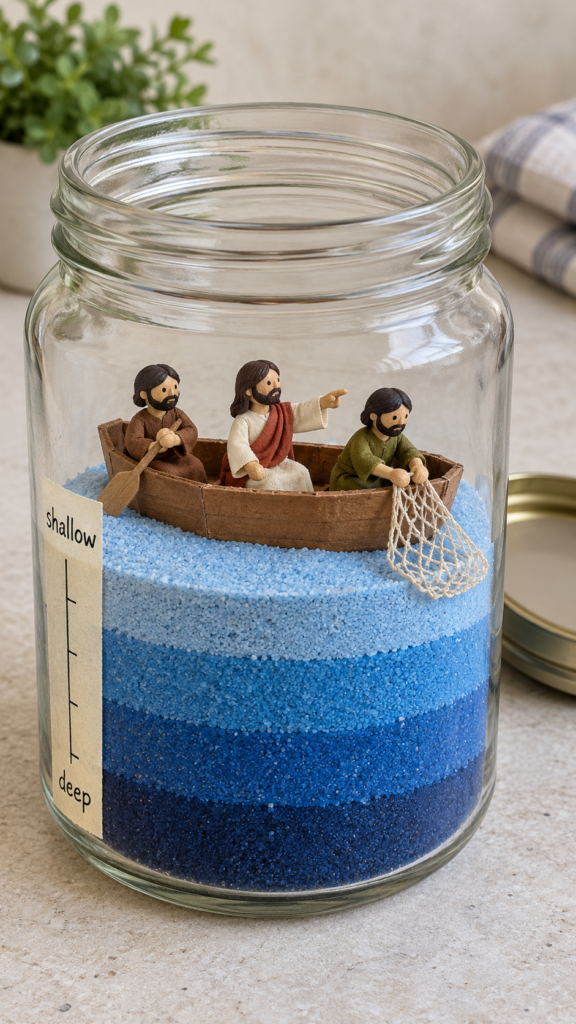
A carpenter was telling a fisherman where to fish.
That is how it must have looked to the people on the shore. Jesus grew up in a carpenter’s family (Mark 6:3).
Simon had spent his life on this lake.
But when Jesus finished teaching, he turned to Simon and said, “Put out into the deep water, and let down your nets for a catch.”
Look closely at the words. Jesus spoke to Simon alone when he said “put out.” That means Simon was steering the boat.
Then Jesus spoke to the whole crew when he said “let down your nets.” Everyone in the boat had a job to do.
Luke doesn’t say how far out they went. “The deep” means away from the shore, where the water gets deeper. The Sea of Galilee is a lake, and Luke calls it the Lake of Gennesaret.
It’s about 13 miles long and 8 miles wide. At its deepest it’s about 141 feet, which is taller than a 10-story building.
Fishers of men crafts work best when kids can see the part of the story that sounds strange. Here, that part is “the deep.” This craft lets kids pour the water layer by layer, from the shallow top to the deep bottom.
You’ll need
- A clear jar with a lid (a pint size works well)
- Craft sand in light blue and dark blue (about 1 cup of each)
- 3 small paper cups and a spoon
- Half a wine cork (an adult cuts it lengthwise)
- 1 toothpick and a small scrap of paper or fabric
- Masking tape and a marker
Steps
- Make five blues. Keep one cup of pure dark blue and one of pure light blue. In the third cup, mix half dark and half light.
Then mix a little dark into some light for a pale-medium shade, and a little light into some dark for a deep-medium shade. - Spoon the darkest blue into the jar first, about 1 inch deep. This is the deepest water.
- Add the layers one at a time, getting lighter each time. Tap the jar gently so each layer sits flat. The lightest blue goes on top, as the shallow water.
- Make the boat. Push the toothpick into the cork and tape the paper scrap to it as a sail. The real boat found in the Sea of Galilee in 1986 could be sailed or rowed, so one small sail is accurate.
- Set the boat on the top layer.
- Put a strip of masking tape down the side of the jar. Write “shallow” at the top and “deep” at the bottom.
- Put on the lid. Don’t shake it. Shaking mixes the layers.
Tip: A shoebox lid works too if you need a cheaper option for a big group. Paint it in stripes from light to dark blue, with the boat sitting in the dark stripe.
Ask the kids: “Simon was tired, and the nets were clean and put away. What would you want to say to Jesus?” For older kids, add: “Which is harder: going out where it’s deep, or trying again after it didn’t work?”
Ages 4 to 6: an adult mixes the shades and cuts the cork, and the kids pour. Ages 7 to 10 can do the whole jar, including the sail.
Help kids think about compassion and why the other passersby did not stop with 7 Good Samaritan Craft Ideas for Kids Who Ask “Why Didn’t Anyone Else Stop?.
4. Nets So Full They Began to Break (Luke 5:6-7)
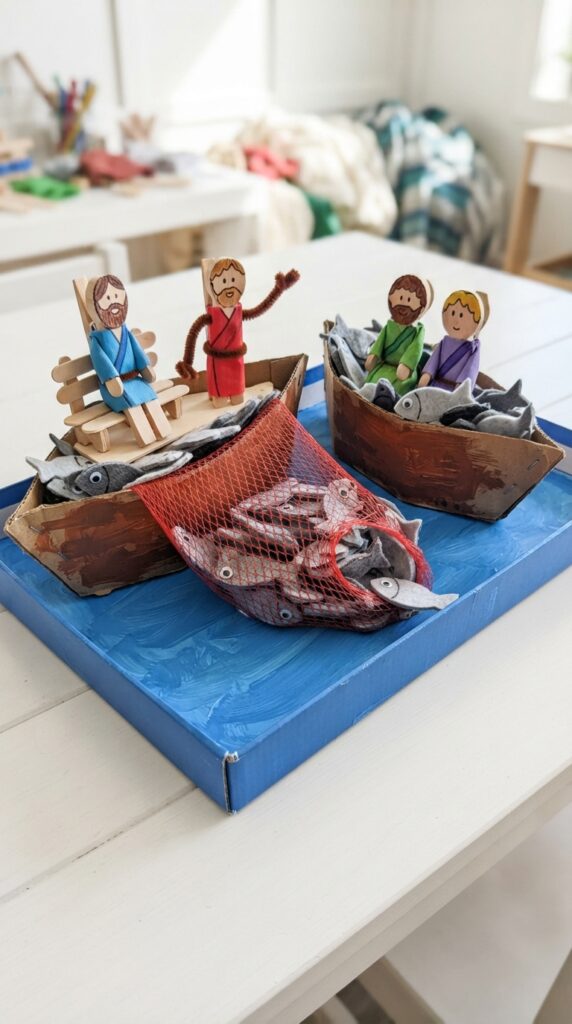
Simon let the nets down, and then he couldn’t pull them back up.
Luke says the crew enclosed so many fish that the nets were starting to break. Simon knew this lake better than anyone, and even he couldn’t handle this alone. So he signaled to his partners in the other boat to come and help.
They were probably too far away to hear a shout, so the crew likely waved their arms.
The partners were James and John (Luke 5:10). They came over, and the fish filled both boats until the boats began to sink.
That means the boats started taking on water. They didn’t go under, because Luke 5:11 says the men brought both boats back to shore.
Luke never says how many fish there were. You may have heard “153,” but that number belongs to a different story in John 21, after Jesus rose from the dead. Luke doesn’t name the fish either, so this craft uses two common fish from the lake.
One is the musht, often called “St. Peter’s fish.” It has a silvery body and a long fin along its back like a comb, and one kind grows to about 18 inches. The other is the Kinneret sardine, a small fish that looks like a little herring.
Notice what Simon didn’t do. He didn’t try to pull it in alone. He called for help, and help came.
You’ll need
- The net from the empty-nets craft
- Gray or silver felt, in two shades
- Wiggle eyes and tacky glue
- A second boat, made like the first (a cardboard strip bent into a U, ends pinched and stapled)
- 2 clothespin dolls for James and John
- 1 pipe cleaner
- Scissors
Steps
- Cut about 12 fish from the felt. Make 6 musht, about 4 inches long, each with a zigzag fin along the back to look like a comb. Make 6 sardines, about 2 inches long and slim.
- Glue a wiggle eye on each fish and let them dry.
- Fill the net. Push each fish’s tail through a mesh hole and fold it back, so the fish looks tangled.
This is how fish were caught in the real nets. Put most of the fish near the bottom so the net hangs heavy. - Pull one mesh hole wider with your fingers. Luke says the nets were starting to break, so don’t tear it all the way.
- Draw faces on the two new dolls for James and John and set them in the second boat.
Twist the pipe cleaner around Simon’s neck to make arms, and bend one arm up to wave. - Lay the net over the side of the first boat. Set the second boat a hand’s width away and have Simon wave. Then slide the second boat next to the first and pile fish in both until they spill over the sides.
Ask the kids: “Simon was the expert on this lake. Why do you think he still called for help?” For older kids, add: “Who do you call when something is too big for you?”
Ages 4 to 6: an adult cuts the fish, and the kids glue the eyes and fill the net. Ages 7 to 10 can do it all.
Make Noah’s long journey easier to follow with Noah’s Ark Crafts for Kids: 9 Ideas That Walk Through the Whole Story, One Craft at a Time.
5. Peter on His Knees (Luke 5:8-10)
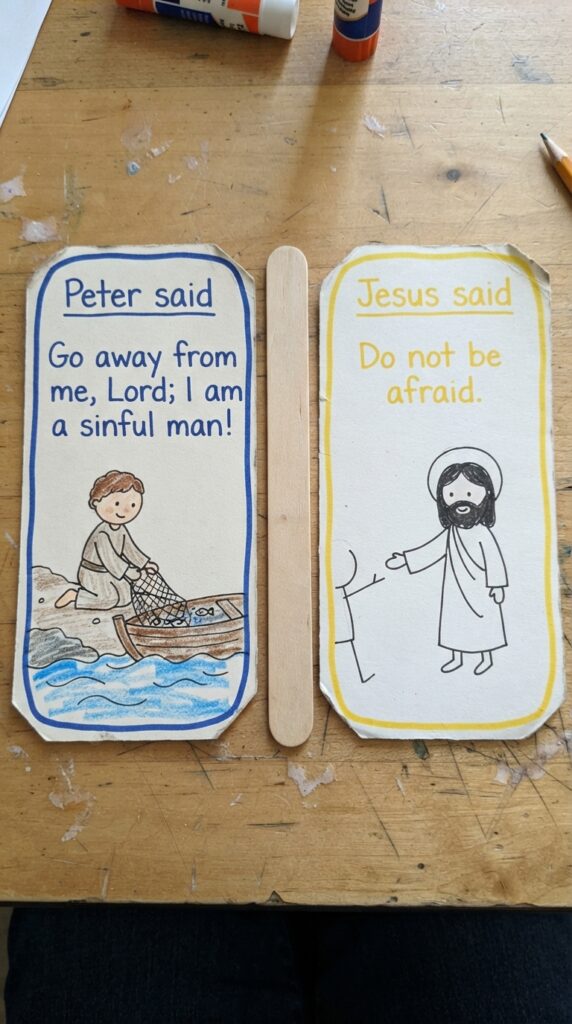
A few minutes earlier, Simon called Jesus “Master.” Now he calls him “Lord.”
“Master” is a title for a teacher. “Lord” is a bigger word. Something changed in what Simon saw. When he saw the catch, he fell down at Jesus’ knees, which means he dropped down at his feet.
He said, “Go away from me, Lord; I am a sinful man!” Everyone in the boat was astonished, and so were James and John.
Peter wasn’t running away from a fight. He had just seen that Jesus was far greater than a teacher, and it made him feel how far he was from perfect. That is the kind of awe the Bible describes when people come close to God.
But Jesus didn’t go away. He said, “Do not be afraid.” Then he gave Peter a job: “From now on you will be catching people.”
Some Bibles say “catching people alive.”
You may know this story from fishers of men crafts and songs. Those exact words, “fishers of men,” are in Matthew 4:19 and Mark 1:17. Luke tells the same call in his own words.
You’ll need
- 2 sheets of cardstock (one for each side of the card)
- 1 jumbo craft stick
- Markers
- Tacky glue
- Scissors
Steps
- Cut two cardstock rectangles, each about 4 x 5 inches. Round the corners.
- On the first card, write “Peter said” across the top. Below it, write “Go away from me, Lord; I am a sinful man!” in big letters. Draw Peter kneeling at the bottom, head down, next to a boat full of fish. Use blue marker around the edges.
- On the second card, write “Jesus said” across the top.
Below it, write “Do not be afraid.” Draw Jesus standing with one hand held out. Use yellow marker around the edges. - Lay the jumbo craft stick down the middle of the blank side of the first card.
Spread glue around it, then press the second card on top, back to back. Put a heavy book on it for 10 minutes. - Practice twirling the stick between your palms to flip the card.
Act it out. Have one child kneel and read Peter’s side. Then flip the card, and the other children read Jesus’ words aloud. The blue and yellow let everyone see the change at a glance.
Ask the kids: “What do you think Peter felt when Jesus didn’t go away?” For older kids, add: “Have you ever felt too small or too messy to be near someone important?”
Ages 4 to 6: an adult writes the words, and the kids draw and decorate. Ages 7 to 10 can do the whole card.
Start a conversation about courage and trusting God with Daniel and the Lion’s Den Craft: A Sunday School Activity for Kids That Teaches Courage and Faith.
6. James and John Mending Nets With Their Father (Matthew 4:21; Mark 1:19–20)
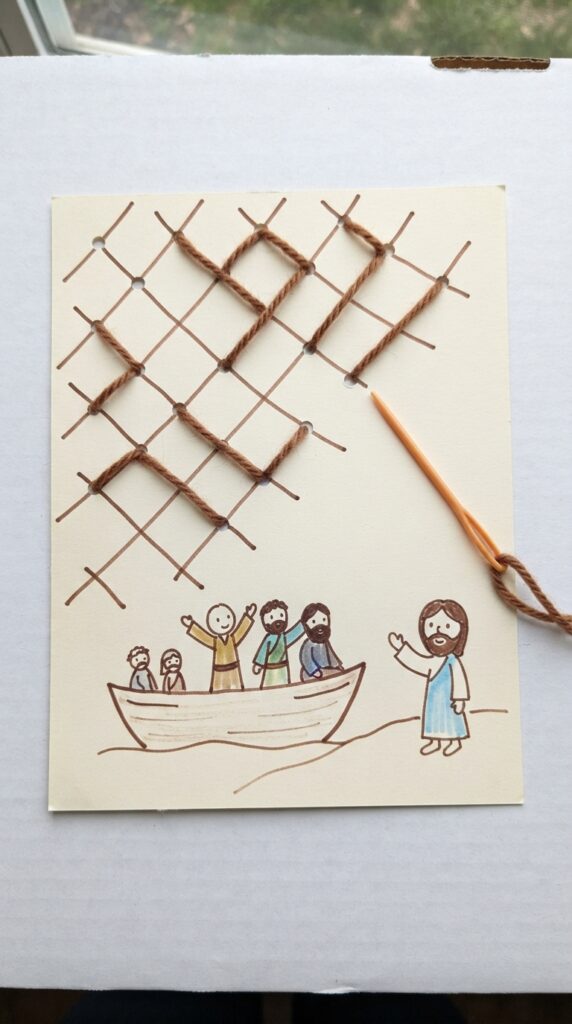
James and John were in a boat with their father, Zebedee, when Jesus called them.
They were preparing their nets, and Mark tells us that Zebedee had hired servants working with him too.
That detail matters. James and John did not leave an empty boat behind. Their father was there, the servants were there, and the family fishing work was underway. Matthew says they left the boat and their father and followed Jesus.
Fishing nets needed care. A tear could let fish escape, so fishermen had to repair damaged sections before using them again.
The Bible does not tell us that James and John were mending a particular tear when Jesus called them, but repairing a net is a useful way for children to picture the work they were leaving behind.
You’ll need
- 1 sheet of sturdy cardstock
- Blue or brown yarn
- A hole punch
- A blunt plastic yarn needle
- Markers
- Scissors
Steps
- Cut a rectangle from the cardstock, about 6 x 8 inches. Draw a large fishing net across it using crisscrossing lines.
- Punch holes along the lines where they cross, leaving enough space between the holes so the card does not tear.
- Cut a length of yarn and thread it through the blunt plastic needle.
Tie a knot at the end, or tape the yarn to the back of the card to keep it from slipping through. - Show the children how to lace the yarn through the holes, crossing over and under to follow the net pattern.
- Leave one small section unfinished. Ask the children to fill that section with yarn, as if they are repairing the net.
- Write “James and John followed Jesus” at the bottom. Add a small drawing of a boat and the names James, John and Zebedee.
Act it out. Ask one child to hold the finished net while another pretends to be James or John repairing it.
Read Matthew 4:21 or Mark 1:19–20, then have the child put down the net and step away from the boat to show the moment they followed Jesus.
Ask the children: “Why do you think fishing was important to this family?”
Explain that James and John left familiar work and family responsibilities to follow Jesus.
Their decision was a big change, not just a move to a different job.
Ages 4 to 6: Prepare the holes beforehand and let children weave thick yarn through them with help. Ages 7 to 10 can draw the net, punch the holes with adult supervision and complete the lacing themselves.
Show children how Zacchaeus’ encounter with Jesus changed him through Creative Zacchaeus Crafts: More Than Just a Man in a Tree.
7. I Will Make You Fishers of Men (Matthew 4:19; Mark 1:17)
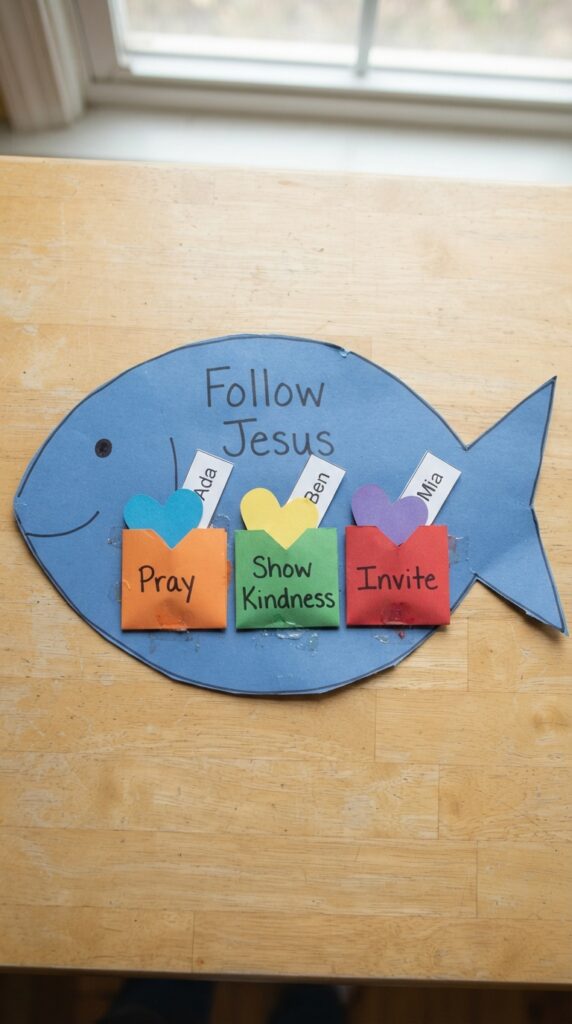
When Jesus called Simon Peter and Andrew, he said, “Follow me, and I will make you fishers of men.” James and John received a similar call. Jesus was using words they understood from their work as fishermen to explain a new purpose.
Luke tells the same story with different wording. In Luke 5:10, Jesus tells Simon, “From henceforth thou shalt catch men” (KJV).
The meaning is not that the disciples would trick people or catch them against their will. Jesus was calling them to help people hear his message and follow him.
That is the lesson behind this craft. Each paper fish holds the name of someone a child could pray for, show kindness to, or invite to church.
The aim is to help children think about sharing their faith in a caring way, not to treat people as prizes to collect.
You’ll need
- Coloured cardstock or construction paper
- Small paper envelopes or folded paper pockets
- Markers
- Glue stick
- Scissors
- Small paper strips for name cards
Steps
- Draw and cut out a large fish from cardstock. Make it about 8 inches long so there is enough space for the pockets.
- Cut three or four smaller fish shapes from different colours of paper.
Write “Follow Jesus” across the large fish, or write the Bible reference Matthew 4:19. - Fold small rectangles of paper into pockets, leaving the top open. Glue each pocket onto the large fish, making sure the opening stays clear.
- Decorate each pocket with a smaller fish, a wave pattern or a simple heart.
Label the pockets with words such as “Pray,” “Show Kindness” and “Invite.” - Cut small paper strips. Let each child write a first name on a strip, or draw a person if they are too young to write. Place the strips inside the pockets.
- Read Matthew 4:19 together. Explain that following Jesus includes learning from him and showing his love to others.
Act it out. Let each child choose one name card and suggest a kind, respectful way to reach out to that person.
Examples include inviting a friend to church, including someone who feels left out, or offering to help a classmate.
Remind them that an invitation should be kind and that the other person is free to say no.
Ask the children: “How can we help someone learn about Jesus without forcing them?” For older children, discuss the difference between inviting someone with kindness and pressuring them.
Ages 4 to 6: Prepare the fish and pockets in advance. Children can decorate the fish and choose picture cards to put inside. Ages 7 to 10 can cut and fold the pockets themselves, write names and think of a suitable action for each person.
Keep children busy when winter weather cuts off the usual activities with 17 Snow Day Crafts Kids Can Make When the Power Goes Out.
8. They Left Their Nets (Matthew 4:20; Mark 1:18; Luke 5:11)
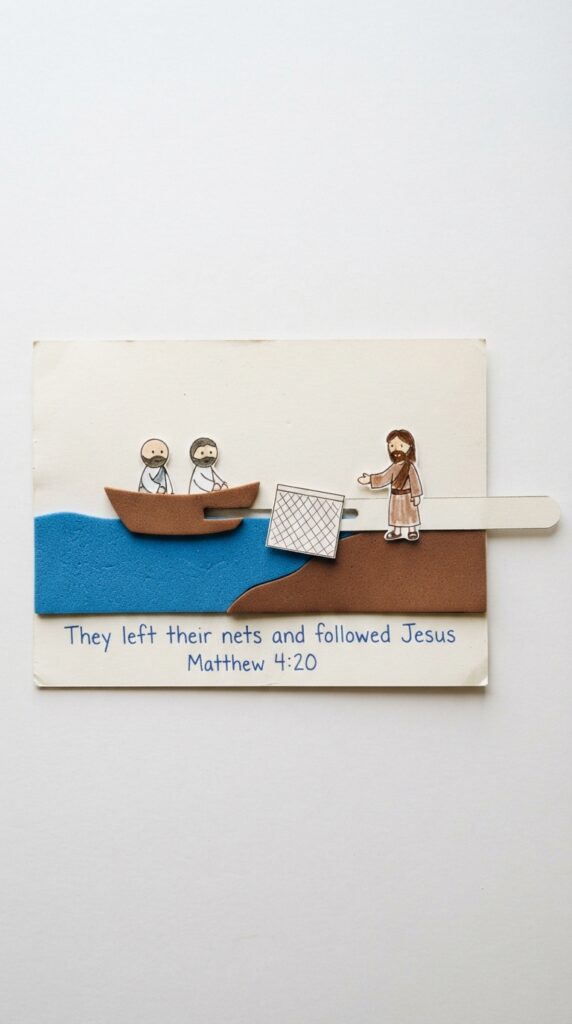
Matthew and Mark describe Simon Peter and Andrew leaving their nets immediately after Jesus called them.
When Jesus called James and John, they also left their boat and their father, Zebedee, and followed him (Matthew 4:22; Mark 1:20).
Luke tells a related account with an important difference. Before Simon follows Jesus, he witnesses a miraculous catch of fish. After the fishermen bring their boats to shore, Luke 5:11 says they leave everything and follow Jesus.
The accounts share the theme of following Jesus, but Luke includes details that Matthew and Mark do not give in the same way.
The craft below helps children picture what the disciples left behind. It uses a moving paper net to show the change from working as fishermen to following Jesus. The sliding net is a creative illustration, not a detail the Bible says happened in that exact way.
You’ll need
- 1 sheet of cardstock for the background
- Blue and brown craft foam
- A small piece of mesh, net-pattern paper or paper with a net drawn on it
- 1 strip of cardstock for the pull tab
- Glue stick
- Scissors
- Markers
- 1 paper fastener (brad), optional
Steps
- Turn the cardstock horizontally. Draw a shoreline across the lower half, with blue water on one side and brown sand on the other.
- Cut a small boat from craft foam and glue it onto the water. Draw two simple figures inside to represent the fishermen.
- Cut a net shape from mesh or paper. If you use paper, draw crisscrossing lines to make it look like a fishing net.
- Cut a narrow horizontal slit in the background near the boat and shoreline. Ask an adult to do this for younger children.
- Attach the net to the end of the cardstock pull tab. Slide the tab through the slit so the net can move from beside the boat towards the shore. Check that it moves freely before adding more glue.
- Add a small paper handle to the tab so children can pull it easily. If you want a movable boat, attach it with a paper fastener instead of gluing it down.
- Write “They left their nets and followed Jesus” beneath the scene. Add the reference Matthew 4:20 or Mark 1:18.
Act it out. Let the children begin with the net beside the boat. Read Matthew 4:18–20, then have them pull the tab to move the net towards the shore.
Explain that the movement helps them picture the disciples leaving their fishing work to follow Jesus; it is not meant to show the exact physical movement of the nets in the Bible account.
Ask the children: “What did the disciples leave behind when they followed Jesus?” Help them notice that fishing was their work, and that following Jesus meant changing what they were doing.
For older children, compare Matthew 4:20 with Luke 5:11. Ask what extra detail Luke gives about the catch of fish and the boats coming to shore.
Ages 4 to 6: Prepare the slit and pull tab in advance. Let the children decorate the boat and move the net with help.
Ages 7 to 10 can make the slider themselves with adult supervision.
Turn pinecones, twigs and other outdoor finds into festive projects with 12 Christmas Nature Crafts for the Kids Who Keep Bringing Pinecones and Winter Finds Home.
9. “Follow Me” Footprint Path (Matthew 4:19–20)
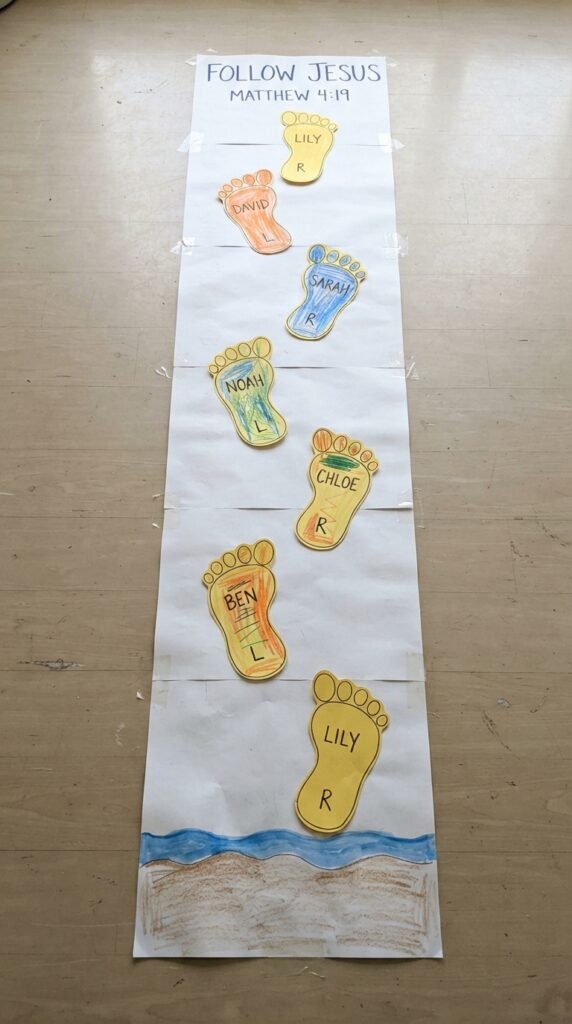
When Jesus called Simon Peter and Andrew, he said, “Follow me, and I will make you fishers of men.” Matthew 4:20 tells us that they immediately left their nets and followed him.
Later, Jesus called James and John, who also left their boat and their father to follow him (Matthew 4:21–22).
The passage does not describe a special path of footprints along the shore. The footprint banner is a way to help children picture what it means to follow Jesus: listening to him, learning from him and choosing to live by his teaching.
This is a different approach from many fishers of men crafts that focus mainly on boats, fish and nets.
Here, the footprints become the main feature, giving children a visual reminder of the disciples’ decision.
You’ll need
- A long strip of banner paper or several sheets of paper taped together
- Washable paint
- Paper plates for the paint
- Markers
- A pencil
- Baby wipes or a damp cloth for cleaning feet
- Optional: cardstock for paper footprints
Steps
- Spread the banner paper on a protected floor or table. Draw a blue waterline along one end and a simple shoreline beside it.
- Use a pencil to mark a winding path leading away from the water. Leave enough space for several footprints.
- Pour a small amount of washable paint onto a paper plate. Help each child coat the sole of one foot lightly with paint, or use paper footprints if you prefer not to use paint on skin.
- Press each foot gently onto the banner along the path. Alternate left and right feet to make the prints look like walking steps.
- Let the children write their names beside their footprints, or write their names on separate paper footprints and glue them along the path.
- At the end of the path, write “Follow Jesus” and add Matthew 4:19. Allow the paint to dry completely before hanging the banner.
Act it out. Read Matthew 4:18–20 aloud. Invite the children to point from the shoreline towards the words “Follow Jesus.”
Explain that the footprints represent the choice to follow Jesus, not a claim that the Bible records these exact footprints.
Ask the children: “What is one way you can follow Jesus today?” Accept practical answers such as telling the truth, helping someone who is left out, forgiving a friend or showing kindness at home.
For older children, discuss the difference between simply walking behind someone and following their example. Jesus was calling the disciples to learn from him and take part in his work.
Ages 4 to 6: Use pre-cut paper footprints and let children decorate them with their names. Ages 7 to 10 can help plan the path, make the footprints and write one action they want to practise during the week.
Choose a gentler approach to Halloween with Halloween Crafts for Kids Who Don’t Like Scary Decorations: 15 Cute Ideas Without the Creepy Stuff.
How to Run the Fishers of Men Crafts in One Class or Over Two Weeks
Children may remember the fish they coloured long after they forget what Jesus said to the fishermen. The discussion between activities is what helps connect the two.
Rather than asking only whether they enjoyed making the crafts, invite them to explain what they think the disciples understood about Jesus, what made their decision significant, and how the lesson relates to their own choices.
Even a short conversation can turn a table full of finished projects into a meaningful Bible lesson.
Option 1: Run the Crafts in One Class
A 45–60-minute session works best when you select two or three fishers of men crafts rather than rushing through all nine. Keep the remaining activities for another lesson or send them home as optional projects.
- First 10 minutes: Read and discuss the Bible passage. Read Matthew 4:18–22 or Mark 1:16–20. Ask the children what the fishermen were doing before Jesus called them and who was with them.
- Next 15 minutes: Make the mending-net craft. Use craft number 6 to introduce the work James and John were leaving behind. Explain why fishermen needed nets and invite children to try the lacing themselves.
- Next 15 minutes: Make the “They Left Their Nets” slider. Use craft number 8 to help children picture the fishermen leaving their work to follow Jesus. Read the relevant verses again while they move the net.
- Final 10 minutes: Talk about the lesson. Ask what the disciples left behind, why following Jesus mattered, and how children can put his teachings into practice. If time allows, let everyone add a paper footprint to a shared banner using craft number 9.
Allow a few extra minutes for cleanup, especially if the children use paint, glue or scissors.
For younger groups, two completed crafts and a thoughtful discussion are better than three unfinished projects.
Introduce children to African cultures through hands-on projects with 12 African Art Projects for Kids That Teach Culture, Not Just Craft.
Option 2: Spread the Crafts Across Two Weeks
Two sessions allow children to revisit the Bible account instead of trying to absorb every detail at once. You can also compare the different Gospel accounts without making the lesson feel rushed.
Week 1: The Fishermen Hear Jesus’ Call
- Read Matthew 4:18–22 or Mark 1:16–20 together.
- Make craft number 6, James and John Mending Nets With Their Father.
- Make craft number 7, “I Will Make You Fishers of Men.”
- Discuss what Jesus meant by making his disciples fishers of people. Explain that they would help others hear his message and follow him, not catch or trick people.
Close by asking the children to recall the names of the fishermen Jesus called. At the next session, begin by seeing how much they remember.
Week 2: The Disciples Leave Their Work and Follow Jesus
- Revisit the previous lesson by asking what Simon Peter, Andrew, James and John were doing when Jesus called them.
- Make craft number 8, They Left Their Nets, and read the relevant verses.
- Make craft number 9, “Follow Me” Footprint Path, as a shared class display.
- Invite the children to name one way they can follow Jesus’ example, such as telling the truth, helping someone who is left out or showing kindness to a classmate.
You can also read Luke 5:1–11 to explore the miraculous catch of fish and compare Luke’s account with Matthew and Mark. Explain that Luke includes additional details about the catch and the fishermen’s response.
Help the Children Connect the Crafts to the Lesson
- Ask questions that need more than a yes or no. “Why do you think the fishermen followed Jesus?” gives children more room to explain their thinking than “Did they follow Jesus?”
- Give children time to answer. Younger children may respond through a drawing or a few words, while older children may be able to explain the difference between hearing Jesus’ call and responding to it.
- Avoid turning the fish-pocket activity into a competition. Children can think of someone to pray for or show kindness to without feeling pressured to invite someone to church.
- Display the finished work together. A class display titled Jesus Calls His Disciples can help children recall the passage during later lessons.
The aim of these fishers of men crafts is not to see how many projects children can finish. It is to help them understand the Gospel accounts, remember the fishermen’s response to Jesus, and think about what following him means in everyday life.
Bring bright yellow petals and sunshine into craft time with Sunflower Crafts for Kids: The Suncatcher and 14 More Easy Ideas They’ll Beg to Make Again.
Conclusion
Jesus’ call to the fishermen was about more than leaving their nets behind. It was an invitation to follow him and help others know him, too.
Let these fishers of men crafts spark conversations that continue long after Sunday school, giving children simple ways to connect the Bible story with the choices they make each day.
Save this collection for your next Sunday school lesson or children’s Bible study, and share it with another teacher looking for creative ways to teach the story of Jesus calling his first disciples.