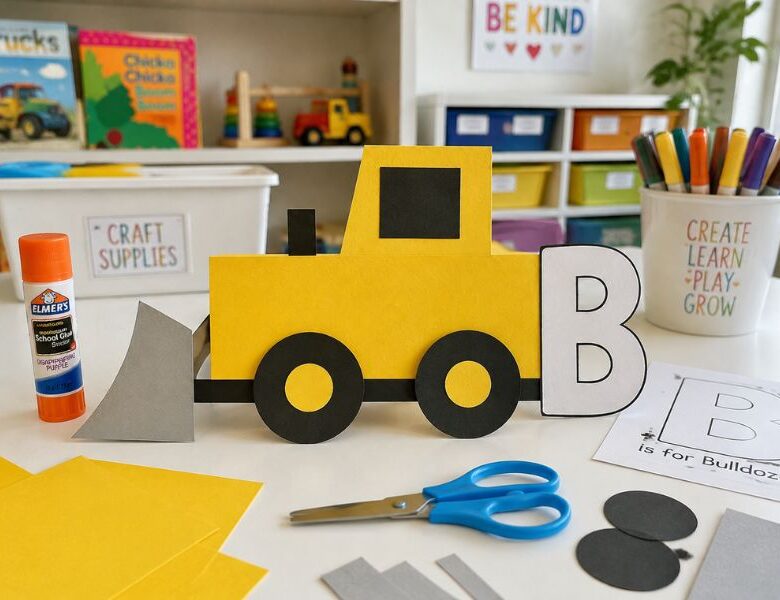
Not every child picks up letters the same way. Try this letter B craft for preschool, a hands-on bulldozer project that’s easy and fun.
Your preschooler probably traced letter B on a worksheet three times this week. Ask them what letter it was an hour later, and there’s a good chance you’ll get a shrug.
That’s not a them problem. At three and four years old, kids’ brains aren’t built for that kind of abstract task yet, sitting still, tracing a symbol on flat paper, and holding onto what it means.
What actually works at this age is using their hands to build something real.
Research backs this up: kids recognize letter shapes better after physically forming them than after just looking at or typing them, and early childhood researchers have found that play-based, hands-on activities beat worksheet drills for both attention and retention.
So instead of another tracing sheet, this is a bulldozer. A real, buildable one, made for letter B, the kind of project that gets a kid saying “B is for bulldozer” without you having to drill it into them.
Take the learning outdoors with Milk Carton Bird Feeder Craft to Get Preschoolers Outside and Off Screens, especially when you want a craft that continues beyond the making stage.
The Right Age for This Craft (And the Reason)
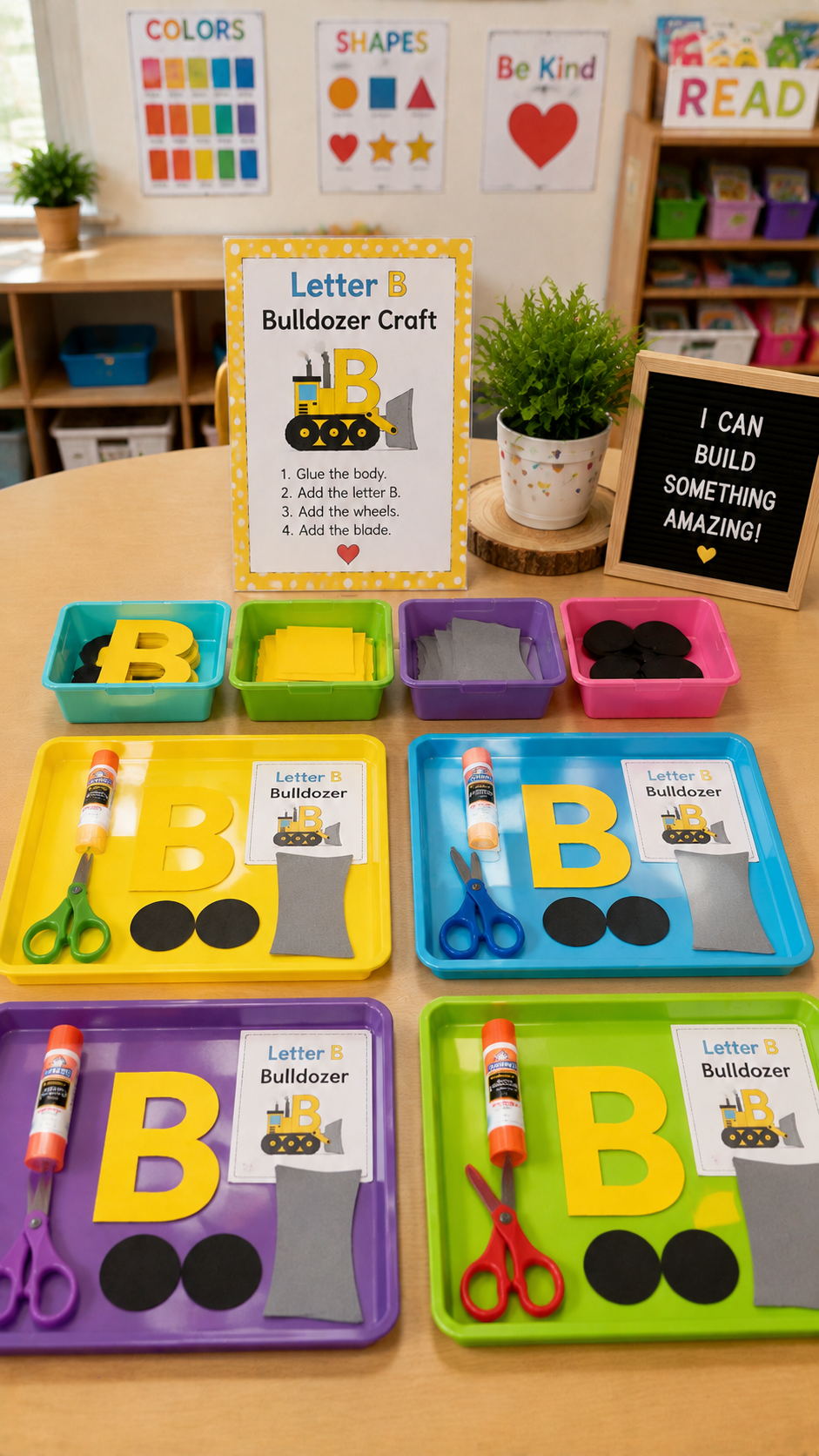
This craft is made for kids between 3 and 5 years old. That’s not a random range, a few things actually have to be in place in a child’s body and brain for this craft to work the way it’s meant to.
First, the hands. Around age 3, most kids can hold safety scissors, squeeze a glue bottle, and press a shape down so it sticks.
Those are the exact moves this craft needs. Try it earlier, and you end up building the bulldozer yourself while your child watches, which skips the whole point.
Second, the brain catches up too. Around this age, kids start linking a shape (the letter B) to a real thing (a bulldozer). Before that, a letter is just a squiggle with no meaning attached. This link, called symbolic thinking, is exactly why preschools wait until around age 3 to start teaching letters one at a time.
Third, attention span. A simple rule teachers use: expect roughly 2 to 5 minutes of real focus for every year of a child’s age.
A 3-year-old can stay with a short, guided version of this craft. A 5-year-old can handle more steps, and even make some choices on their own, like where the wheels go.
If your child is under 3, or still puts things in their mouth, don’t skip this craft, just change it. Use bigger, pre-cut pieces instead of small ones, and stay close during the gluing part. Small pieces are a real choking risk at that age, not just a formality.
Save those empty cartons for another project with 13 Easy Egg Carton Craft Ideas for Preschoolers at Home (Perfect for Tired Days).
What Makes Bulldozer the Right Pick for Letter B
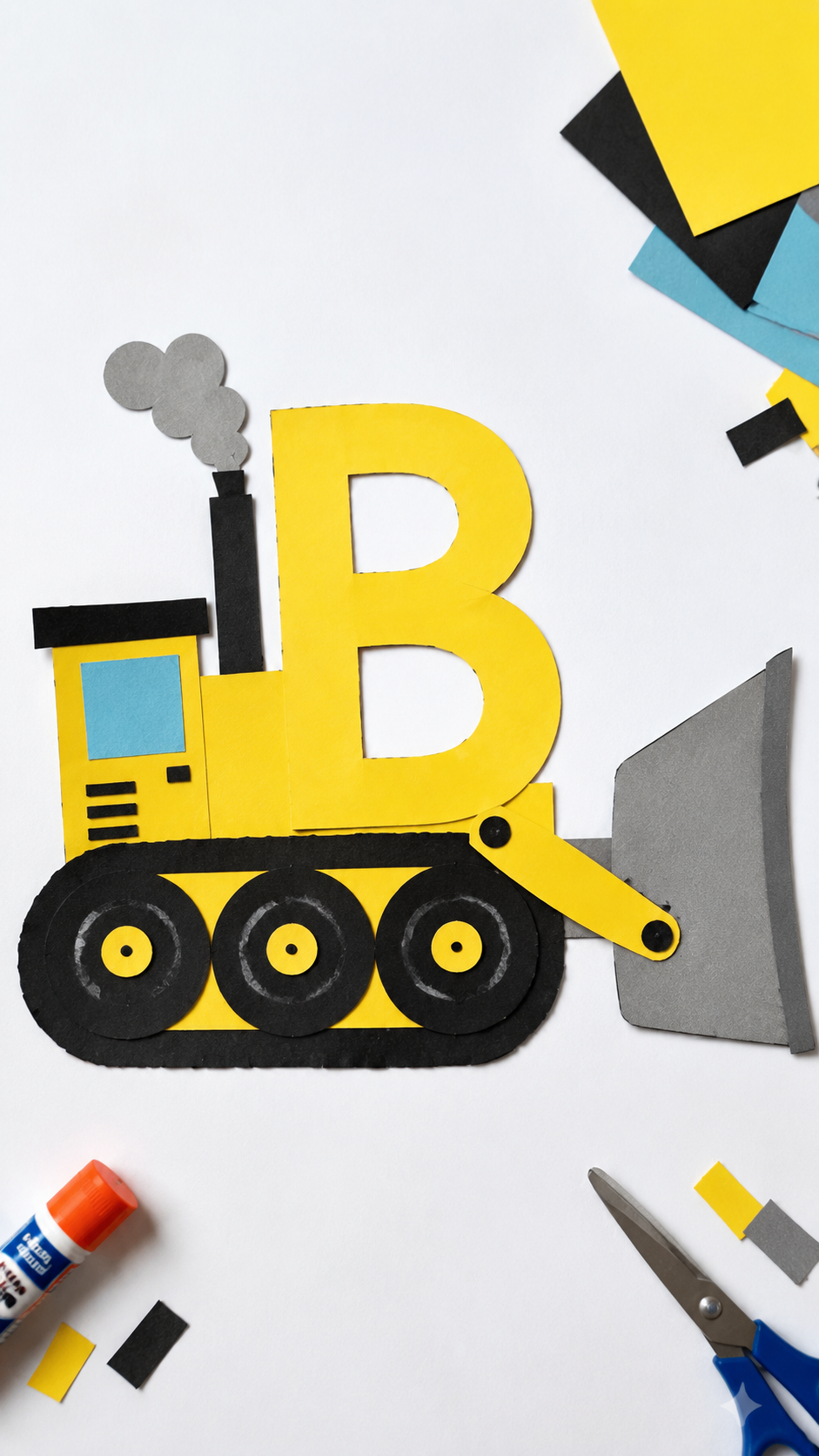
Most letter B crafts default to the same handful of ideas, a butterfly, a ball, a bear. Nothing wrong with those, but a bulldozer does something they don’t: it gives a child a whole world to talk about, not just a picture to color.
A bulldozer moves, has a job, and shows up in books, toy bins, and construction sites kids already know.
That matters more than it sounds like it should. When a child can connect a letter to something they’ve actually seen and touched, not just a flat image, the letter has more to attach to in their memory.
A ball is round and static. A bulldozer pushes dirt, has wheels, makes noise. There’s simply more for a young brain to hold onto.
It also opens the door to more B words without any extra effort, build, big, blade, boom.
A parent or teacher can slip those in naturally while making the craft, which is exactly the kind of repeated, varied exposure to a letter that helps it stick, according to early literacy research.
And practically speaking, a bulldozer is buildable with basic shapes a preschooler can actually place, a rectangle for the body, circles for wheels, a scoop shape for the front.
That’s a real craft a small child can finish and feel proud of, not one where an adult ends up doing the fiddly parts.
Bring more color into your preschool activities with Sunflower Crafts for Kids: The Suncatcher and 14 More Easy Ideas They’ll Beg to Make Again.
What You’ll Need
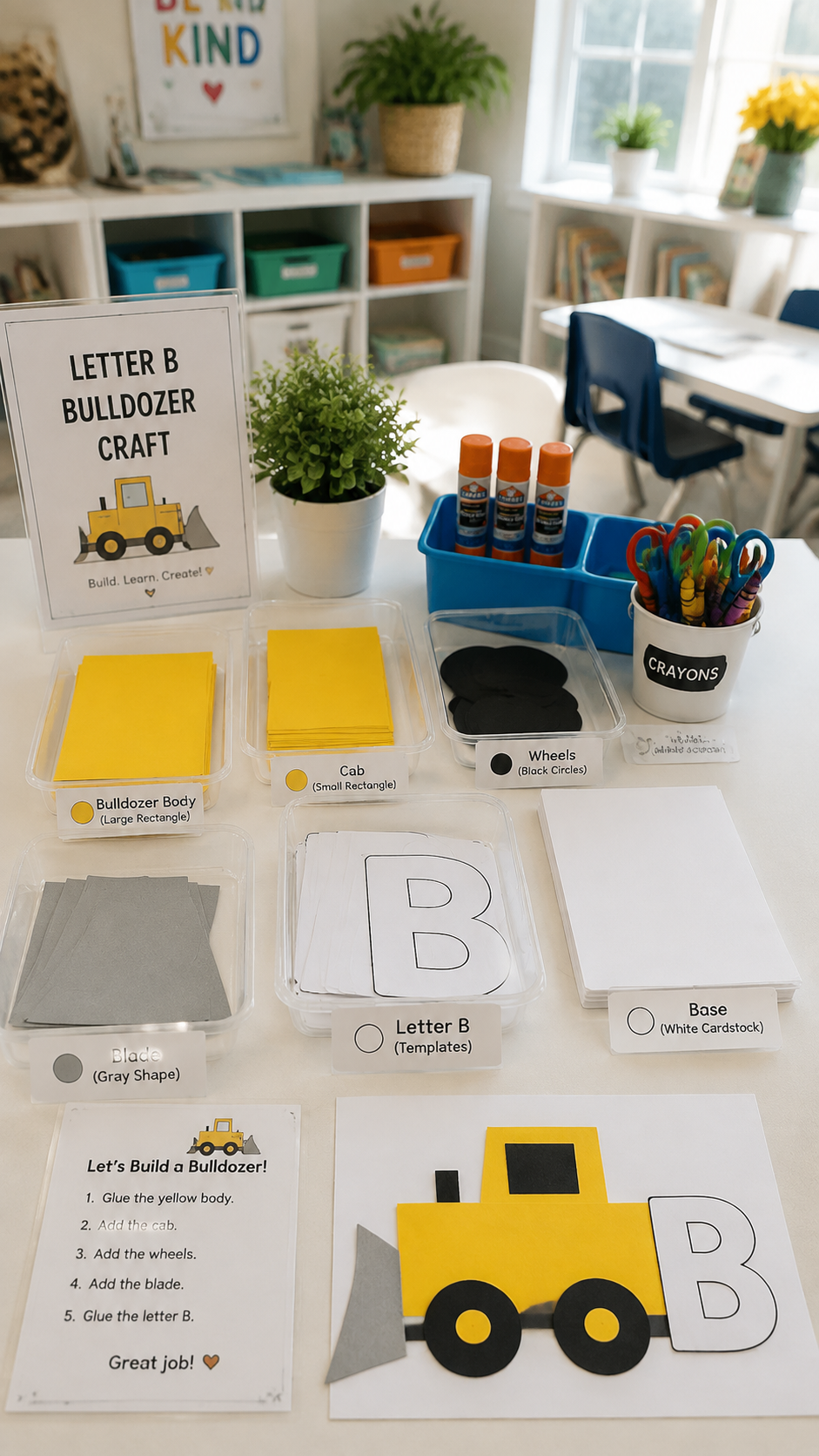
- 1 sheet of plain paper or cardstock — this is the base everything gets glued onto. Cardstock holds up better than thin paper if little hands press hard while gluing.
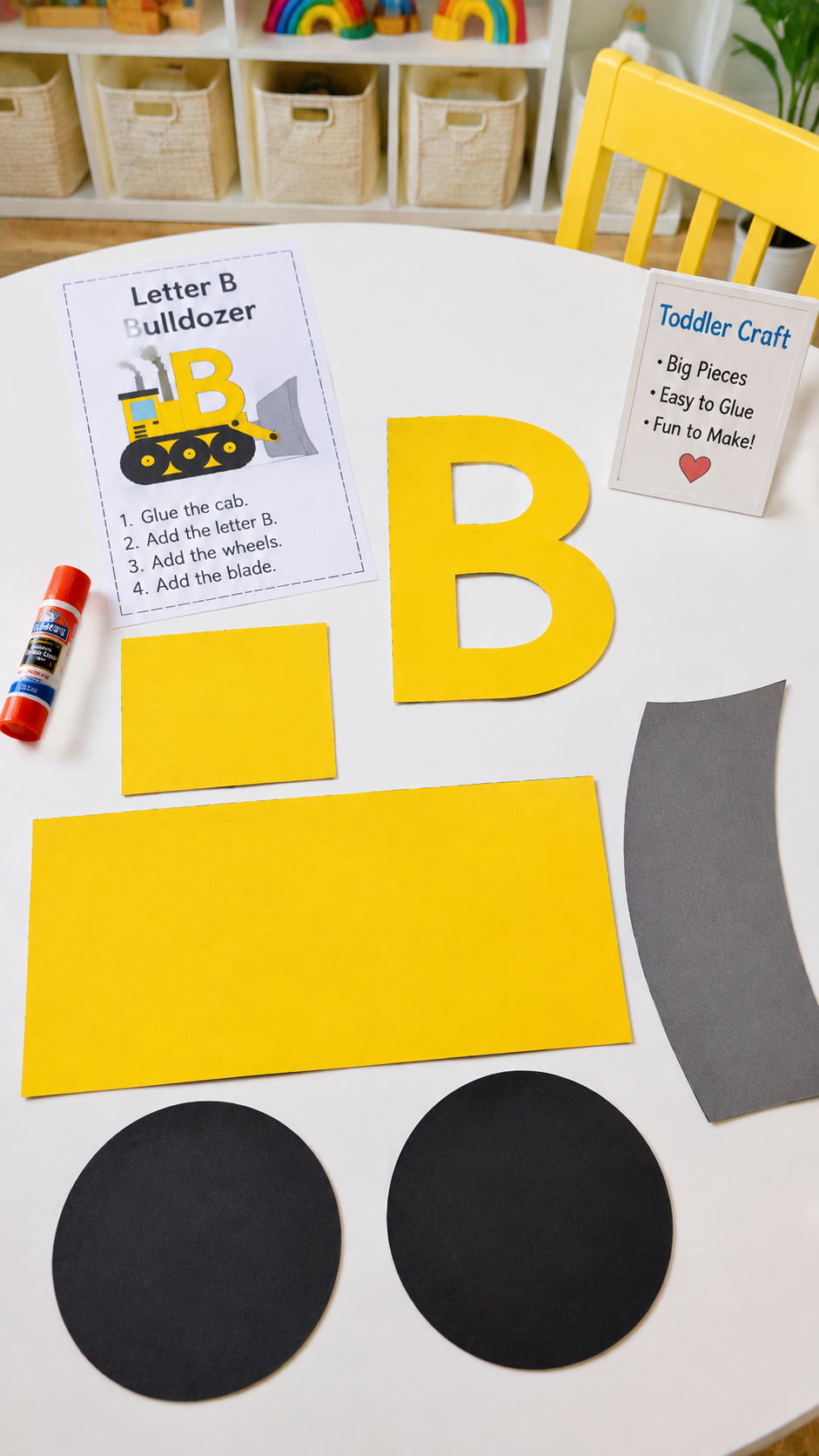
- Yellow construction paper, cut into 1 large rectangle (body) and 1 smaller rectangle (cab) — yellow is what makes it instantly readable as “a bulldozer” rather than just a shape on a page, since that’s the color kids already associate with construction vehicles from books and toys.
- Black construction paper, cut into 2 circles — these become the wheels. Two is enough to read as a vehicle at this scale; you don’t need four for a flat, side-view design.
- Gray or silver construction paper, cut into a rectangle or trapezoid — this becomes the blade at the front. It’s the one shape that turns a generic truck into a bulldozer specifically.
- Glue stick — a stick is easier to control than a bottle for a flat paper craft like this; there’s no drying time to fight since nothing needs to hold its own weight upright.
- Safety scissors — only needed if your child is old enough to cut their own shapes (closer to 4–5); otherwise, pre-cut everything.
- A printed or hand-drawn letter B — glued on at the end, this is what actually makes it a letter B craft instead of just a bulldozer picture.
Turn broken crayons into something useful with Melted Crayon Art for Kids: What to Do With Broken Crayon Pieces.
Step-by-Step: How to Build the Flat Letter B Bulldozer
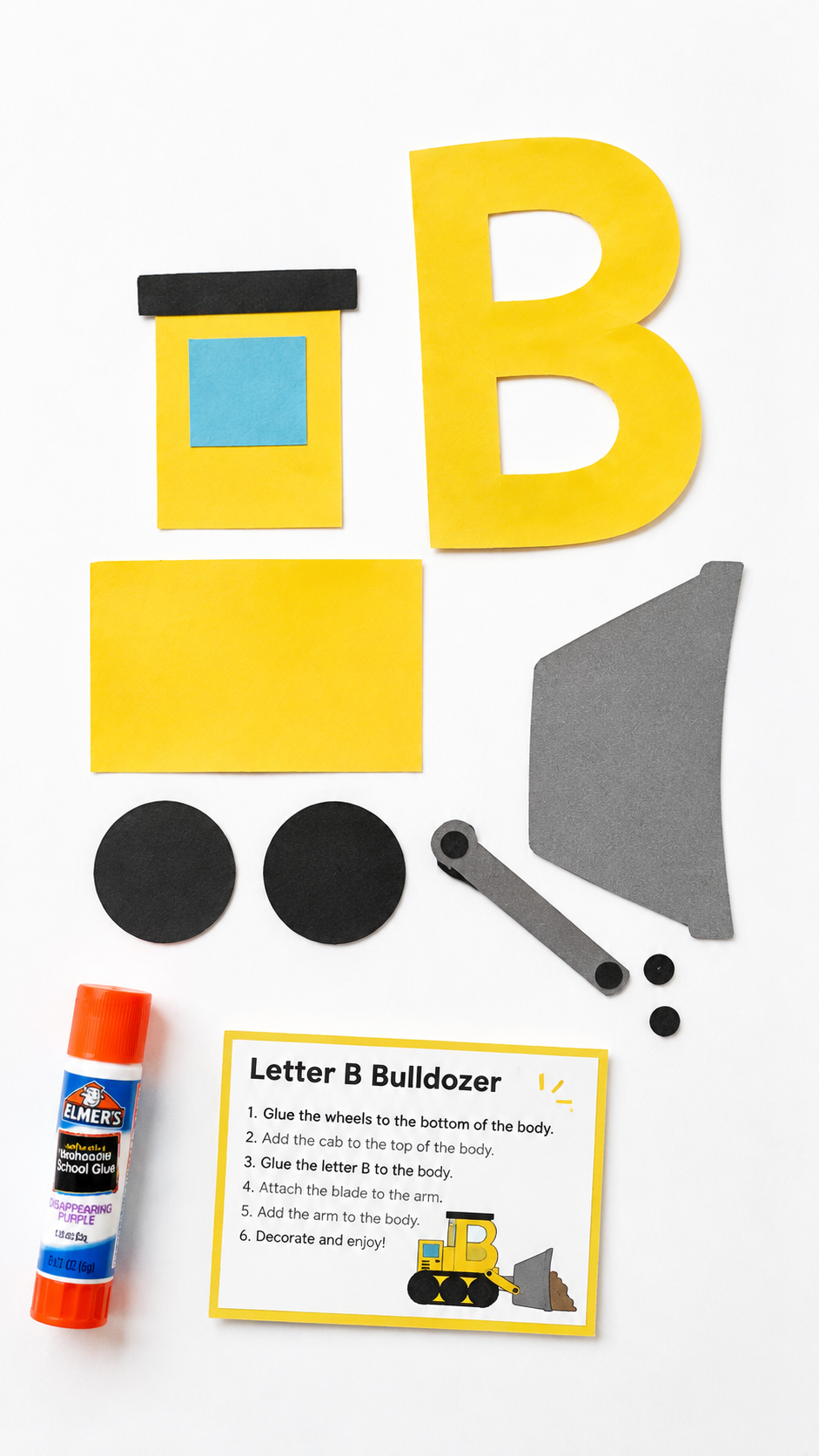
1: Prep your pieces before your child sits down
Cut out the body, cab, wheels, blade, and letter B ahead of time if your child is under 4 or not yet confident with scissors.
- This matters more than it sounds, a preschooler’s patience runs out fast, and if they’re waiting on you to cut while they’re ready to glue, that’s usually where the meltdown starts
- If your child is 4–5 and wants to help cut, hand them the circles, circles are the most forgiving shape for early scissor skills
- Trace around a bottle cap or cup first if they’re cutting their own wheels, so the shapes stay usable.
Bring familiar animals into craft time with Farm Animal Crafts for Toddlers: Build Creativity and Fine Motor Skills Beyond Playtime.
2: Glue the body down
Have your child glue the large yellow rectangle horizontally onto the base sheet.
- Glue stick works better than liquid glue here, there’s no drying wait, and the shape won’t slide while your child moves to the next piece
- This is a good moment to say “yellow” and “bulldozer” together a few times out loud — not required, but repetition like this is part of what helps new words stick at this age
3: Add the cab
Glue the smaller yellow rectangle on top of the body, toward one end, standing slightly taller than the rest.
- This is the piece that gives the bulldozer its recognizable silhouette, without it, the shape reads as a plain block, not a vehicle
- Let your child decide exactly where it goes rather than placing it for them, small decisions like this are part of what makes the craft theirs, not yours.
For a Bible-based activity, Daniel and the Lion’s Den Craft: A Sunday School Activity for Kids That Teaches Courage and Faith connects crafting with the story’s lesson.
4: Glue on the wheels
Have your child place the 2 black circles along the bottom edge of the body.
- This step does the most for fine motor skills in the whole craft, pressing a small circle into place with two fingers is the same pinch-grip motion used later for holding pencils and scissors
- If a circle lands crooked, leave it. A slightly off-center wheel isn’t a mistake worth fixing, it’s evidence the child did it themselves.
5: Attach the blade
Glue the gray shape at the front of the body, ahead of the wheels.
- This is the single shape that makes it a bulldozer and not a generic truck, worth pointing out to your child directly: “that’s the blade, it pushes things”
- Say “blade” out loud and note it starts with the same sound as bulldozer, a free, low-effort repeat of the letter B sound.
6: Add the letter B
Glue the letter somewhere clearly visible, above or beside the finished bulldozer.
- This is the step that actually closes the loop on the whole point of the craft, without it, you’ve made a bulldozer picture; with it, you’ve made a letter B craft
- If your child is old enough, have them trace the letter with a finger before gluing it down , a tactile rep of the shape, not just a visual one.
One honest note: because this version stays flat on paper, there’s no drying time, no cardboard fighting the glue, and nothing to prop up while it sets, which makes it the more forgiving choice for a first attempt, especially with a 3-year-old.
If a piece won’t sit flat or keeps sliding, that’s normal for paper on paper, not a sign anything went wrong.
Keep the alphabet theme going with Train Craft Ideas for Kids That Make Learning the Alphabet Fun With Things You Already Have.
Making the Letter B Actually Stick
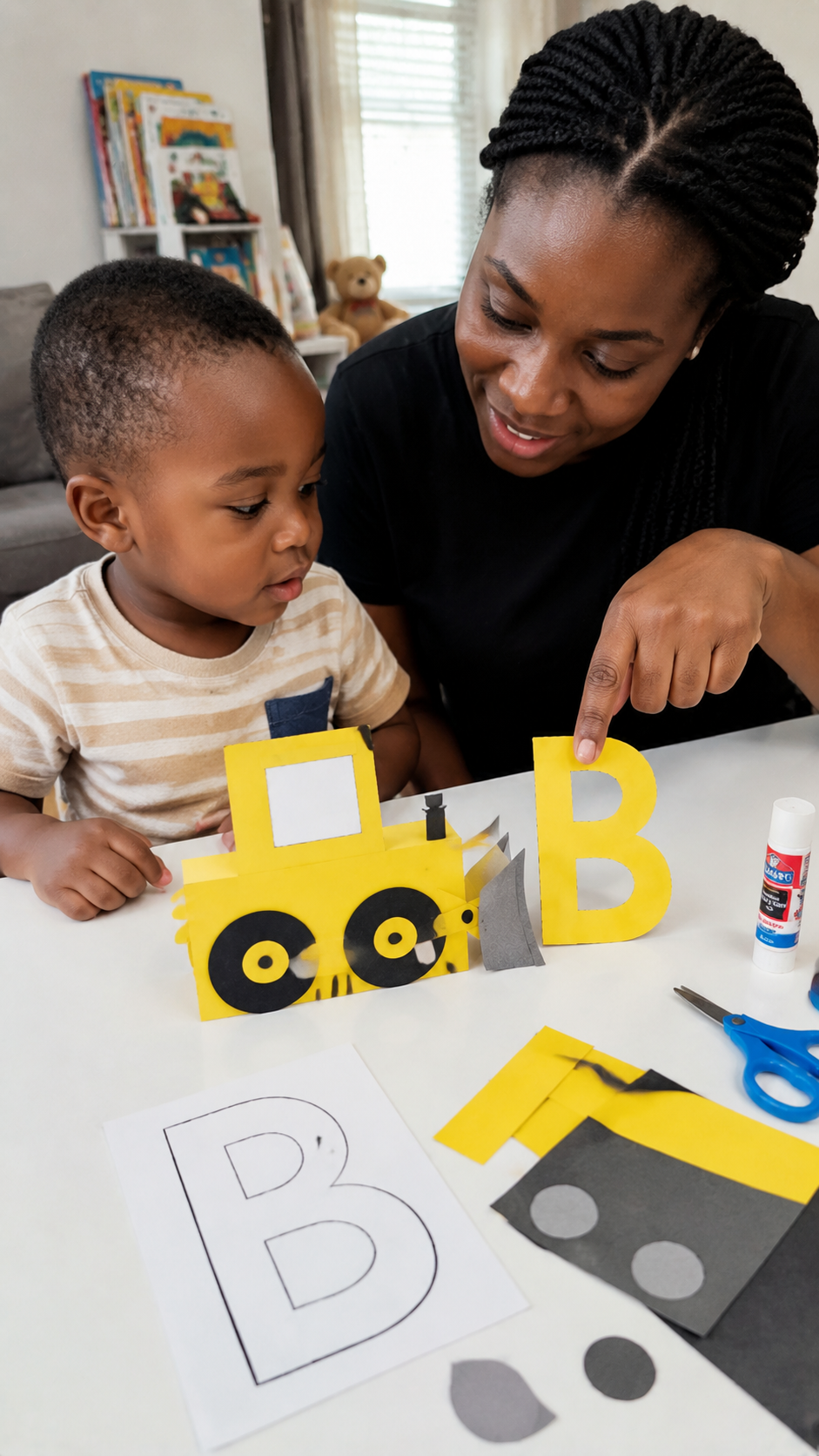
The craft is not the end goal. A finished paper bulldozer sitting on the table does not teach a letter by itself. What actually helps a child remember letter B is what happens right after the craft is done, in the first few minutes.
Here is what actually works, kept simple:
- Say the letter and the word out loud, together, more than once. Point to the letter B and say “B — bulldozer.” Say it a few times, not just once. Saying it once rarely sticks. Saying it a few times, close together, helps it stay in a child’s memory.
- Let your child trace the letter with their finger. Do this before or after gluing it down. Tracing adds touch to the lesson, not just looking. Touch helps a child learn a letter shape faster than sight alone.
- Look around the room for other things that start with B. A ball. A book. A blanket. This takes one minute and gives the letter more chances to be seen and said, without turning it into a lesson that feels like school.
- Let the bulldozer become a toy, not just a craft. If your child keeps pushing it around and playing with it later, they will see the letter B again and again over the next few days. That repeat exposure is what makes the letter stick over time, not the one afternoon spent making it.
None of this takes long. The goal is not to turn a fun craft into homework. The goal is simple: make sure the time spent on this letter B craft for preschool actually leaves something behind, instead of ending the moment the glue dries.
When you need activities that support learning through hands-on play, see 15 Sensory DIY Craft Ideas for Kids With Special Needs That Support Learning Through Play.
Adapting the Craft Up or Down
This letter B craft for preschool works well for ages 3 to 5, but not every child lands right in the middle of that range. Here is how to shift it either way.
For younger toddlers (under 3):
Leave out cutting and small pieces entirely. Give your child large pre-cut shapes, just the body, the cab, and one big wheel shape, and let them handle only the gluing.
Even better, stick glue dots onto the paper ahead of time so all your toddler has to do is press each piece down. This keeps their hands busy and their attention held, without the choking risk small pieces bring at this age, and without asking them to do something their hands cannot manage yet.
Keep exploring simple materials with Coffee Filter Butterfly Craft for Kids (Easy Stained Glass Effect Craft Idea).
Older preschoolers (5 and up):
Do not just hand over the same steps with more pieces. Turn the finished bulldozer into a small game instead. Once it is glued and dry, write two or three other letters next to the letter B on a scrap of paper, one wrong, like D or R.
Ask your child to point to the real letter B before gluing it onto their craft. This turns a simple gluing step into a quick recognition check, and it shows you right away whether the letter is actually sinking in, not just whether the craft got made.
Add an easy texture activity with Bubble Wrap Painting: The Easy Texture Trick That Turns Bored Kids Into Little Artists.
Conclusion
A letter B craft for preschool does not need to be complicated to work.
What matters more than the craft itself is what you and your child do with those few minutes together, the talking, the tracing, the pointing, the playing afterward and the learning. That is where a letter actually starts to stick, not on the page.
If you try this bulldozer with your child, I would love to read how it went, drop a comment below and let me know what letter you are tackling next.
And if you are working through letters one by one at home, keep an eye out for the next post in this series, where we will build a new craft around the next letter on the list.
For another hands-on activity, Safe and Easy Slime Craft Ideas for Kids — Non-Toxic Projects That Keep Them Busy for Hours offers several ideas to try.
FAQs
Do I have to teach letter B first, or should I start with A?
No. Many educators start with letters from a child’s own name or ones that are easier to write, there’s no rule requiring alphabetical order.
How many letters should a preschooler learn per week?
Most approaches teach one letter per week, though some stretch it over two to three. Repeated exposure matters more than speed.
Is letter recognition the same as knowing letter sounds?
No — recognition means knowing what the letter looks like; the sound (like “buh” for B) is a separate skill, usually taught alongside it.
My child already knows letter B — is this craft still worth doing?
Yes, as reinforcement. If they’re already bored by it, though, it’s a good sign to move on to the next letter.
Does a craft like this actually help with kindergarten readiness?
It helps, but it’s one piece, fine motor skill and following steps through to the end matter just as much as the letter itself.