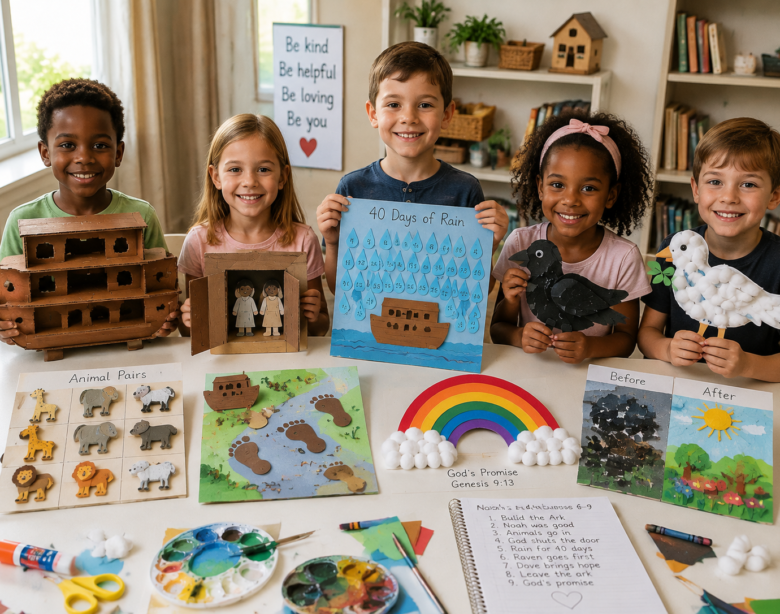
Build the ark, send the raven, count the 40 days, 9 Noah’s Ark crafts for kids that follow Genesis 6-9 in the exact order it happened.
Ask a child what happens in Noah’s Ark, and you’ll usually get three words back: boat, animals, rainbow.
That’s the whole story to them. And it’s not their fault, it’s the story we’ve handed them, flattened into a nursery print on a wall.
But open Genesis 6–9 and something different is there. A man builds something enormous because he’s asked to, before there’s any proof it’s needed. A door closes, and it isn’t Noah who closes it.
Months pass, not days, with nothing outside the window but water. A bird goes out to test whether the world is safe again, and comes back empty.
Another goes out later, and doesn’t come back at all, because it finally found somewhere to land. Only then, once the ground is truly dry, does anyone step outside. The rainbow isn’t the ending. It’s the promise that comes after the waiting is finally over.
That’s the sequence these nine crafts are written to teach, not as decoration, but as memory. Each one holds a single moment from the story, in the order it actually happened, so a child isn’t just gluing cotton balls onto paper.
They’re building patience with Noah while he waits, testing the water with the bird, and stepping onto dry ground for the first time in over a year.
By the last craft, your child won’t just recognize Noah’s Ark. They’ll be able to tell you what happened, in order, and why it mattered, because they built it with their own hands, one true piece at a time.
Connect another Bible story craft with Daniel and the Lion’s Den Craft: A Sunday School Activity for Kids That Teaches Courage and Faith, which gives children another hands-on way to remember a Bible lesson.
1: Noah Builds the Ark (Genesis 6:14-16)
The Story
Before there was a flood, before there was a single drop of rain, there was just an instruction, and no evidence yet that it made sense.
God tells Noah to build an ark of gopher wood, to cover it with pitch inside and out, and to build it with rooms across three decks, sealed tight enough to keep water out and everything inside alive. Noah had no storm to point to. He built the entire thing on the strength of being told to.
That’s worth sitting with for a child. Long before the animals, before the rain, before any of the parts of the story kids usually remember, there’s just a man doing something enormous because he trusted the one who asked him to.
The Craft: Build-Your-Own Three-Deck Ark
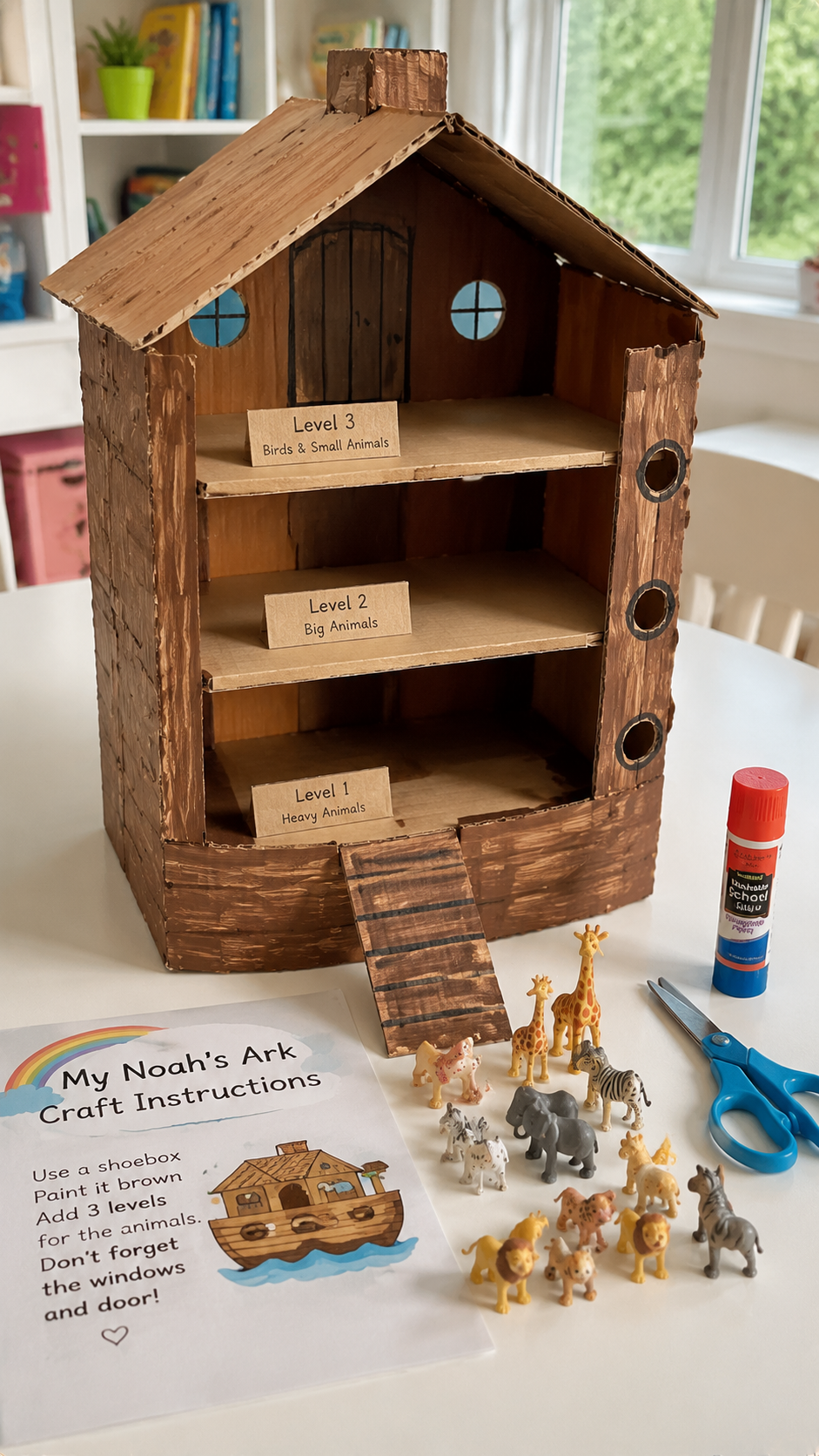
This craft turns the actual construction details from Genesis 6:14-16 into something a child builds with their hands, not a generic boat shape, but a structure with the same three-level design the text describes.
The Craft: Build-Your-Own Three-Deck Ark
What you’ll need:
- A shoebox or empty cereal box
- 2 pieces of stiff cardboard or cardstock, cut to fit inside the box
- Brown paint or brown paper
- White glue + a little brown paint (to make pretend “pitch”)
- Scissors, tape, a paintbrush
Steps:
- Make it look like wood. Paint the outside of your box brown, or wrap it in brown paper.
- Add the three floors. Slide your two cardboard pieces inside the box, one above the other, like shelves. Now your ark has three levels just like the real ark in the story had three floors, one on top of the other.
- Make your “pitch.” Mix a little brown paint into your glue until it turns thick and dark. This is your pretend pitch, a stand-in for the real waterproof sealant Noah used.
- Seal your ark. Brush your pitch along the inside and outside edges of the box. Explain as you go: this is exactly what Noah did, he covered his ark inside and out with pitch so no water could get through the wood.
- Leave the top open for now. We’ll add a door and a window in the next craft, once the animals and Noah’s family are ready to climb inside.
As they build, ask them: Would you have believed there was a flood coming, if you were Noah? Let the question sit. That’s the tension the next sections are going to build on.
For a craft that combines making with early literacy, Letter B Craft for Preschool: Build a Bulldozer That Makes Letter Recognition Click is a natural next read.
2. A Good Man in a Broken World (Genesis 6:9, 6:11-12)
The Story
Before we get to the animals, there’s something important to understand about why Noah was chosen at all.
The Bible says the world at that time had become full of violence and wrongdoing, everything about it had gone wrong. But Noah was different. Genesis 6:9 calls him a righteous man, someone who “walked with God.” Out of everyone alive at that time, Noah was the one who stayed good.
This is a great moment to pause with your child and explain that Noah wasn’t chosen because he was lucky, he was chosen because of how he lived, even when everyone around him didn’t.
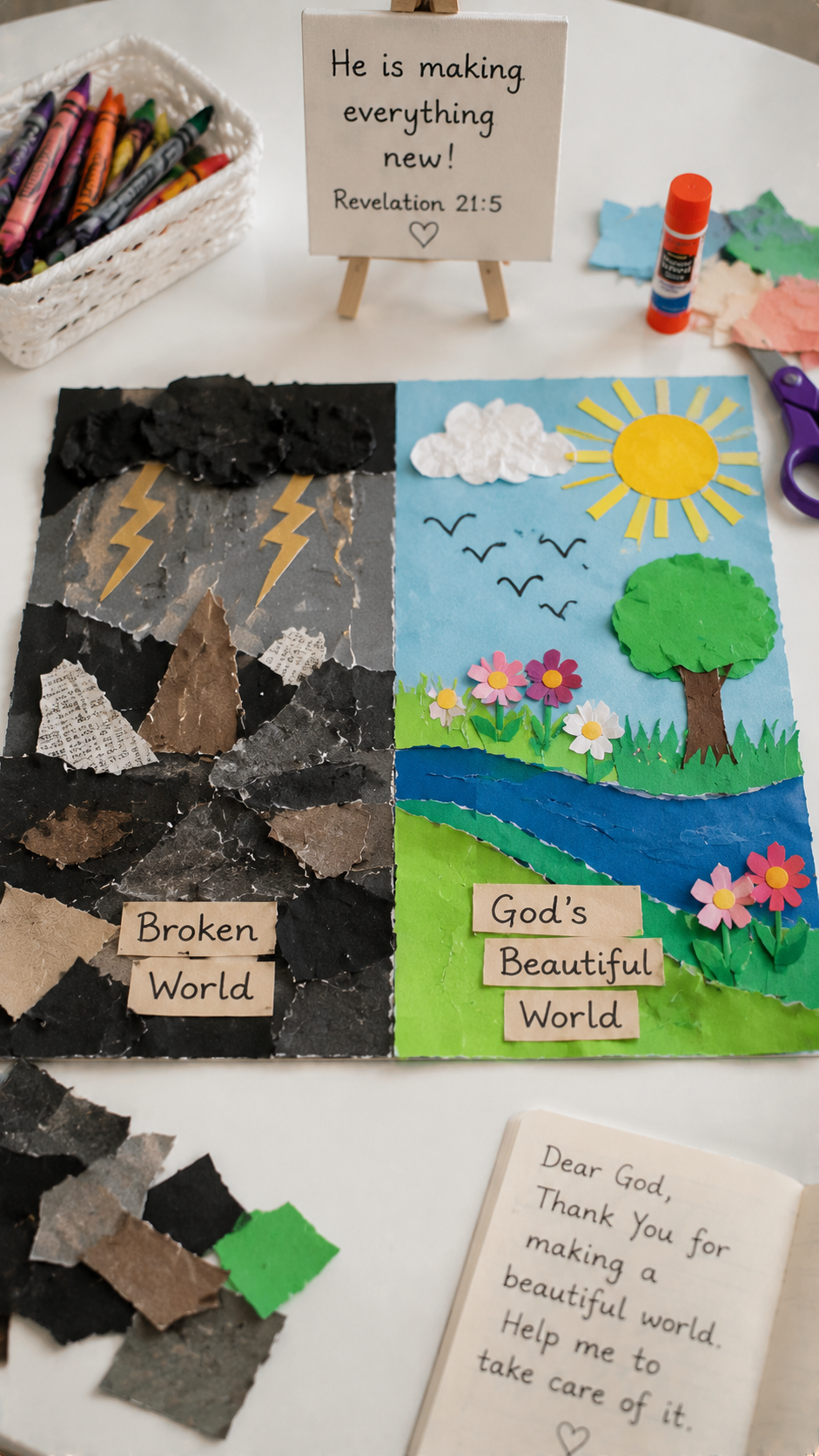
The Craft: Before-and-After World Collage
This is one of the simplest crafts in this list of Noah’s Ark crafts for kids, but it teaches one of the most important ideas in the whole story, the contrast between a broken world and one being made right again.
What you’ll need:
- 2 sheets of paper or cardstock
- Scrap paper, torn newspaper, or dark-colored paper scraps
- Colorful paper, stickers, or crayons
- Glue
Steps:
- Make the “broken” side. On one sheet of paper, glue down torn, dark, messy scraps of paper. This side represents the world Noah lived in, messy and broken.
- Make the “good” side. On the second sheet, glue down neat, colorful shapes — a sun, trees, or a simple happy scene. This side represents Noah, standing apart from everyone else by doing what was right.
- Place them side by side. Tape or glue both sheets next to each other so your child can see the contrast clearly.
- Talk it through. Ask your child: even if everyone around you was doing something wrong, could you still choose to do what’s right, like Noah did?
This craft doesn’t need any fancy materials, just a simple visual a child can look at and understand right away, before moving on to the ark filling up with animals in the next section.
Bring more nature-inspired color to craft time with Sunflower Crafts for Kids: The Suncatcher and 14 More Easy Ideas They’ll Beg to Make Again.
3. Seven Pairs, Not Two (Genesis 7:2-3)
The Story
Noah didn’t take two of every animal onto the ark. Genesis 7:2-3 says he was told to bring seven pairs of every clean animal, animals used for food and offerings, and just one pair, a male and a female, of every unclean animal.
That’s a detail that gets left out of most versions of this story, but it’s written clearly in the text.
The difference matters because it shows how carefully Noah followed the instructions he was given, not just “bring animals,” but bring the right number of the right kinds, exactly as God laid it out.
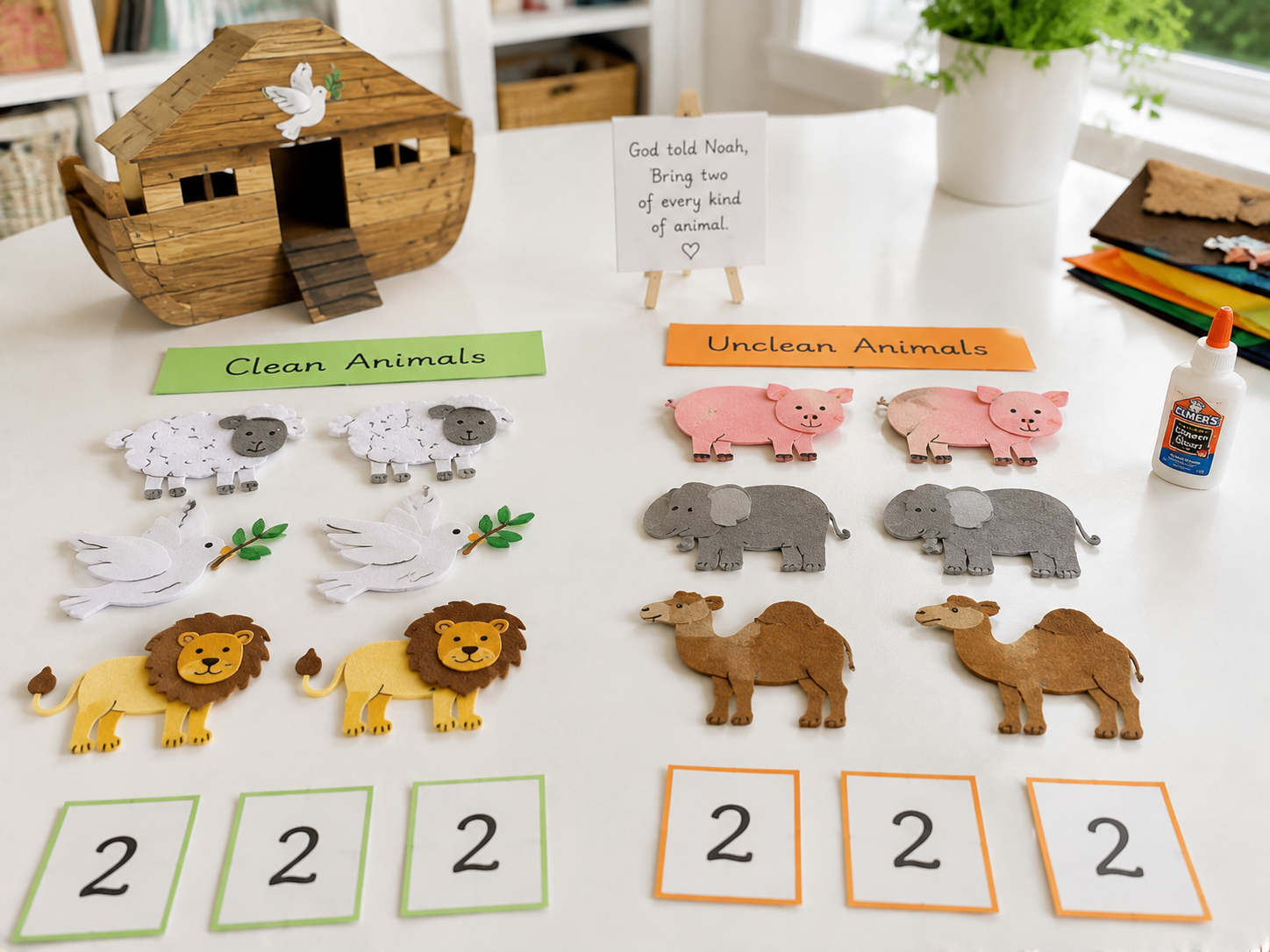
The Craft: Animal Pairing and Sorting Craft
This craft turns that exact detail into something kids can act out with their hands, instead of just gluing down random animal shapes.
What you’ll need:
- Small paper or felt animal cutouts (you can print simple animal shapes or use animal stickers)
- Clothespins, or just paper strips to link pairs together
- Two small boxes, bowls, or paper plates labeled “Clean Animals” and “Unclean Animals” (you can just draw a simple label, or help your child write it)
- Crayons or markers
Steps:
- Make your animals. Color and cut out a mix of animals, sheep, cows, doves, lions, camels, whatever you like.
- Sort them into two groups. Explain simply: some animals in the story came in sevens (seven pairs), and some came in twos (one pair). You don’t need to explain every rule of clean and unclean animals, just pick a few animals for each group (for example: sheep and doves as “clean,” lions and camels as “unclean”).
- Pair them up. For the “clean” animals, have your child make seven matching pairs. For the “unclean” animals, just one pair each.
- Load them into your ark. If you built the ark from Section 1, this is a great moment to have your child “load” the animals in, two by two, into their correct decks.
By counting out real pairs instead of just gluing down random animals, kids get a reason to actually think about the story while they build, not just decorate it.
Add an early-learning connection with Train Craft Ideas for Kids That Make Learning the Alphabet Fun With Things You Already Have.
4. The Door Is Shut by God (Genesis 7:16)
The Story
Once the animals and Noah’s family were all inside the ark, something important happened, and it wasn’t Noah who did it. Genesis 7:16 says that after everyone was in, “the Lord shut him in.” Noah didn’t seal the door himself. God did.
That’s a small detail, but it says something big: once Noah had done his part, building the ark, gathering the animals, bringing his family inside, the rest was out of his hands. He had to trust that he was safe, even though he wasn’t the one closing the door.
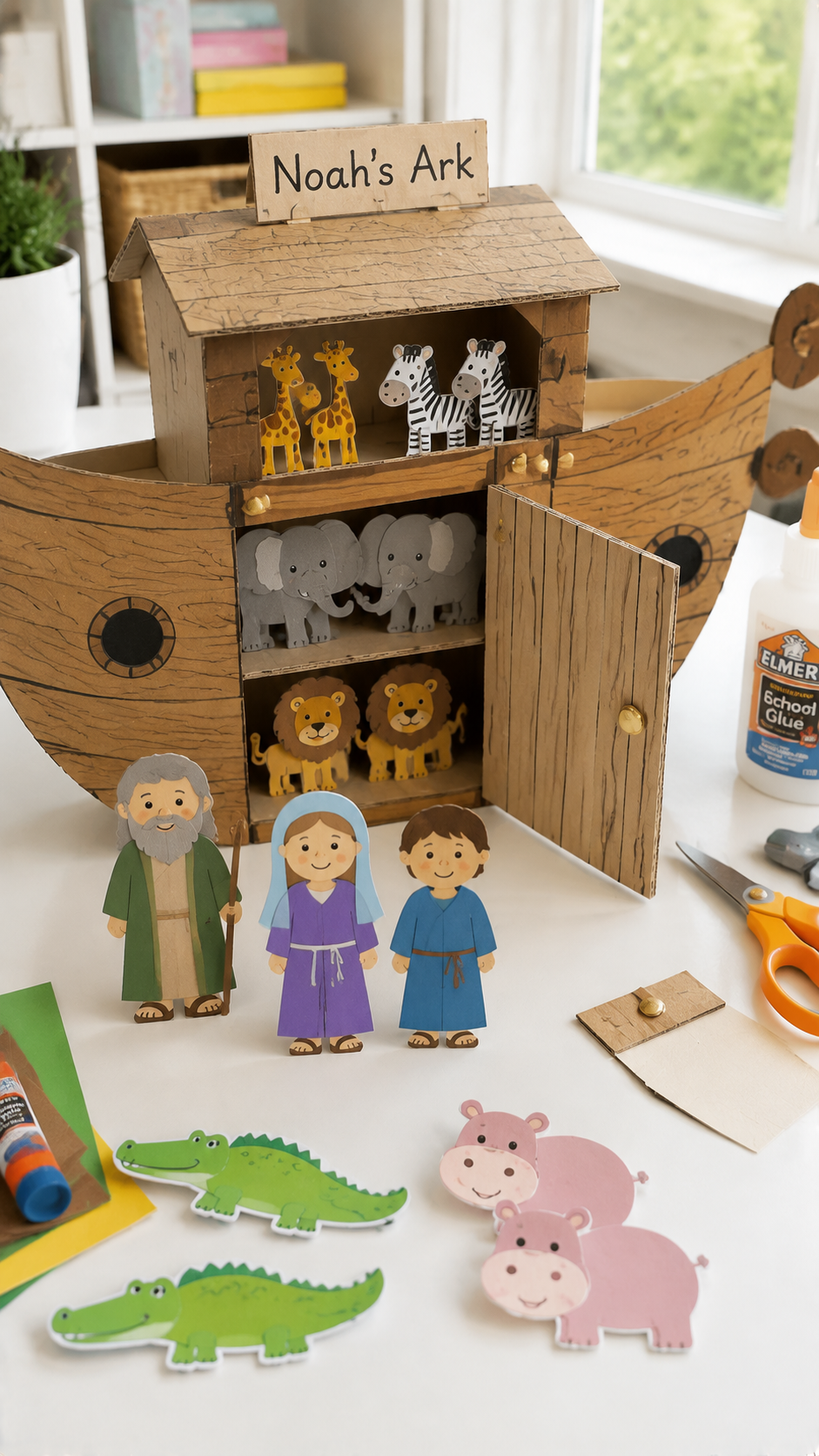
The Craft: Working Ark Door
This craft adds a moving door to the ark built in Section 1, so kids can act out this exact moment, closing their family and animals inside, and understanding that it was God, not Noah, who sealed it.
What you’ll need:
- The ark box from Section 1
- A piece of cardboard or cardstock, cut slightly smaller than one side of the box
- A brass fastener, or two pieces of tape folded to act as a hinge
- Scissors, a pencil
Steps:
- Cut a doorway. On one side of the ark, cut a rectangle shape to make an opening — this is the door frame.
- Make the door. Cut a piece of cardboard slightly bigger than the opening, so it can cover it fully.
- Attach the hinge. Use a brass fastener or folded tape along one edge of the door so it can swing open and closed, like a real door.
- Load everyone in. Have your child place their paper family and animal pairs inside the ark through the open door.
- Close it — but explain who closes it. As your child swings the door shut, tell them: in the story, Noah didn’t close this door himself. God closed it for him, once everyone was safely inside.
Once the door is shut, the next part of the story begins, the rain, and the long wait that follows.
For an easy process-art activity, try Bubble Wrap Painting: The Easy Texture Trick That Turns Bored Kids Into Little Artists.
5. Forty Days of Rain (Genesis 7:11-12, 7:17)
The Story
Once the door was shut, the rain began. Genesis 7:11 says the flood wasn’t only rain, “all the fountains of the great deep burst open” at the same time the sky’s windows opened.
In simple English, that means water came from below the ground as well as from above it.
It rained for 40 days and 40 nights, but the flood itself kept rising for much longer than that, the waters didn’t fully cover the earth right away, and stayed high for months afterward.
That’s a good moment to teach a child that big problems don’t always come from just one direction. For Noah’s family, the water wasn’t only falling from the sky, it was rising up around them too, from every side.
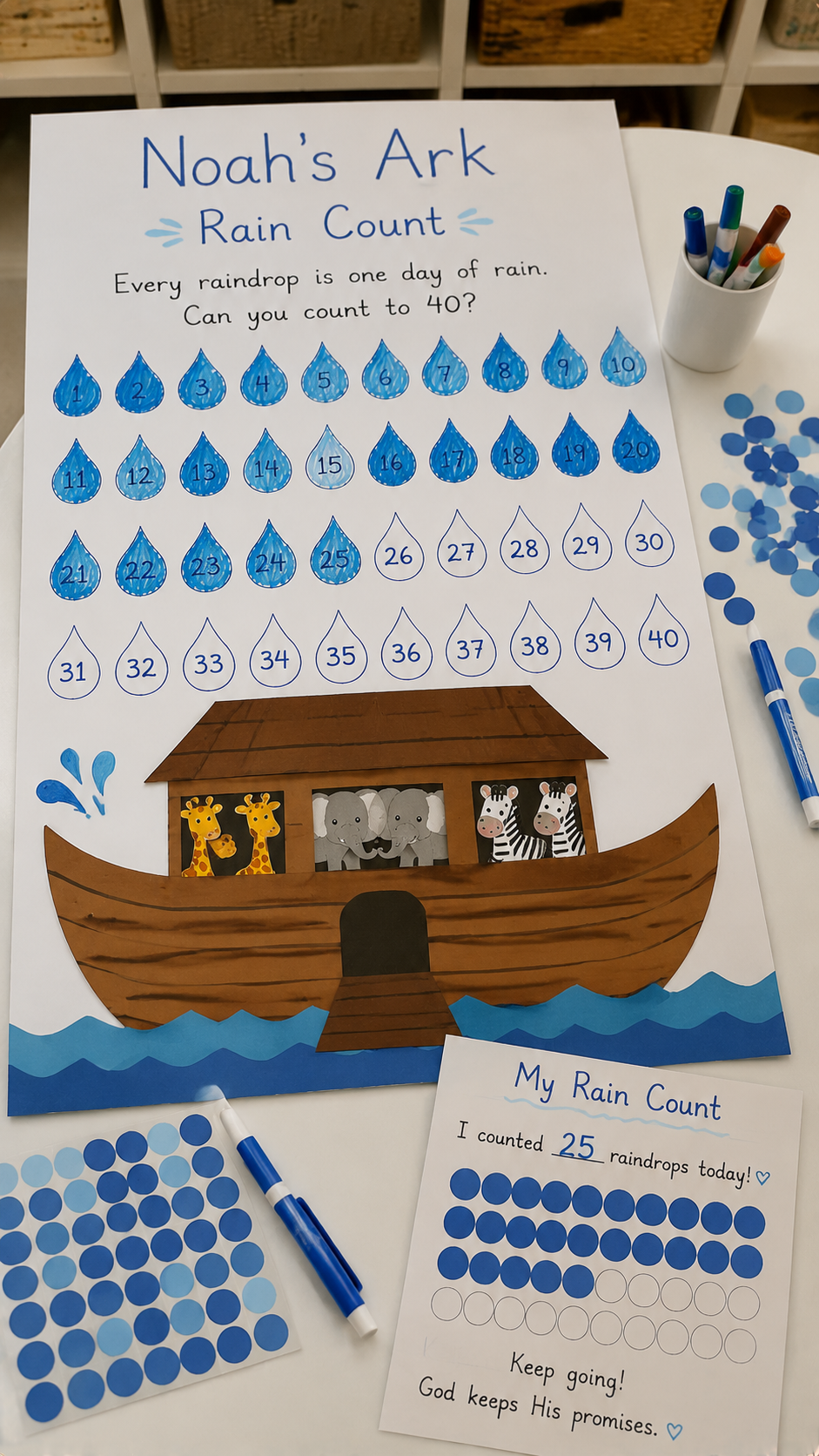
The Craft: 40-Day Rain Count
This is one of the simplest Noah’s Ark crafts for kids in this whole list, but it’s a strong way to make a number, 40 days, feel real to a child instead of just being a fact they hear once and forget.
What you’ll need:
- One large sheet of paper or poster board
- Blue crayons, markers, or blue paper dots/stickers
- A pencil to mark days off
Steps:
- Draw a simple ark shape at the bottom of your paper, with plenty of blank space above it.
- Mark 40 small raindrops lightly in pencil across the top of the page, these represent the 40 days of rain.
- Color in one raindrop each day. If you’re using this alongside a Sunday school series or a family devotional, have your child color in a new raindrop every day for 40 days, tracking how long the rain actually lasted.
- Talk about what’s happening below, too. As you color, remind your child: it wasn’t just rain falling — the story says water was also rising up from the ground at the same time, from every direction.
Once all 40 raindrops are filled in, your child won’t just know the number 40, they’ll have counted it out themselves, one day at a time.
Help children connect creativity with culture through 12 African Art Projects for Kids That Teach Culture, Not Just Craft.
6. The Raven Goes First (Genesis 8:6-7)
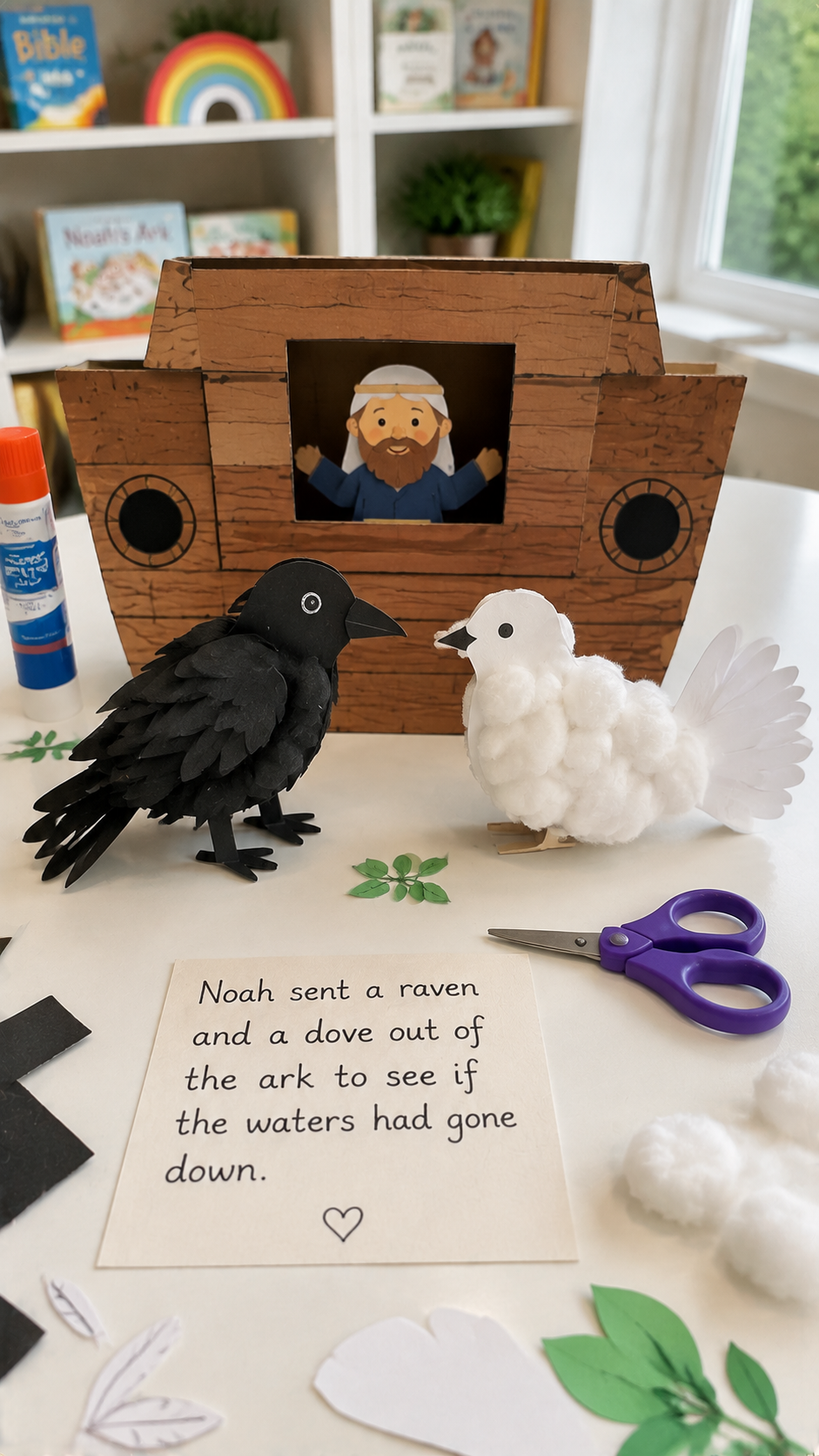
The Story
After 40 days, Noah opened a window in the ark and sent out a bird to check the world outside, and it wasn’t a dove. Genesis 8:7 says he sent out a raven first.
In Hebrew, the word used is orev, the same bird still known today: a large, all-black bird in the crow family.
Ravens are strong fliers and can survive on almost anything, including dead animals or debris floating in water, which is likely why this particular bird never needed to come back to the ark.
It could rest on floating wreckage and find its own food, unlike the dove, which needed dry land and fresh plants to survive. Genesis says the raven kept flying back and forth until the water had dried up from the earth.
Sending the raven first, before the dove, was Noah’s way of testing conditions outside without knowing yet whether it was safe.
Here is a good moment to teach a child that Noah didn’t just wait around once the rain stopped, he took action to find out what was happening outside, one small test at a time.
The Craft: Raven and Dove Craft
This craft has your child make both birds side by side, so they understand two different birds were sent out, in a specific order, not just one.
What you’ll need:
- Black paper or a black crayon (for the raven)
- White paper or cotton balls (for the dove)
- Glue, scissors
- A small green paper leaf shape (used in the next craft)
Steps:
- Make the raven first. Cut a simple bird shape out of black paper, or color one in with a black crayon. Point out that ravens are all black, no other colors on this bird.
- Make the dove. Cut a bird shape out of white paper, or glue small cotton balls onto a paper bird outline for a soft, feathery look.
- Send the raven out first. Hold the raven up to the ark window and “fly” it out. Explain that this bird could survive out there on its own, resting on floating debris and eating whatever it could find, which is why it never came back.
- Set the dove aside for now. Its turn comes in the next craft, once the raven has done its job.
Making both birds, in the order they actually appear in Genesis 8, helps a child understand why two different birds were needed, not just which one is more familiar.
For another hands-on sensory project, Safe and Easy Slime Craft Ideas for Kids — Non-Toxic Projects That Keep Them Busy for Hours offers simple options to try.
7. The Dove and the Olive Branch (Genesis 8:8-11)
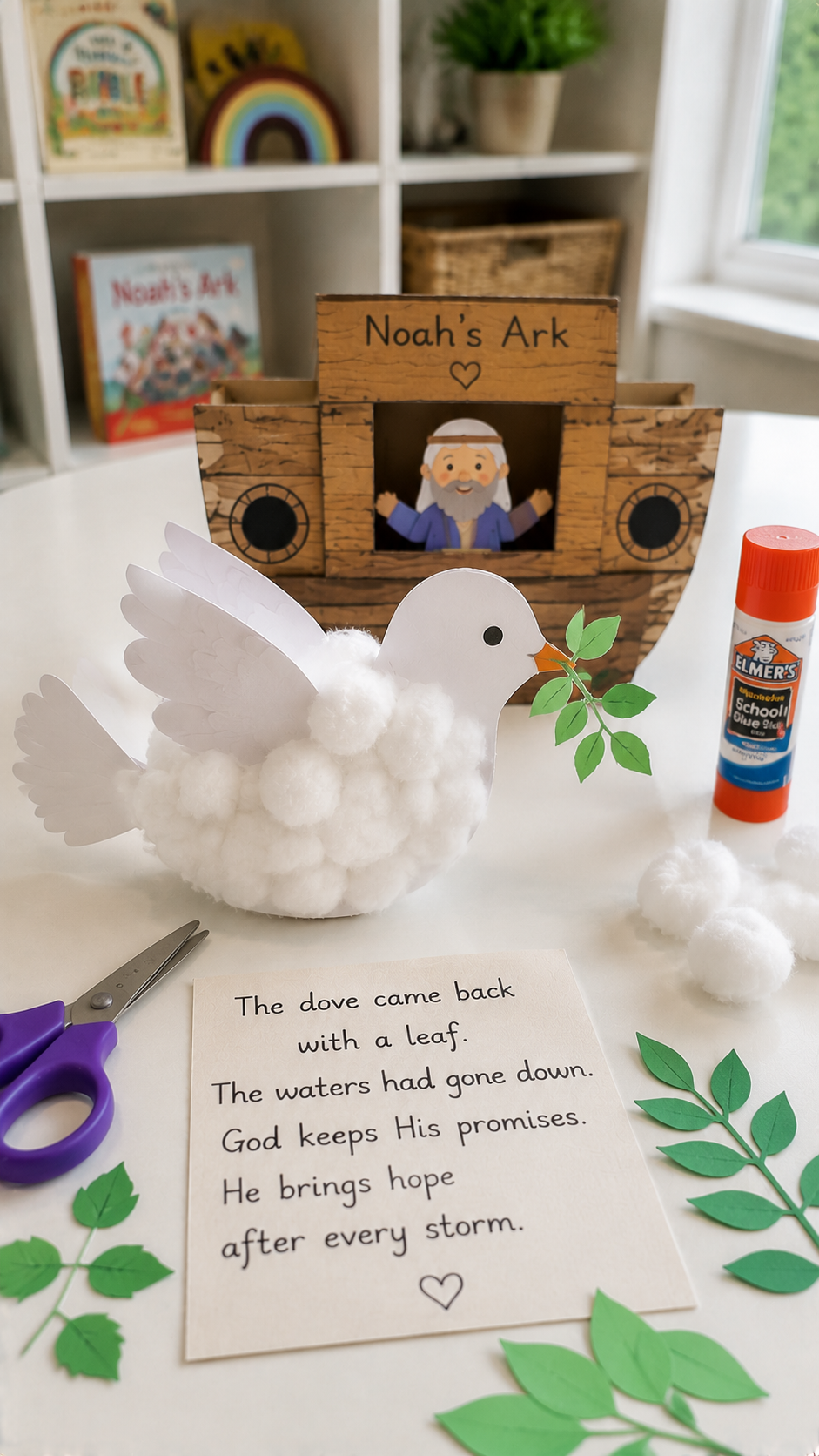
The Story
After the raven, Noah sent out a dove, but it took three separate tries before the dove brought back real proof that dry land had returned.
The first time, Genesis 8:9 says the dove found nowhere to rest, so it flew straight back to the ark. Seven days later, Noah sent it out a second time, and this time it came back in the evening with an olive leaf in its beak, a clear sign that trees were growing again somewhere below. Noah waited seven more days and sent the dove out a third time. That time, it didn’t come back at all.
Unlike the raven, the dove needed dry land and fresh plants to survive, so its return each time actually told Noah something useful about the world outside.
The Craft: Dove with Olive Branch
This is one of the more well-known Noah’s Ark crafts for kids, but doing it with all three sendings in mind, instead of just one dove holding one branch, makes the moment mean more.
What you’ll need:
- The white dove made in Section 6 (or a new white paper or cotton-ball dove)
- A small strip of green paper, cut and snipped into a simple leaf or branch shape
- Glue
Steps:
- Set the dove at the ark window three times, walking through each trip out loud: the first time, it comes back with nothing. The second time, seven days later, it comes back holding something.
- Glue the green leaf into the dove’s beak for that second trip, so your child can see exactly what Noah saw — proof that land and plants were finally showing again.
- Send the dove out a third time, seven days after that, and this time, let it “fly away” for good, since Genesis 8:12 says it never returned.
- Talk about what each trip meant. No leaf meant nothing had changed yet. A leaf meant real progress. No return at all meant it was finally safe.
Walking through all three trips, instead of just one, helps a child understand that Noah didn’t get one clear sign all at once, the answer came slowly, a little at a time.
Keep the colorful craft ideas coming with Coffee Filter Butterfly Craft for Kids (Easy Stained Glass Effect Craft Idea).
8. Leaving the Ark (Genesis 8:15-19)
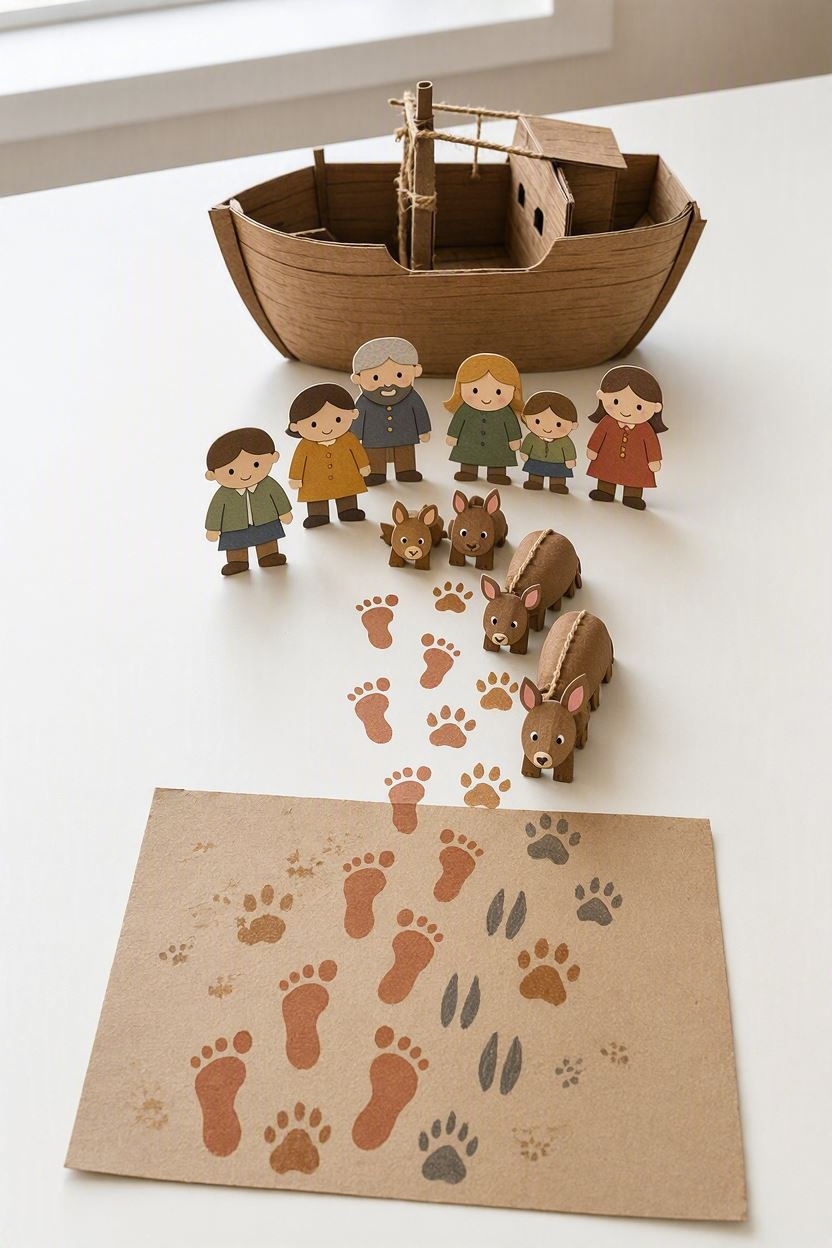
The Story
Even after the dove didn’t return, Noah didn’t just open the door and walk out. Genesis 8:15-16 says God had to tell Noah directly: “Go out of the ark.”
Noah waited for that instruction, the same way he’d waited for every other instruction in the story.
When he finally stepped out, Genesis tells us this happened over a year after the flood began, Noah was 600 years old when it started, and 601 when he left the ark. The whole time inside wasn’t 40 days. It was more than a year of waiting.
Genesis 8:17 also says something easy to miss: when the animals came out, they were told to “be fruitful and multiply on the earth”, the same words used back at creation. Coming out of the ark wasn’t just an ending. It was a fresh start for everything living on the earth.
The Craft: Stepping Onto Dry Ground
This craft gives kids a way to feel the difference between waiting and finally stepping out, instead of just hearing the words “Noah left the ark.”
What you’ll need:
- Brown or green construction paper
- Washable paint (brown or green)
- A large sheet of paper or poster board to use as “the ground”
- Wet wipes for cleanup
Steps:
- Paint your child’s foot with brown or green washable paint.
- Press one footprint firmly onto the poster board, right in the middle of the empty space.
- Add more footprints for the rest of Noah’s family and the animals, using small paper cutouts of paw prints or hand prints around the first footprint.
- Talk about how long the wait really was. As you add each print, remind your child: Noah didn’t step out after 40 days. He waited over a year, through the rain, through the flood, through sending out birds, before finally hearing God say it was time to go.
Feeling how long it takes to fill a page with prints gives a child a real sense of how long that wait actually was, more than a number on its own ever could.
Turn broken crayons into colorful artwork with Melted Crayon Art for Kids: What to Do With Broken Crayon Pieces.
9. The Rainbow Covenant (Genesis 9:12-17)
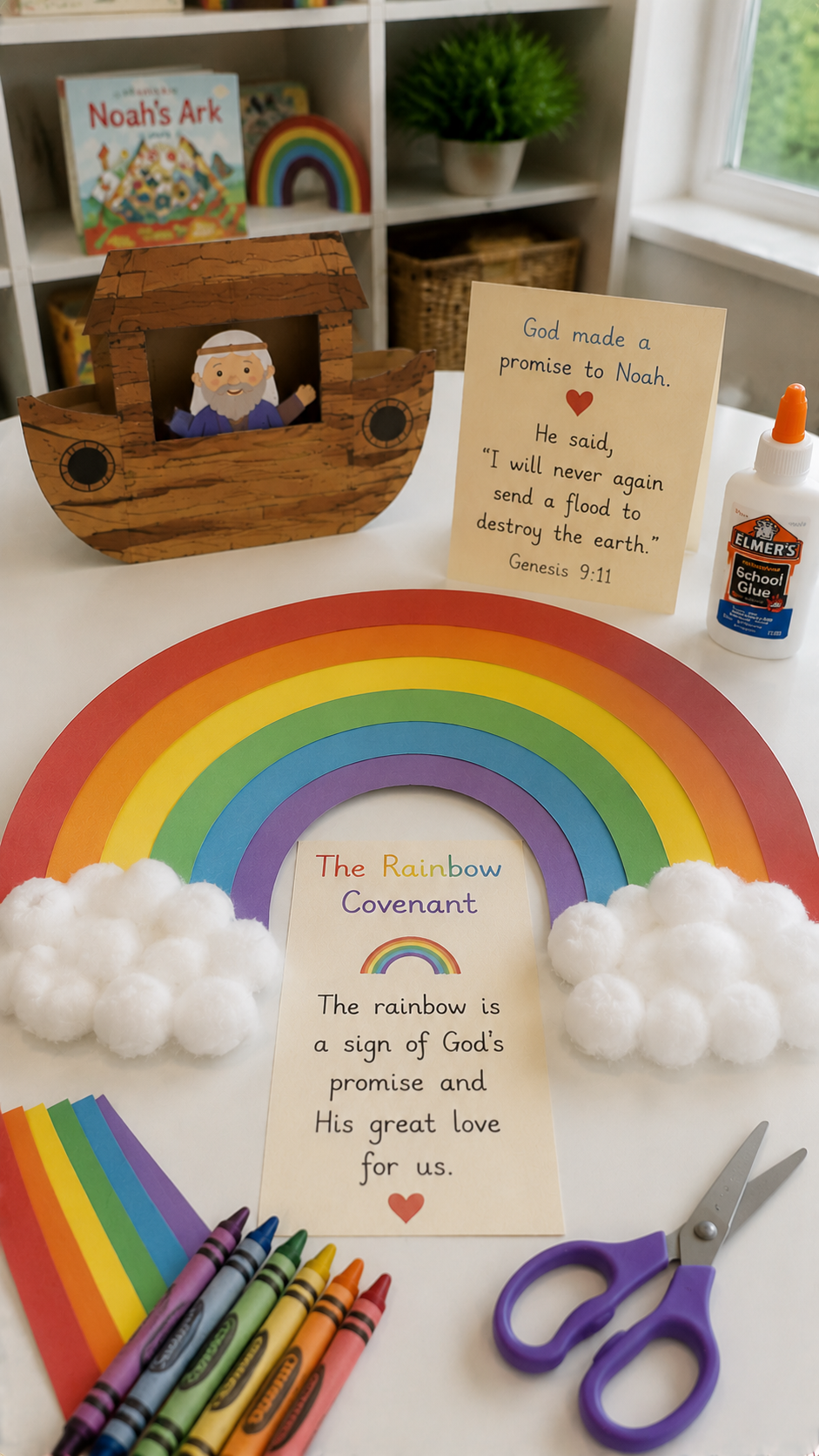
The Story
Once Noah and his family were out of the ark, God made a promise, and gave a specific sign to go with it. Genesis 9:13 says, “I have set my rainbow in the clouds, and it will be the sign of the covenant between me and the earth.”
This wasn’t just a beautiful thing to look at after a long storm.
It was a promise that God would never again destroy the earth with a flood, and the rainbow was the reminder of that promise, meant to be seen again and again, long after Noah was gone.
Genesis 9:16 adds something worth teaching directly: God says he’ll look at the rainbow and remember the covenant himself. It wasn’t only a sign for Noah’s family, it was tied to God’s own promise-keeping.
The Craft: Rainbow Covenant Craft
Out of all the Noah’s Ark crafts for kids in this list, this is the one most children have already made before, but pairing it with the actual meaning behind it turns a familiar craft into the ending the story deserves.
What you’ll need:
- White paper or paper plate
- Red, orange, yellow, green, blue, and purple paper strips, or crayons/markers in those colors
- Glue
- Cotton balls (optional, for clouds on either end)
Steps:
- Draw or glue the rainbow arcs, one color at a time, in order, across the paper.
- Add a cloud at each end using cotton balls, if you’d like, to frame the rainbow the way it would appear in the sky.
- Talk about what the rainbow means, one color at a time if you like, or all at once: this wasn’t just a nice ending — it was God’s promise, and the rainbow was the sign of it.
- Set this craft next to the ark from Section 1 if you’ve kept it, so your child can see the whole story laid out from start to finish, the ark that was built out of trust, and the rainbow that closed it out as a promise kept.
With this last craft finished, your child has something to point to for every major moment in Genesis 6-9, not just a boat and a rainbow, but the whole story, one piece at a time.
Add another classic craft material with 13 Popsicle Stick Crafts for Kids That Actually Keep Them Busy and Boosts Creativity.
Conclusion
Nine crafts, nine moments, one story told the way it actually happened. That’s what makes these Noah’s Ark crafts for kids different, not the materials, but the order.
A child who’s built their way through Genesis 6-9 with their own hands remembers it differently than a child who colored one rainbow and moved on.
Kids don’t hold onto information because they’re told it once.
They hold onto it because they made something, asked a question, and got a real answer, the kind that sticks past Sunday and shows up again months later, when they’re retelling the story on their own, in their own words, without anyone prompting them.
Try even a few of these with your child or your class, and pay attention to which one they connect with most, or what question it sparks along the way. That’s usually where the real learning is happening.
Create without a big cleanup afterward using 13+ Pipe Cleaner Crafts for Kids That Are Simple, Fun, and Completely Mess-Free.
Frequently Asked Questions
-
How big was Noah’s Ark, really?
Genesis 6:15 gives exact measurements: 300 cubits long, 50 cubits wide, and 30 cubits high. Using a standard cubit of about 20.4 inches, that works out to roughly 510 feet long, long enough that three space shuttles could be laid nose to tail on its roof, with a roof over 50 feet off the ground, taller than a modern four-story house.
-
Where did the ark come to rest?
Genesis 8:4 says the ark came to rest on “the mountains of Ararat”, a mountain range in what is now eastern Turkey, not a single specific peak.
How many people were actually on the ark?
Eight people total: Noah, his wife, his three sons, and his three sons’ wives. Genesis doesn’t state the number directly, but it’s confirmed by naming exactly who entered the ark.
-
How did every kind of animal fit on the ark?
The Bible describes pairs of every animal “kind” boarding the ark, a broader category than modern species classification, closer to a family-level grouping. That’s part of why the total number of animals aboard is thought to be far smaller than the millions of individual species alive today.
-
How long did it take Noah to build the ark?
Genesis doesn’t give an exact number of years, but it offers strong clues, Noah was 500 years old when his first son was born, and his son Shem was 98 when the flood came. That timeframe suggests construction took place over a span of decades, not a quick project.