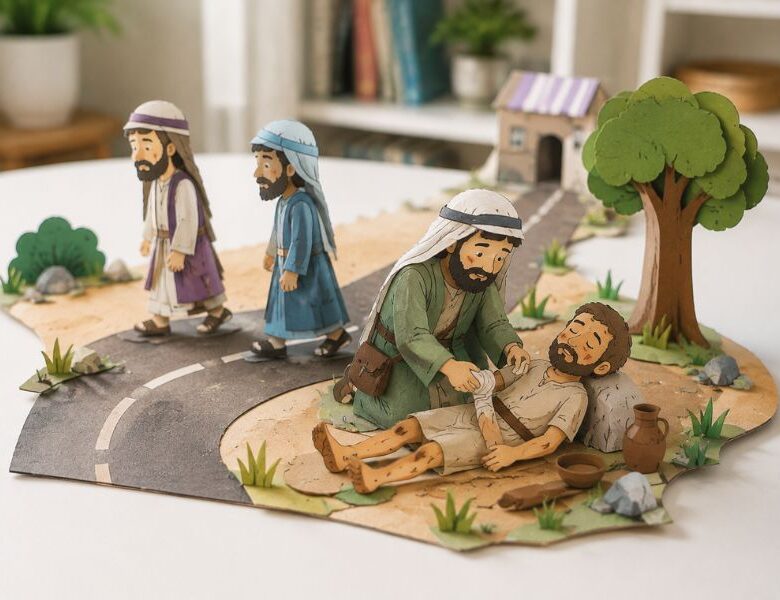
Kids may not accept “be kind” as the whole lesson. These Good Samaritan craft ideas for kids unpack the harder questions and make the story easier to talk about.
“Why didn’t anyone else stop?”
That may be the first question a child asks after hearing the story of the Good Samaritan, I asked the same question myself. And honestly, it is a better question than simply asking, “Who was the good guy?”
In Luke 10:25–37, a man is attacked, robbed, and left badly injured on the road. A priest sees him. A Levite sees him. Neither stops. Then a Samaritan comes along, sees the injured man, and responds with compassion.
The Bible tells us what the priest and Levite did, but it does not tell us exactly why they walked past. That matters when teaching children. We don’t need to invent a reason the passage never gives.
Instead, we can use their question to help children think about something much more meaningful: what should we do when we notice that someone needs help?
These Good Samaritan craft ideas for kids are designed around that question.
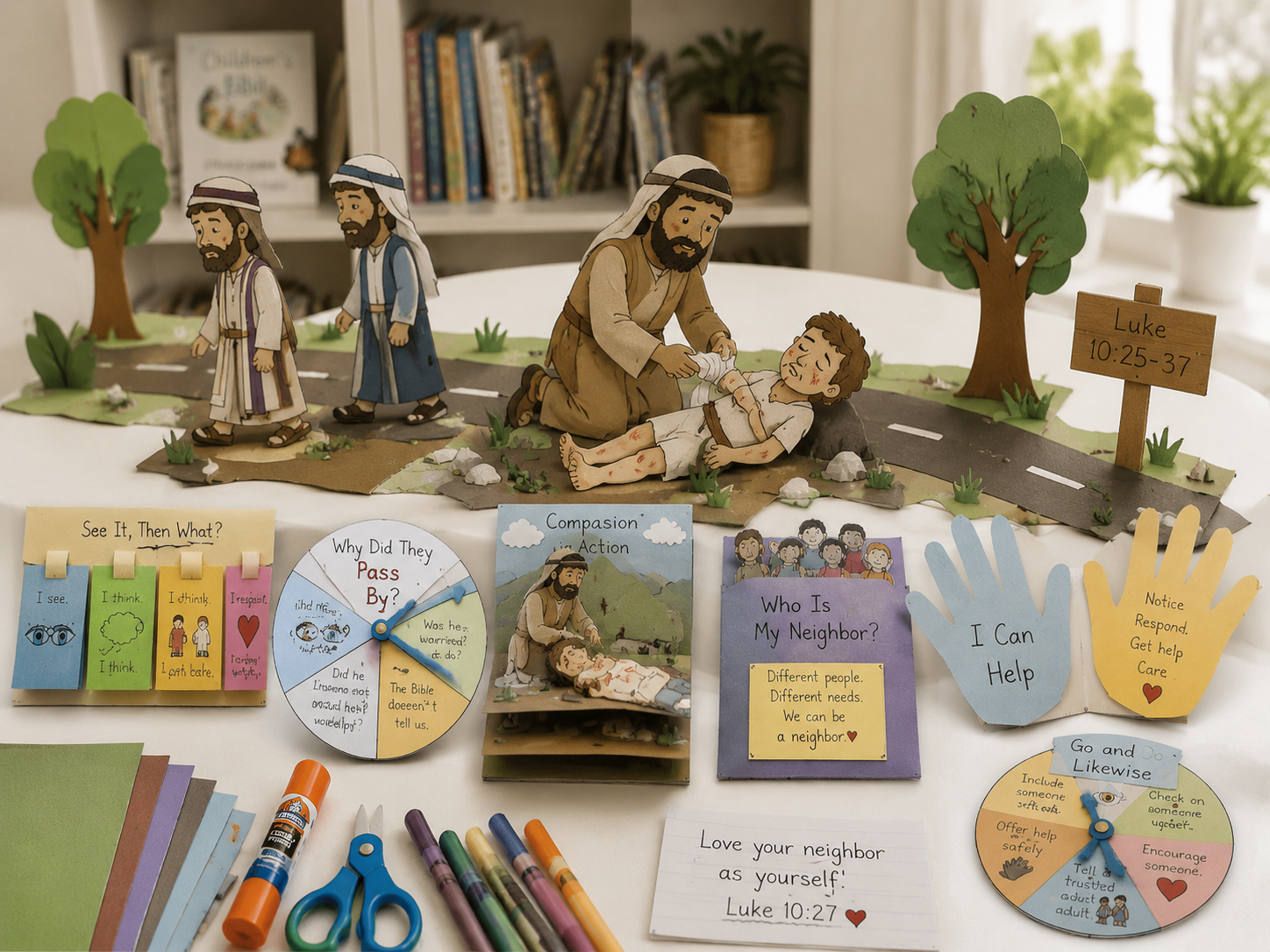
Rather than making seven crafts that simply say “be kind,” each activity helps children look closely at what happened in the parable, from noticing someone’s need to responding with compassion, knowing when to get help, and understanding what it means to be a neighbor.
Because sometimes the most important lesson isn’t making the craft. It’s the conversation that happens while a child is making it.
Make another Bible story memorable with Noah’s Ark Crafts for Kids: 9 Ideas That Walk Through the Whole Story, One Craft at a Time.
1. The “Who Stopped?” Road Scene Craft
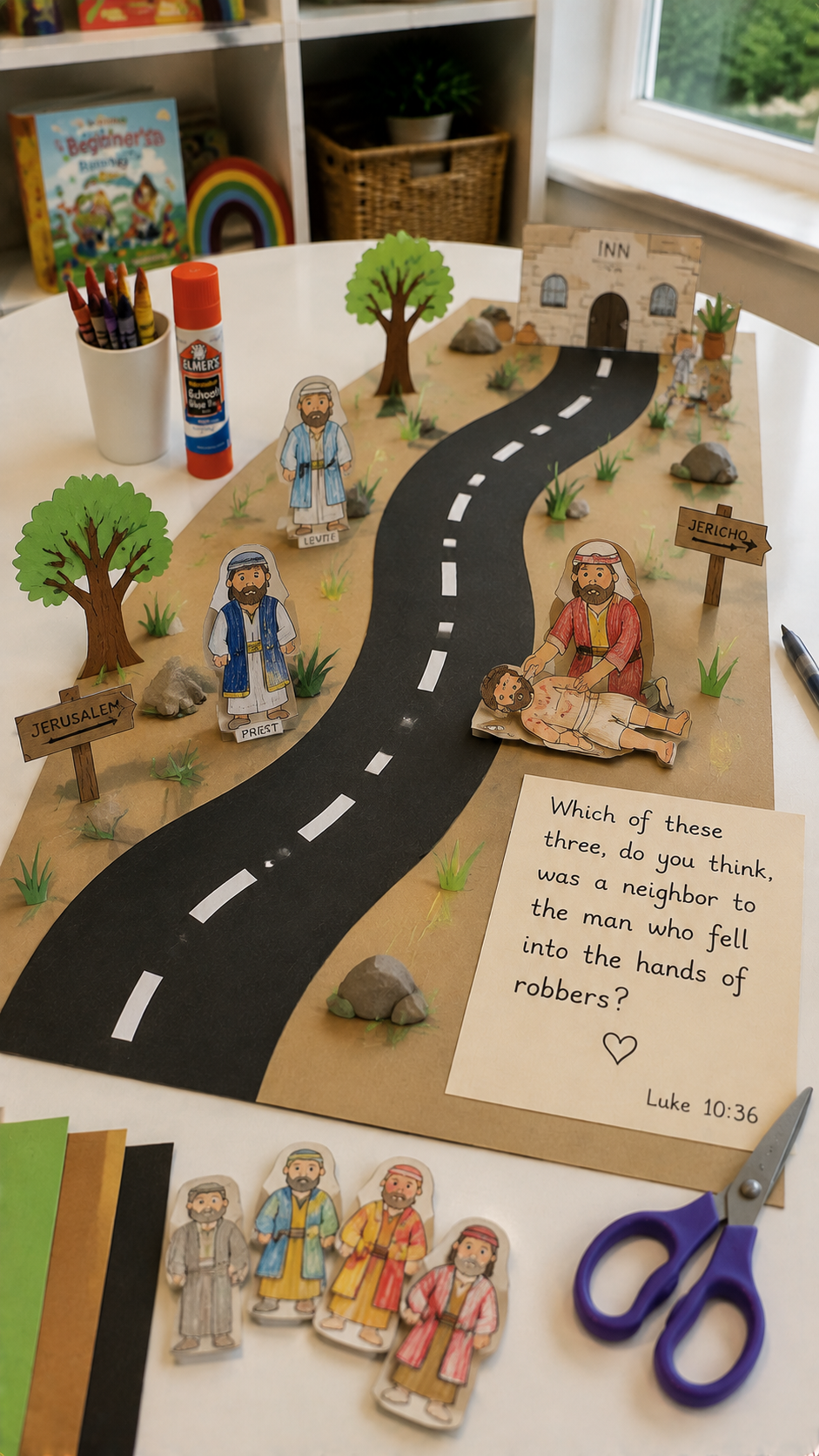
This craft turns the Good Samaritan story into a simple scene children can see, move, and retell rather than simply decorating a picture of the Samaritan.
It works especially well for children who keep coming back to the question, “Why didn’t anyone else stop?”
Create a simple road from cardstock or paper and add movable figures representing the injured traveler, the priest, the Levite, and the Samaritan.
You can also include the inn at the end of the road. As the child moves each figure along the road, retell the events in Luke 10:25–37 in the order they happen.
The important part is not making the road look elaborate. It is getting the child to notice the difference between seeing someone in need and responding to that need.
What the child can do
Place the injured traveler on the roadside first. Then move the priest toward him and ask:
“What did he do when he saw the man?”
Next, repeat the scene with the Levite.
Finally, bring in the Samaritan and ask:
“What did he do differently?”
Luke’s account says the priest saw the injured man and passed by, and the Levite also saw him and passed by. The Samaritan, however, saw him, was moved with compassion, went to him, treated his wounds, and arranged for his care.
The conversation that makes this craft meaningful
Don’t rush to tell children why the priest and Levite passed by. The passage doesn’t give their reasons. Instead, let the child sit with the unanswered question.
You can ask:
- “What do you think the Samaritan noticed?”
- “What changed when he decided to come closer?”
- “Is seeing that someone needs help the same as helping?”
- “What could a child do when someone needs help but the situation isn’t safe?”
That last question brings the ancient story into a child’s world without suggesting that children should put themselves in danger to imitate the Samaritan.
A simple lesson to leave them with
Being a neighbor begins with noticing, but compassion doesn’t stop at noticing.
For a child, that might mean getting a trusted adult when someone is hurt, checking on a classmate who is upset, or speaking up when another child is being left out.
The goal is not to make children responsible for solving every problem themselves, but to help them understand that seeing someone’s need gives us an opportunity to respond wisely and compassionately.
Continue teaching Bible lessons through hands-on activities with Daniel and the Lion’s Den Craft: A Sunday School Activity for Kids That Teaches Courage and Faith.
2. See It, Then What?” Flip-Tab Craft
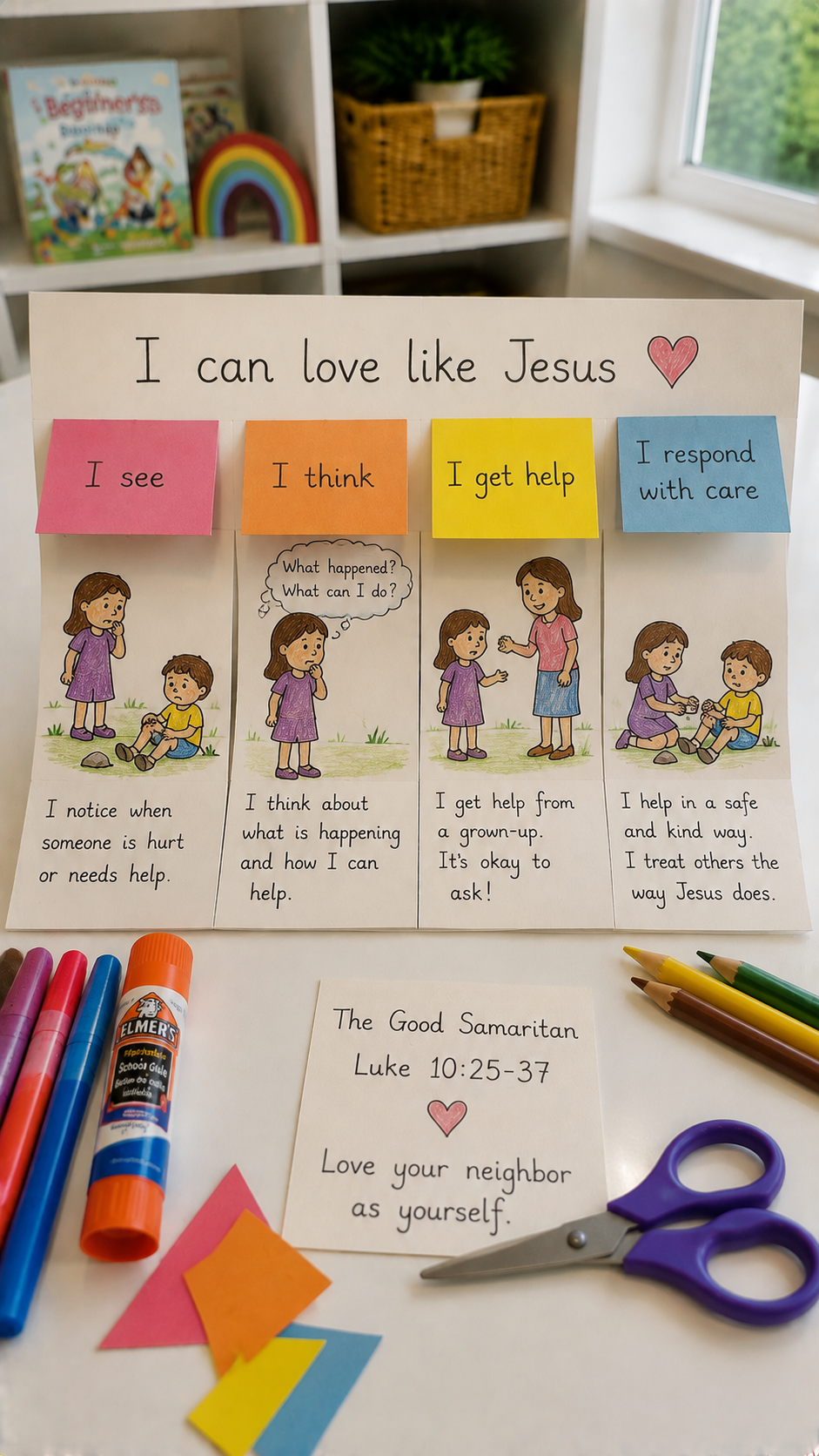
The Good Samaritan story gives children an important detail to notice: the Samaritan did not simply see the injured man—he responded to what he saw.
That makes this flip-tab craft a simple way to help a child think about what happens between noticing that someone needs help and deciding what to do next.
Start with a sheet of cardstock and create three or four lift-up tabs. Under each tab, place one part of the response:
I see someone needs help.
>I stop and think.
>I get help if I need to.
>I do what I can safely.
You can draw a small picture under each flap to make the sequence easier for younger children to understand.
Make the Craft
On the front of the cardstock, draw a child noticing someone who needs help. The situation can be simple—a classmate who has fallen on the playground, a child who is upset, or someone who has been left out of a group.
Cut and fold your tabs so that each one lifts to reveal the next step.
Under the first tab, write:
“I see.”
Ask the child, “What did the Samaritan see?”
In Luke 10, the Samaritan comes across a man who has been attacked and left badly injured. The passage says that he saw him and was moved with compassion. The priest and Levite also saw the man, but the story describes them passing by.
Under the second tab, write:
“I think.”
This is where you can teach a lesson children can actually use. Seeing that someone needs help does not mean they should immediately rush into the situation. Ask:
“Is this something I can safely help with, or do I need an adult?”
A child who sees someone injured, frightened, lost, or in a dangerous situation may need to get a parent, teacher, caregiver, or another trusted adult rather than trying to handle the problem alone.
Under the third tab, write:
“I get help.”
Give the child examples of what this could look like:
- Tell the teacher when a child is hurt on the playground.
- Get a parent when someone needs assistance.
- Tell a trusted adult when another child is being bullied.
- Ask an adult for help when a situation feels unsafe.
Then let the final tab say:
“I respond with care.”
Explain that helping does not always look the same. Sometimes it means offering encouragement or including someone who is alone. Othertimes it means getting an adult.
Sometimes the kindest and safest thing a child can do is recognize that the situation needs someone with the right knowledge or authority to handle it.
Bring early literacy into craft time with Letter B Craft for Preschool: Build a Bulldozer That Makes Letter Recognition Click.
Talk About What the Samaritan Did
Once the craft is finished, open the tabs again and walk through the biblical story together.
The Samaritan saw the injured man, went to him, treated his wounds, took him to an inn, and arranged for his continued care. Jesus later asks which person proved to be a neighbor, and the answer is the one who showed mercy.
That gives you a chance to make an important distinction:
Compassion is more than noticing that something is wrong. It changes what we choose to do next.
The child does not need to copy every action of the Samaritan literally. The point is to help them understand the principle behind the story: when we notice someone in need, we should look for a wise and appropriate way to respond.
Add a bright nature-themed project with Sunflower Crafts for Kids: The Suncatcher and 14 More Easy Ideas They’ll Beg to Make Again.
Try These “What Would You Do?” Questions
After making the craft, give your child or class a few situations and let them decide which flap applies.
- Your friend falls and hurts their knee at school. What do you do?
- You see a child crying alone. What could you safely do?
- You notice someone being bullied. Should you handle it yourself or get an adult?
- You see someone in a situation that looks dangerous. What should you do first?
The goal isn’t to find one identical answer for every situation. It is to teach children to notice, think, seek appropriate help, and respond with compassion without putting themselves in danger.
That makes this more than a paper craft. It gives the question behind the Good Samaritan story somewhere to go:
I saw someone needed help. What did I choose to do next?
Put broken crayons to good use with Melted Crayon Art for Kids: What to Do With Broken Crayon Pieces.
3. The “Why Did They Pass By?” Question Wheel
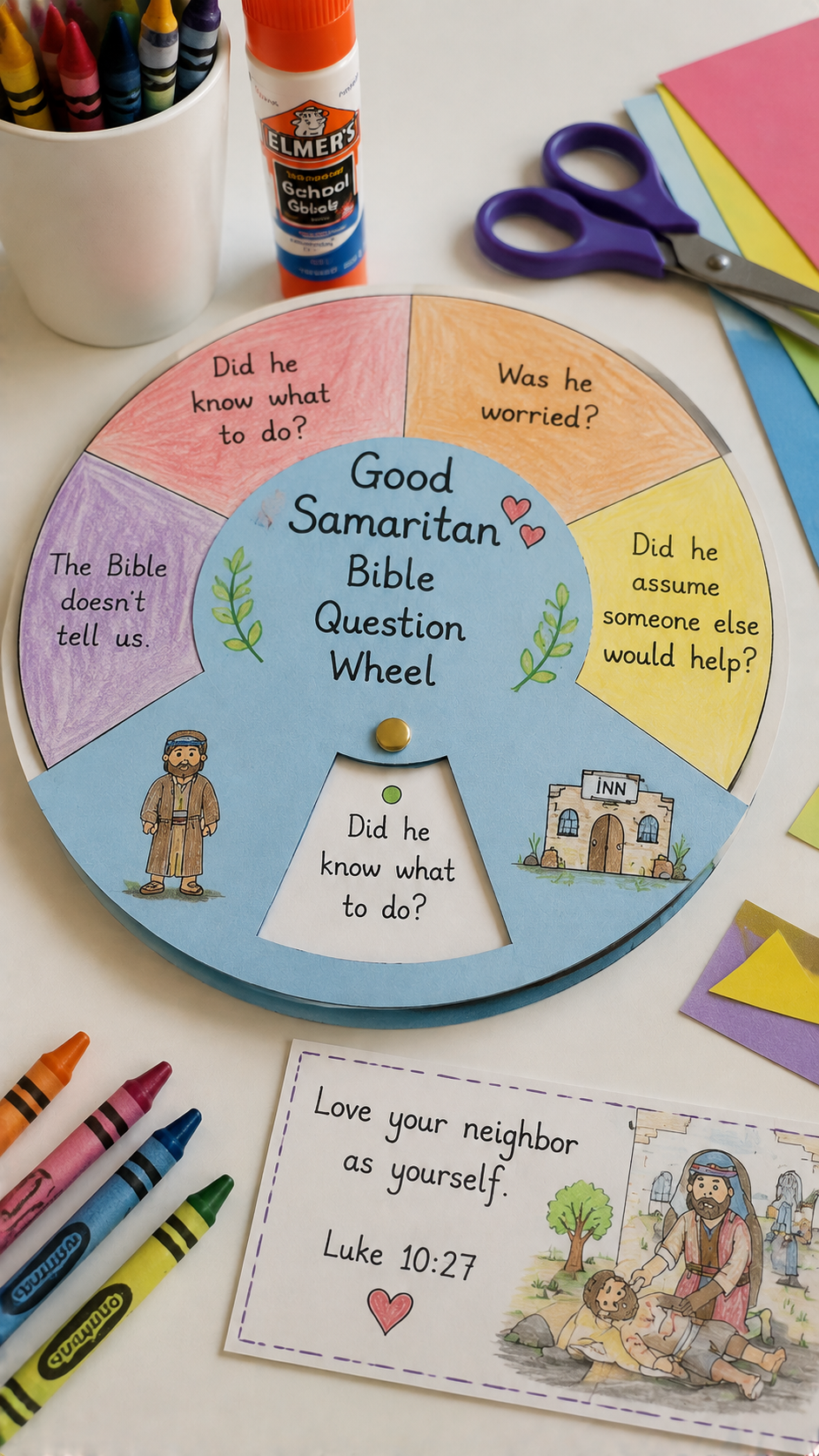
One of the hardest questions children can ask about the Good Samaritan story is also one the Bible does not directly answer: “Why did the priest and the Levite pass by?”
That makes this question wheel a useful addition to your Good Samaritan craft ideas for kids because it gives children permission to think about the question without turning an interpretation into a Bible fact.
In Luke 10:25–37, Jesus tells us that the priest saw the injured man and passed by.
The Levite also saw him and passed by. The Samaritan, however, saw him, had compassion, and went to help him. The passage does not explain the priest’s or Levite’s motives.
How to Make the Question Wheel
Cut two circles from cardstock. On the bottom circle, divide the surface into several sections and write possible questions or explanations:
- Did he feel responsible for the man?
- Did he know what to do?
- Was he worried about getting involved?
- Did he assume someone else would help?
- Was there something else happening that we are not told?
- What does the Bible actually tell us?
Attach a second circle on top with a small window cut into it. Fasten the two circles in the middle with a paper fastener so the top circle turns and reveals one question at a time.
The final section should be especially important:
“The Bible doesn’t tell us.”
Let the Child Investigate the Question
As the child turns the wheel, don’t immediately give them an answer. Instead, ask:
“Where does the Bible say that?”
If they suggest that the priest was afraid of touching a dead body, for example, explain that this is one interpretation people have discussed, but Luke does not actually say that was his reason.
The injured man is described as being left “half dead,” and the story never tells us whether either man believed he was dead or what was going through their minds.
That small distinction teaches children something surprisingly valuable: we can think about a Bible story without pretending to know details the text doesn’t give us.
Extend craft time into outdoor learning with Milk Carton Bird Feeder Craft to Get Preschoolers Outside and Off Screens.
Turn the Question Toward the Samaritan
Once you’ve explored the unanswered question, turn the wheel back to what the story does tell us.
Ask:
“Whatever their reasons were, what did the Samaritan do differently?”
He did not simply notice the injured traveler. He approached him, treated his wounds, transported him to an inn, and made arrangements for his continued care.
That shifts the lesson away from trying to label the priest and Levite as “bad people” and toward the response Jesus actually highlights: showing mercy to someone in need.
A Question to Leave With the Child
Finish the Good Samaritan craft by asking:
“When you notice someone needs help, what could you safely do instead of simply walking past?”
The answer will look different depending on the situation. A child might comfort a classmate, include someone who is alone, or get a trusted adult when someone is hurt or in danger.
The goal isn’t to teach children that they must personally solve every problem they encounter.
It is to help them understand the heart of the parable: noticing another person’s need gives us an opportunity to respond with compassion and wisdom.
For activities that combine making with sensory learning, see 15 Sensory DIY Craft Ideas for Kids With Special Needs That Support Learning Through Play.
4. Samaritan “Compassion in Action” Layered Craft
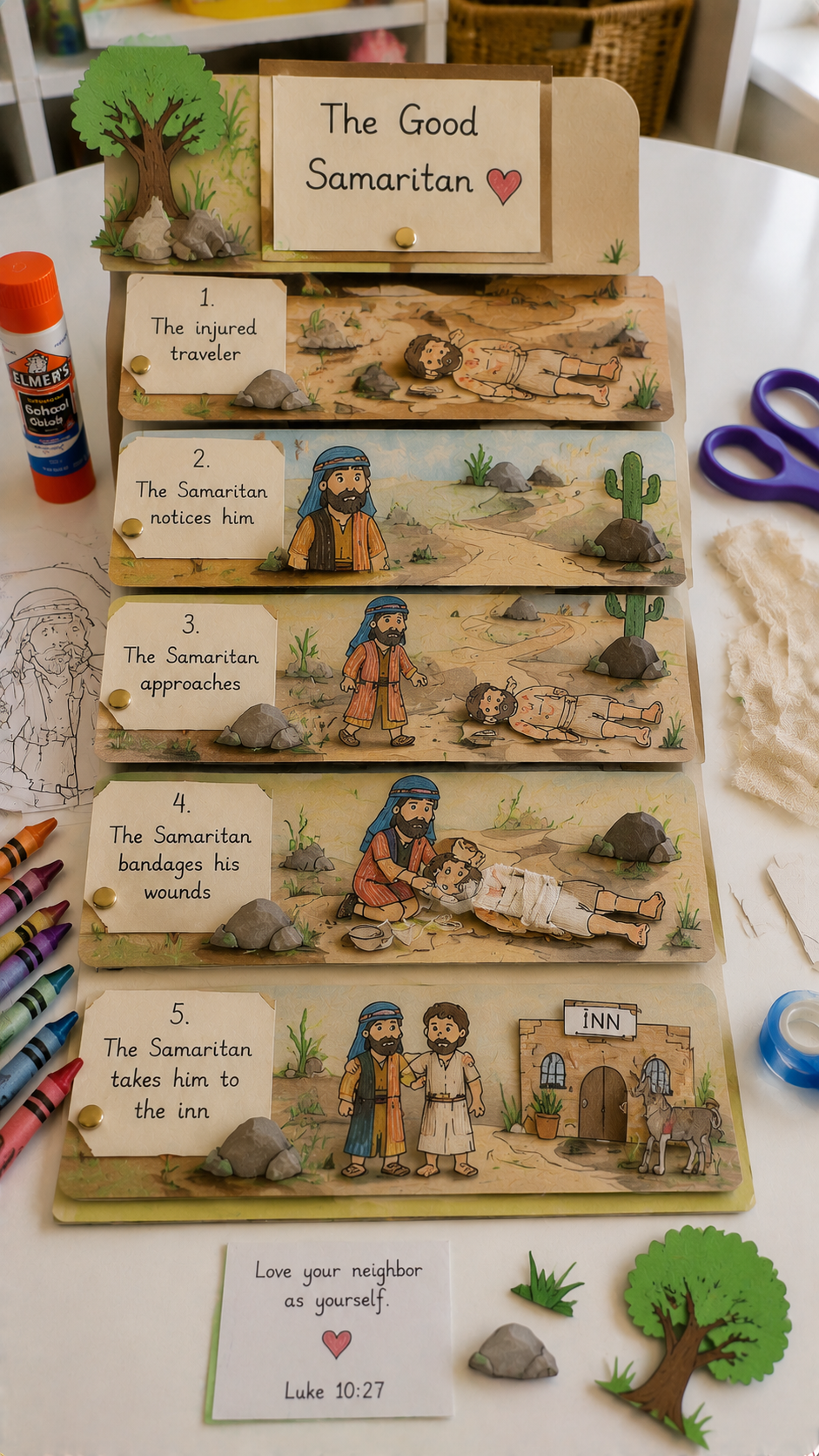
The Samaritan’s response in Luke 10 is easy for children to summarize as, “He was kind.” But the story gives us more detail than that.
His compassion led to specific actions, and those actions are what make this craft worth doing.
For this Good Samaritan craft, create a layered scene that allows children to uncover the Samaritan’s response one step at a time.
What You Need
- Cardstock or construction paper
- Scissors
- Glue
- Pencil
- Markers or crayons
- A paper fastener, if you want the layers to open and close
- Optional: small pieces of bandage or fabric for the injured traveler
How to Make the Craft
Create a simple picture of the injured traveler lying beside the road. Place the Samaritan beside him and build the scene with several paper layers that can be lifted or opened.
Each layer should reveal one action from the story.
1. He Saw Him
Start with the injured traveler lying on the roadside.
Explain that the Samaritan first saw the man’s condition. This is also important because the priest and Levite had seen him too. The difference in the story comes in what happened after they saw him.
2. He Had Compassion
Under the next flap, write:
“He felt compassion.”
Luke describes the Samaritan as being moved with compassion when he saw the injured man. You can explain to children that compassion means recognizing another person’s suffering and caring about what happens to them.
3. He Went to Him
Lift the next layer to reveal the Samaritan approaching the injured man.
This is a useful moment to point out that the Samaritan did not remain at a distance. The story says he went to the man and cared for his wounds.
4. He Cared for His Wounds
Add small paper strips to represent the bandages.
Luke says the Samaritan bandaged the man’s wounds and poured oil and wine on them. There is no need to turn this into a modern first-aid lesson; simply explain that these were the forms of care described in the ancient story.
5. He Continued to Help
For the final layer, add the Samaritan’s animal and the inn.
The Samaritan placed the injured man on his own animal, brought him to an inn, and took care of him.
The next day, he gave the innkeeper money and arranged for the man’s continued care, saying he would repay any additional expense when he returned.
What Children Can Learn From the Layers
Once all the layers are open, look at the whole scene together.
The Samaritan’s compassion wasn’t only a feeling. It was followed by action. He noticed the man’s suffering, approached him, provided care, and made sure the man’s needs continued to be looked after.
That does not mean a child should copy every action literally. A child who sees someone injured today may need to get a trusted adult rather than attempt medical care themselves.
The lesson children can take from the craft is simpler:
Notice when someone is hurting. Care about what happens to them. Then choose a safe and appropriate way to help.
A Simple Question to Ask
When the craft is finished, ask:
“Which part of the Samaritan’s response showed compassion?”
Let the child look at all the layers before answering. They may notice that compassion appears not just in what the Samaritan felt, but in the things he actually did for the injured man.
That gives children a more complete understanding of the story than simply remembering that the Good Samaritan was a nice person.
Keep the alphabet theme going with Train Craft Ideas for Kids That Make Learning the Alphabet Fun With Things You Already Have.
5. Who Is My Neighbor? Pull-Out People Craft
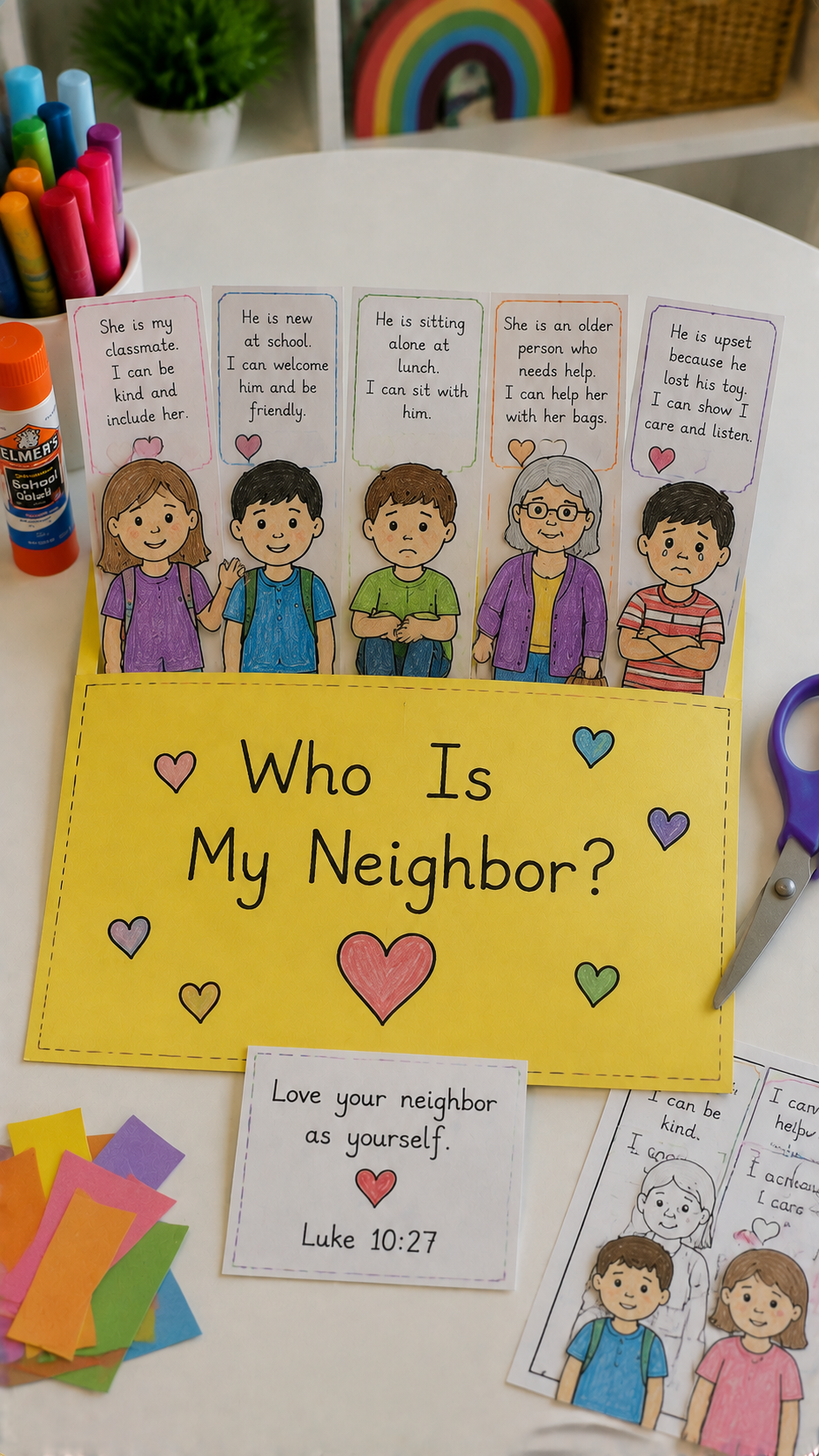
Jesus tells the Good Samaritan story in response to a question: “And who is my neighbor?” That question gives you a natural way to help children think about what Jesus was actually teaching instead of reducing the story to “help people who are nice to you.”
For this Good Samaritan craft idea for kids, make a paper pocket filled with different people.
Each person can be pulled out one at a time, giving you an opportunity to talk about how children can show care toward people around them.
How to Make It
Cut a rectangle from cardstock and glue three sides to another sheet, leaving the top open to create a pocket.
Then cut out several simple paper figures. You don’t need detailed drawings. A face, body, and a few identifying details are enough.
You could include:
- A classmate
- A new child at school
- Someone sitting alone
- An older person who needs assistance
- Someone who looks different from the child
- A person who is upset
- Someone who needs help
Write a simple situation on the back of each figure, such as:
“This child is sitting alone during lunch.”
“A new child doesn’t know anyone yet.”
“This person needs help carrying something.”
“Someone is upset and needs an adult.”
Let the child pull one person from the pocket at a time and discuss what a caring response might look like.
Connect It to the Good Samaritan Story
Before Jesus tells the parable, a legal expert asks him, “And who is my neighbor?” Jesus responds with the story of the man attacked on the road.
At the end, rather than having the listener identify which category of person counted as a neighbor, Jesus asks which of the three men was a neighbor to the injured man. The answer is the one who showed mercy.
That difference is worth explaining to children.
The question begins as:
“Who is my neighbor?”
But the story ends with a question about:
“Who acted like a neighbor?”
So, as your child pulls each paper person from the pocket, don’t focus only on whether that person is someone they know or like. Ask:
“How could you be a good neighbor to this person?”
Keep the Lesson Realistic for Children
Being a good neighbor doesn’t mean children should approach every stranger or put themselves in an unsafe situation.
For a child, being neighborly might mean inviting someone into a game, checking on a classmate, sharing appropriately, or getting a trusted adult when someone needs help.
And sometimes the right response is simply to get an adult.
For example, if the paper figure represents someone who is injured, the child shouldn’t be expected to provide medical care.
They can learn that getting a teacher, parent, caregiver, or another responsible adult is itself a way of responding to someone’s need.
A Question to Finish the Craft
Once all the figures have been pulled from the pocket, ask:
“Does someone have to be your friend before you can treat them like a neighbor?”
Then return to Jesus’ closing instruction in the passage: “Go and do likewise.”
The craft gives children something concrete to remember: being a neighbor is not only about identifying who belongs in our circle.
It is also about how we choose to treat people when we encounter their needs.
Add a simple process-art activity with Bubble Wrap Painting: The Easy Texture Trick That Turns Bored Kids Into Little Artists.
6. Good Samaritan Helping Hands Craft
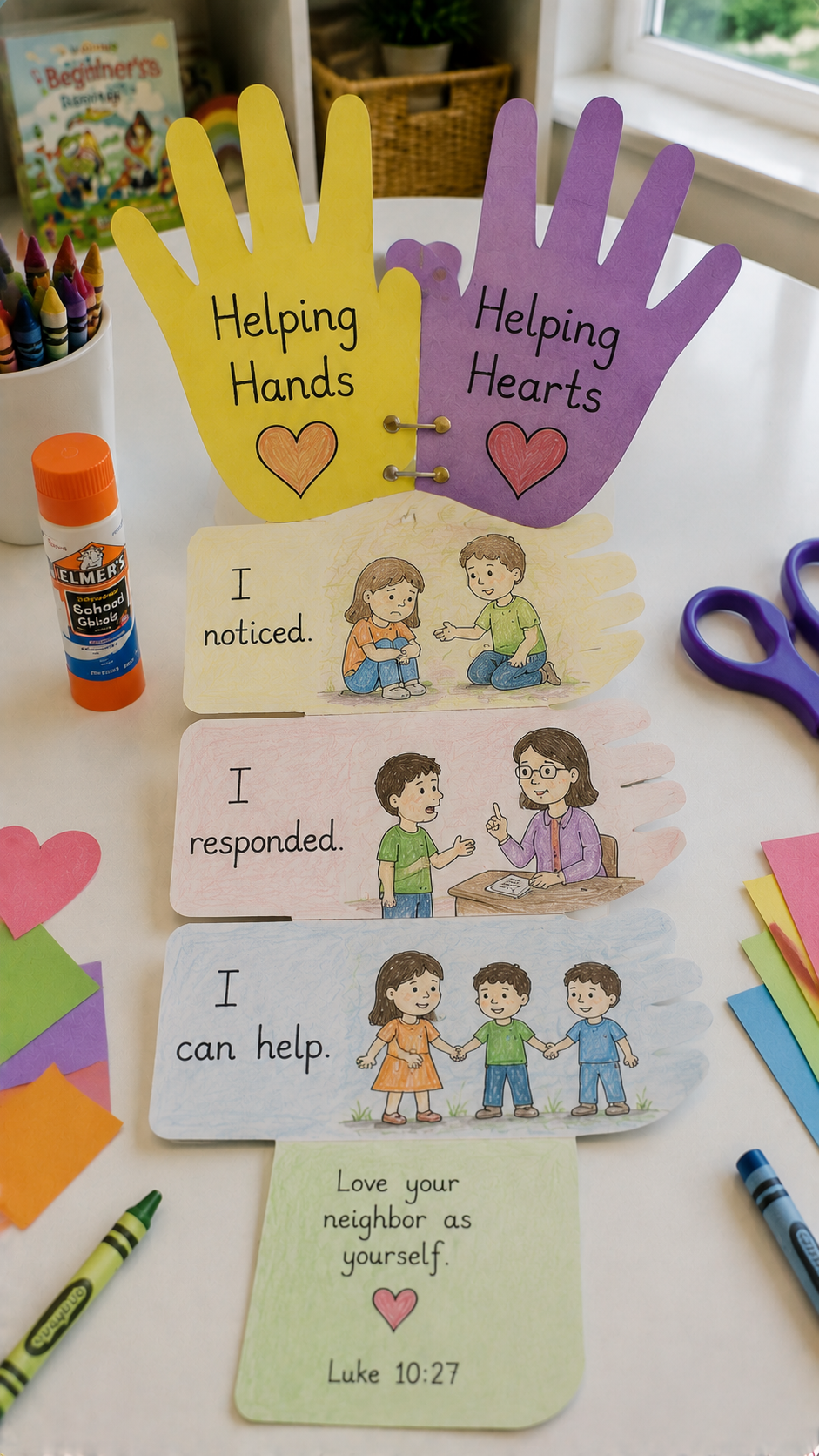
A helping hand is an easy image for children to understand, but the Good Samaritan story gives it a deeper meaning.
The Samaritan did not help the injured man because someone told him to perform a particular kind act. He saw a person in serious need and responded with mercy.
This helping-hands craft gives children a chance to think about what helping someone actually looks like in everyday life.
Make the Helping Hands
Trace your child’s hand twice on a sheet of cardstock and cut out both hand shapes. Join the wrists with a strip of paper or a small piece of folded cardstock so the hands open like a little booklet.
On the front, write:
“I Can Help.”
Inside, write:
“How can I be a good neighbor?”
Now let the child draw or write examples of safe ways they can help someone.
You might see answers such as:
- “I can include someone who is playing alone.”
- “I can help a classmate pick up their things.”
- “I can comfort my friend when they are sad.”
- “I can tell a teacher when someone is hurt.”
- “I can ask an adult for help when something is unsafe.”
Introduce culture through hands-on creativity with 12 African Art Projects for Kids That Teach Culture, Not Just Craft.
Connect It to the Samaritan
Open the hands and revisit what happened in Luke 10.
The Samaritan saw the injured traveler, felt compassion, went to him, treated his wounds, took him to an inn, and made arrangements for his continued care.
Jesus presents these actions as an example of showing mercy to a person in need.
Point out something children can easily miss: helping does not always mean doing everything yourself.
The Samaritan was an adult in a particular situation, so children should not be expected to copy his actions literally.
If a child encounters someone who is seriously injured or a situation that could be dangerous, the appropriate response may be to get a trusted adult rather than stepping into the situation themselves.
That is still a form of helping.
Turn the Hands Into a Real-Life Lesson
Ask your child to think about the difference between these two situations:
“Your friend drops their pencils.”
They may be able to help pick them up.
“You see someone seriously injured.”
They should get an adult and avoid putting themselves in danger.
Then ask:
“Are both people being helped?”
Yes, but the safest response is different.
This helps children understand that compassion requires more than having good intentions. We also need to think about what kind of help is appropriate.
Finish With One Simple Question
On the palm of one hand, write:
“I noticed.”
On the other:
“I responded.”
Ask the child:
“What is one thing you can do this week when you notice someone needs help?”
That turns these Good Samaritan craft from a Bible-story activity into an opportunity to practice the lesson in ordinary situations, while teaching children that being helpful can mean acting, speaking up, or getting someone else to help when that is the safest choice.
For another sensory-friendly option, try Safe and Easy Slime Craft Ideas for Kids — Non-Toxic Projects That Keep Them Busy for Hours.
7. Go and Do Likewise Take-Home Action Wheel
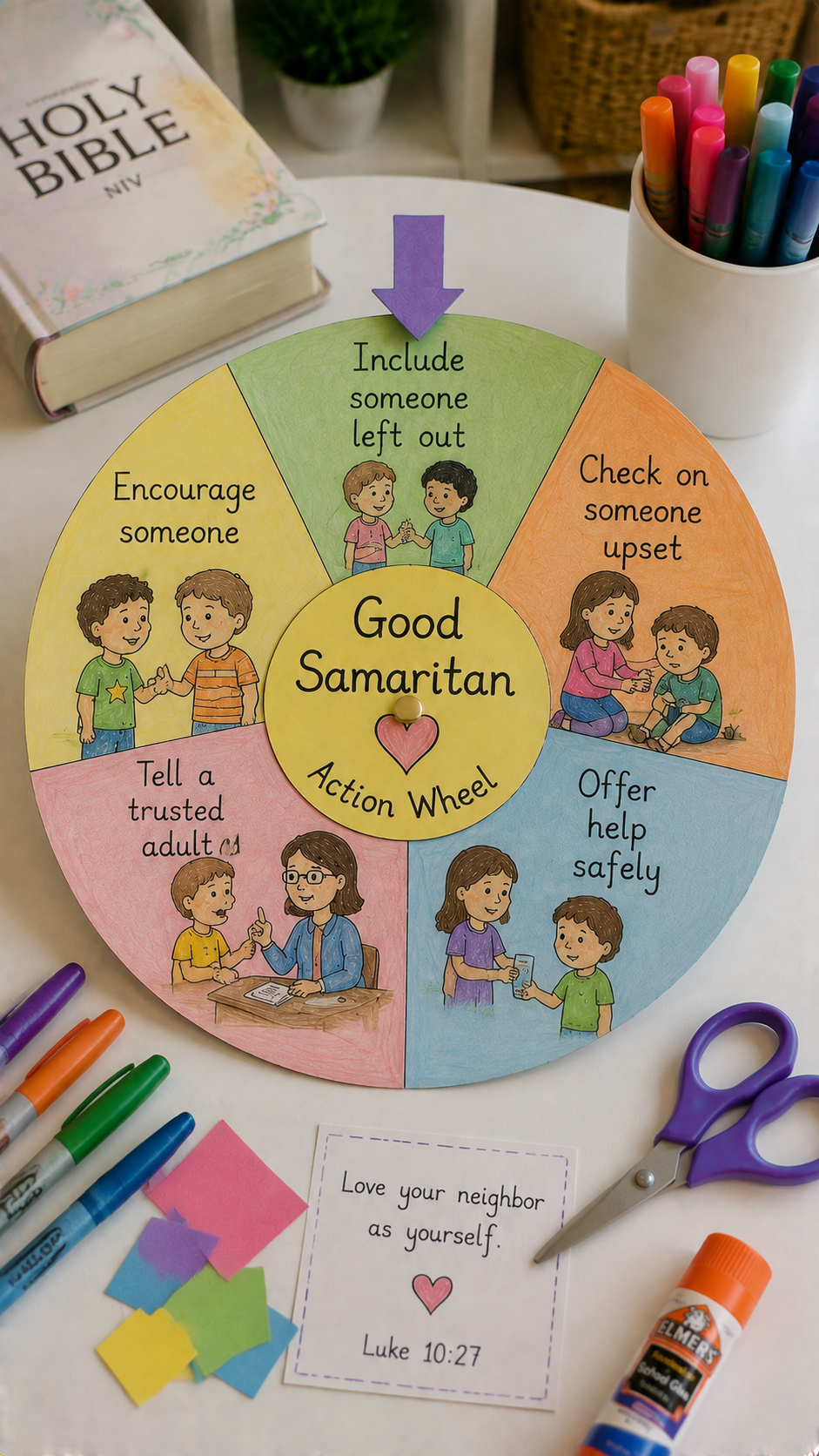
A child may remember the story of the Good Samaritan for a few minutes after a Bible lesson, but the real challenge is helping them understand what Jesus meant when he said, “Go and do likewise.”
This final Good Samaritan craft gives children something they can take home and use to connect the lesson with ordinary situations.
The action wheel is not meant to turn kindness into a game where children have to complete a certain number of good deeds.
Instead, it helps them think about how they can respond when they notice someone needs care, encouragement, or appropriate help.
Make the Action Wheel
Cut two circles from cardstock. Divide the bottom circle into sections and write one safe, practical response in each section:
- Include someone who is left out
- Check on someone who is upset
- Offer help when it is safe
- Tell a trusted adult when someone needs help
- Encourage someone who is struggling
- Share or take turns when appropriate
- Speak up when someone is being treated unfairly
Cut a small window into the top circle and attach the two circles in the center with a paper fastener. The child can turn the top circle to reveal one action at a time.
Save those empty cartons for 13 Easy Egg Carton Craft Ideas for Preschoolers at Home (Perfect for Tired Days).
Connect It to the Bible Story
When the wheel is finished, read the ending of the parable together. After the legal expert identifies the Samaritan as the one who showed mercy, Jesus tells him, “Go and do likewise.”
Explain that Jesus was not giving him a list of seven particular good deeds to complete. The point was to show mercy as the Samaritan had done.
That distinction matters because children can easily think being a “good” person means collecting points for every kind thing they do.
The parable is teaching something deeper: when another person is in need, don’t limit your concern to people you already know, like, or consider part of your own group.
Give the Wheel a Real-Life Test
Before the child takes the Good Samaritan craft home, give them a few situations and ask which response on the wheel might fit.
“A new child is sitting alone at school. What could you do?”
“Your friend is upset after losing a game. How could you respond?”
“You see someone hurt and the situation looks serious. What should you do?”
“Someone is being bullied. Should you handle it alone or tell a responsible adult?”
There won’t always be one identical response. The important thing is helping the child think about the person’s needs, what they can safely do, and when they should involve an adult.
Turn It Into a Take-Home Reminder
Let the child choose one action from the wheel to practice during the week. They can turn the wheel again whenever they need a reminder that helping others is not limited to the Bible-story setting.
And when they bring the craft home, ask them one question:
“What did you notice this week that gave you a chance to be a good neighbor?”
That question brings the lesson back to the heart of Jesus’ command. The goal isn’t to make children perform impressive acts of kindness.
It is to help them become more attentive to the people around them and learn to respond to genuine needs with mercy, wisdom, and appropriate action.
Turn household waste into creative projects with Toilet Paper Roll Crafts for Kids That Turn Everyday Waste into Fun, Skill-Building DIY Projects at Home.
Download the
Print it after the last craft and have your child fill it out, it walks through the same five stops as the story, ending with one real thing they can do this week.
How to Talk About the Good Samaritan Without Teaching Children the Wrong Lesson
The Good Samaritan is often reduced to a simple lesson about “being kind,” but there are a few details worth getting right when teaching children.
1. Don’t Pretend You Know Why the Priest and Levite Passed By
Children may ask, “Why didn’t they stop?”
Luke tells us that both men saw the injured traveler and passed by, but it does not tell us why.
So don’t tell children that they definitely passed by because they were afraid, busy, or concerned about ritual purity. Those are interpretations, not reasons stated in the passage.
Simply say:
“The Bible tells us what they did, but it doesn’t tell us why.”
2. Try Not Reduce the Samaritan’s Actions to “He Was Nice”
The Samaritan saw the injured man, had compassion, approached him, treated his wounds, took him to an inn, and arranged for his continued care.
That gives children a stronger lesson:
Compassion is not only a feeling; it can lead us to action.
Finish with another classic craft material through 13 Popsicle Stick Crafts for Kids That Actually Keep Them Busy and Boosts Creativity.
3. Teach Children That Helping Must Also Be Safe
Children should not think being a Good Samaritan means rushing toward danger or trying to treat serious injuries themselves.
Sometimes the right thing to do is get a parent, teacher, caregiver, or another trusted adult.
Explain it simply:
“You can help someone without putting yourself in danger.”
4. Focus on Mercy, Not Labels
Instead of teaching that the priest and Levite were simply “bad” and the Samaritan was “good,” draw attention to their actions.
Jesus ends the parable by asking which person acted as a neighbor to the injured man. The answer is the one who showed mercy.
That keeps the lesson where it belongs: notice someone’s need, care about what happens to them, and respond appropriately.
For low-mess activities using a simple material, see 13+ Pipe Cleaner Crafts for Kids That Are Simple, Fun, and Completely Mess-Free.
Conclusion
A good craft can give a child something to hold onto long after the Bible lesson ends, but the bigger goal is helping them understand why Jesus told this story in the first place.
These Good Samaritan craft ideas for kids give you simple ways to keep that conversation going without reducing the parable to a paper project or a lesson about being “nice.”
Choose the craft that fits your child’s age, let the questions lead the conversation, and give them room to think about what mercy can look like in real life.
Which one will you make first? Gather your supplies, make it together, and see where your child’s questions take the conversation.