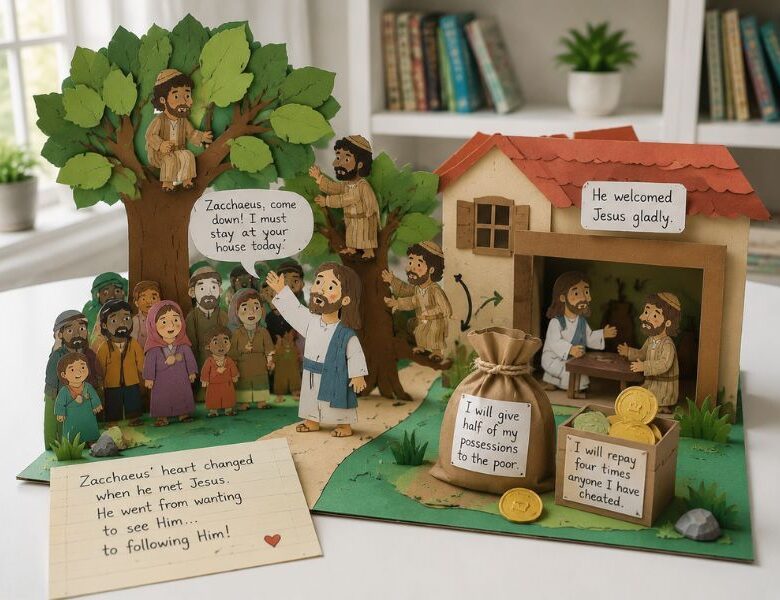
The tree is only the beginning, these Zacchaeus crafts uncover the surprising details kids often miss about his money, reputation, and encounter with Jesus.
Most children meet Zacchaeus in the same place: up in a tree, trying to see Jesus over the crowd.
It is the part of the story they remember easily, but Luke 19 gives us much more to talk about once Zacchaeus comes down.
There is the man behind the tree: a wealthy chief tax collector whose position already shaped how people saw him. There is the crowd that questioned why Jesus would go to his house.
And then there is Zacchaeus himself, whose response involved his money, the poor, and making things right with people he said he had cheated.
That gives us a better reason to make Zacchaeus crafts than simply recreating the familiar tree scene.
The right craft can help a child notice details they might otherwise miss, and give you something concrete to talk about when the story raises harder questions about reputation, wealth, welcome, and changing the way we treat other people.
These crafts take Zacchaeus out of the tree and into the parts of his story that are worth knowing to understand.
Connect this Bible lesson with 7 Good Samaritan Craft Ideas for Kids Who Ask “Why Didn’t Anyone Else Stop?, especially when teaching children about compassion and helping others.
1. The Chief Tax Collector Money Bag Craft
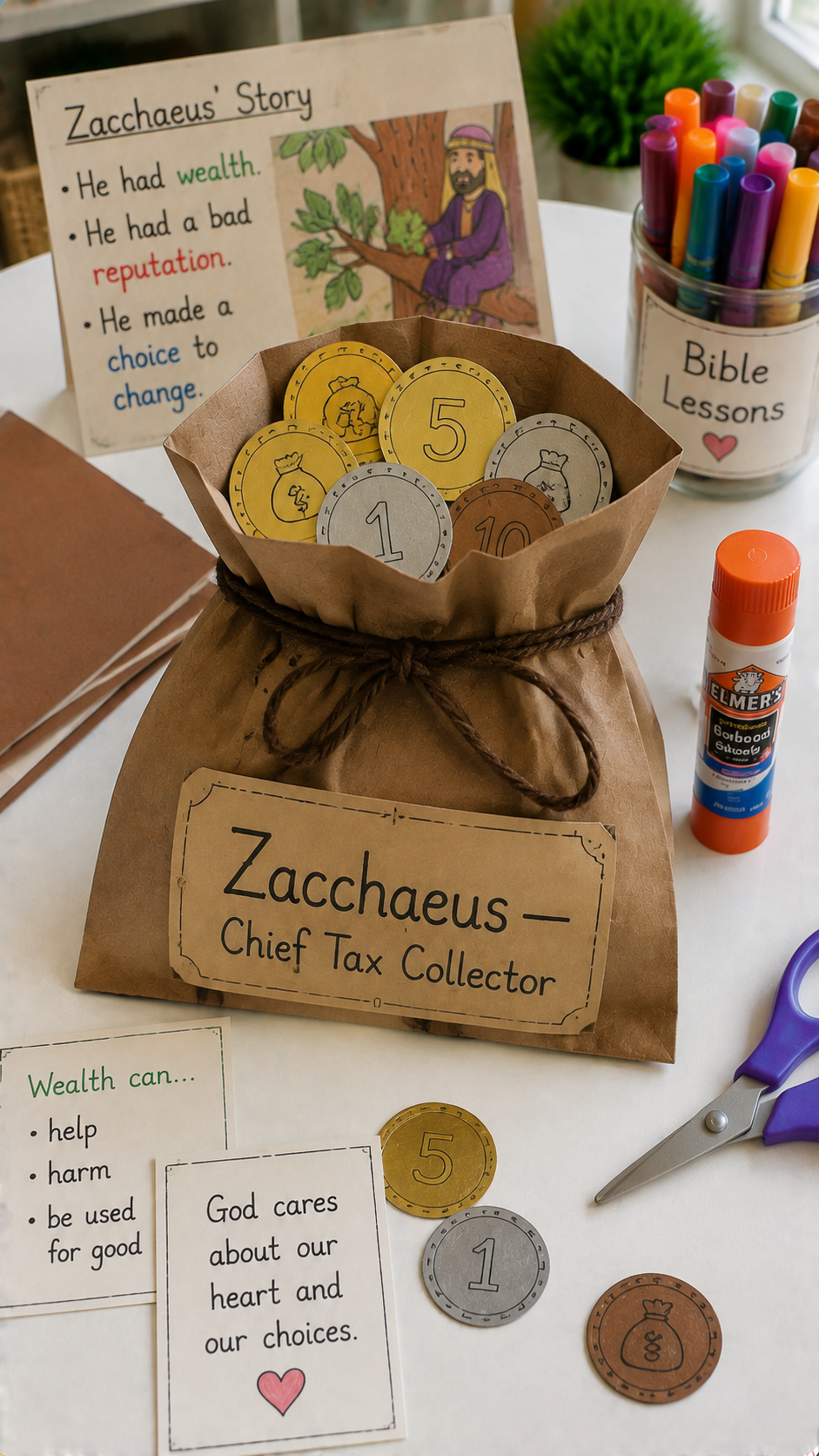
Zacchaeus is often introduced simply as “the man who climbed the tree,” but Luke gives us another important detail: he was a chief tax collector and was wealthy.
That matters because his occupation and wealth help explain why the crowd later reacted so strongly when Jesus chose to stay at his house.
This craft gives children a simple way to understand that Zacchaeus had a complicated reputation before the tree scene even happened.
What You Need
- Brown cardstock or construction paper
- Colored paper for the coins
- Scissors
- Glue
- Black or brown marker
- String or yarn
- Optional: a paper fastener
How to Make It
- Make the money bag.
Cut a large oval or rounded pouch shape from brown cardstock. Fold the top down slightly and glue or tape the sides together, leaving the top open. - Add the tie.
Punch two small holes near the top and thread a short piece of yarn through them. Tie it loosely so the bag can open and close. - Make the coins.
Cut several small circles from yellow or gold-colored paper. Let the child draw simple marks on them to make them look like coins. - Add Zacchaeus’ title.
Write “Zacchaeus — Chief Tax Collector” on the front of the bag. - Put the coins inside.
Let the child place the paper coins inside the bag. Don’t label the coins as money Zacchaeus personally stole; Luke does not give us that level of detail. What the passage does tell us is that he was wealthy and later spoke about repaying anyone he had cheated.
What to Teach While Making It
Explain that tax collecting in the Roman world was not the same as simply paying taxes at a modern government office. Tax collectors worked within the Roman system, and the role could be associated with exploitation or dishonest collection.
But don’t tell children that every tax collector was automatically a cheat, that goes beyond what Luke says about Zacchaeus.
Luke specifically calls Zacchaeus a chief tax collector and wealthy, and later Zacchaeus himself says he will repay four times anyone he has cheated.
That gives you a more accurate question to ask:
“What do you think people noticed first about Zacchaeus, the money he had, his job, or the person he was?”
The point isn’t to make children think that having money makes someone bad. It is to help them understand that Zacchaeus’ story involves money, reputation, and eventually what he chose to do with what he had.
That makes this more than a money-bag craft, it gives children the background they need to understand why the rest of the story matters.
Continue exploring Bible stories through hands-on projects with Noah’s Ark Crafts for Kids: 9 Ideas That Walk Through the Whole Story, One Craft at a Time.
2. The Blocked View Crowd Craft
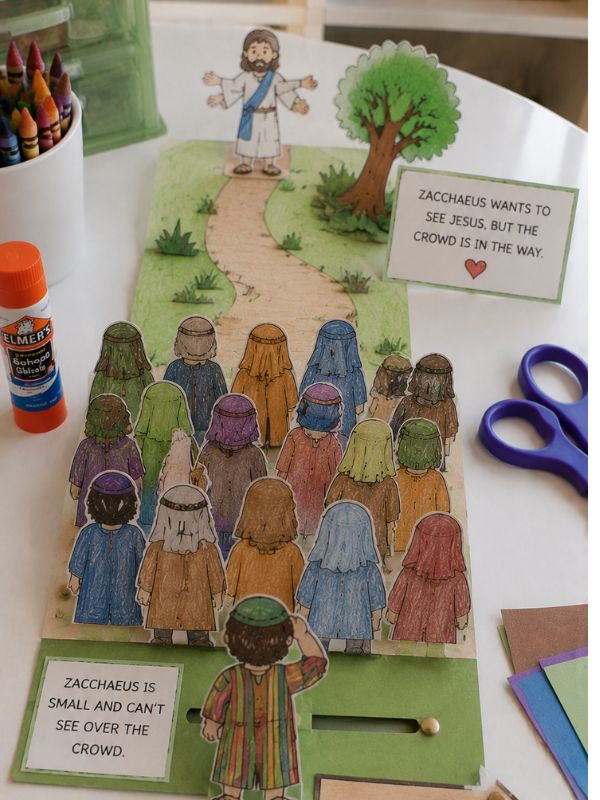
Zacchaeus wanted to see Jesus, but the crowd was in his way. Luke tells us that he could not see over the crowd because he was short, so he ran ahead and climbed a sycamore-fig tree.
This craft focuses on the problem Zacchaeus was trying to solve, rather than jumping straight to the tree.
What You Need
- Cardstock or construction paper
- Scissors
- Glue
- Markers or crayons
- A paper fastener
- Small paper figure for Zacchaeus
- Several small paper figures for the crowd
How to Make It
- Cut a piece of cardstock for the background and draw a simple road with Jesus standing farther along it.
- Cut several small people from colored paper to make the crowd. Keep them simple; they don’t need detailed faces.
- Glue some of the figures to the background, but leave two or three loose so they can move.
- Make a small Zacchaeus figure and attach him to a paper fastener or sliding strip behind the crowd.
- Let the child move Zacchaeus from one side of the crowd to another and see how his view changes.
- Add a small caption at the bottom: “He wanted to see Jesus.”
What Children Can Learn
The important detail here is that Zacchaeus did not climb the tree simply because trees were fun to climb. Luke gives us a reason: he wanted to see who Jesus was, but the crowd blocked his view.
That makes this one of the more meaningful Zacchaeus crafts because the child can actually see the problem described in the passage.
You can ask:
“What could Zacchaeus do when he couldn’t see?”
Let the child notice that he didn’t simply give up. He found another way to get a better view.
This isn’t a lesson that every problem can be solved by trying harder. It simply helps children notice something Luke deliberately includes: Zacchaeus wanted to see Jesus badly enough to find another way around the obstacle.
For another faith-based craft that teaches an important lesson, see Daniel and the Lion’s Den Craft: A Sunday School Activity for Kids That Teaches Courage and Faith.
3. Zacchaeus in the Sycamore-Fig Tree Craft
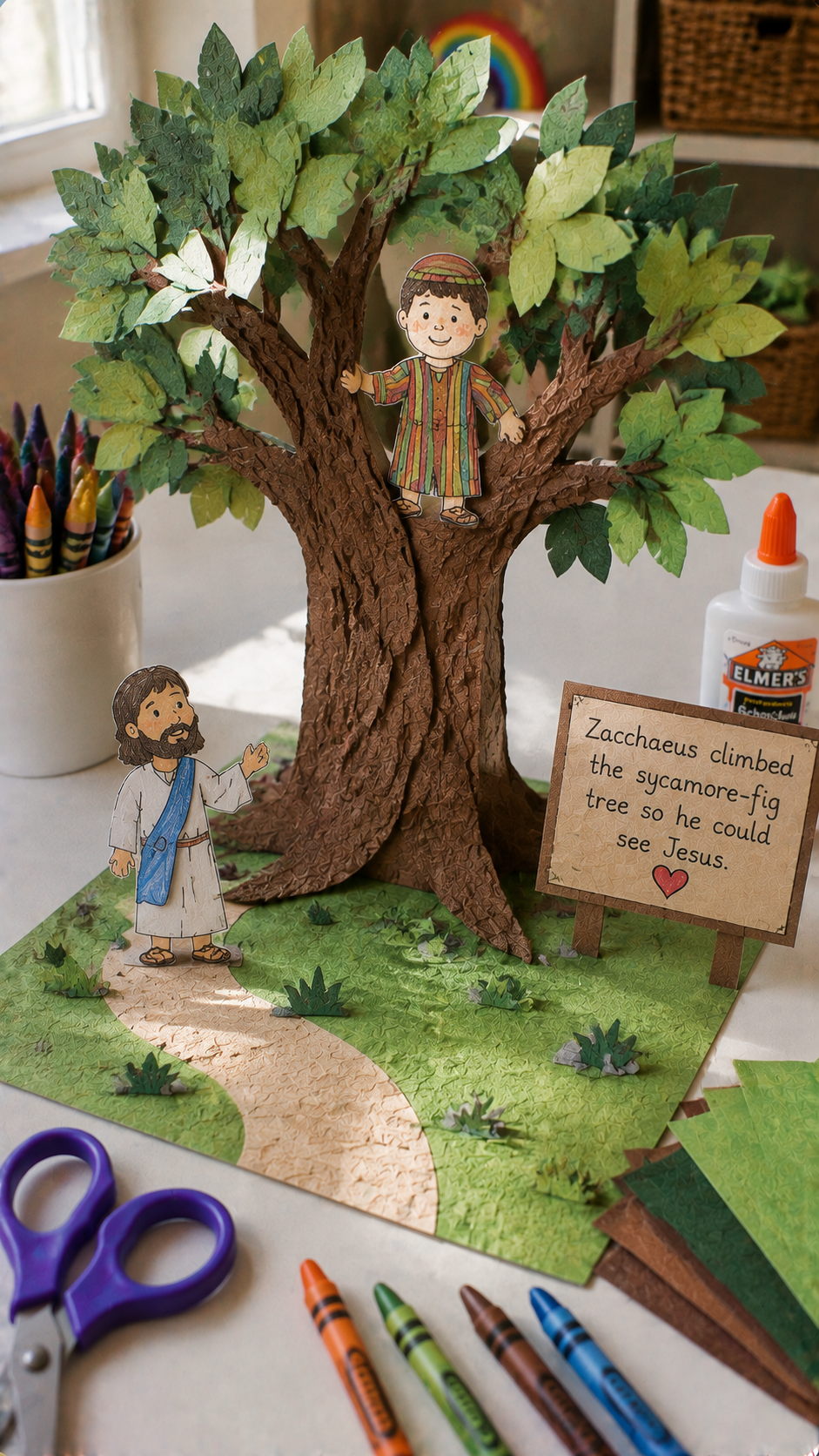
The tree is the detail most children remember from Zacchaeus’ story, so this craft can use it to teach something more precise than simply “Zacchaeus climbed a tree.”
Luke tells us that Zacchaeus wanted to see Jesus but could not see over the crowd because he was short. He therefore ran ahead and climbed a sycamore-fig tree because Jesus was coming that way.
What You Need
- Brown cardstock or construction paper
- Green construction paper
- Cardboard for the base
- Scissors
- Glue
- Markers or crayons
- Small piece of cardstock for Zacchaeus
- Paper fastener or a narrow strip of cardstock
How to Make It
- Cut a wide tree trunk from brown cardstock and attach it to the cardboard base.
- Cut several branches and glue them near the top of the trunk.
- Cut green leaves in different sizes and add them to the branches to create a simple sycamore-fig tree.
- Make a small Zacchaeus figure from cardstock and draw simple clothing and facial features.
- Attach Zacchaeus to a paper fastener or cardstock strip so he can be moved up and down the tree.
- Add a simple road underneath and place a small paper figure of Jesus farther along it.
- Write “He wanted to see Jesus” on a small paper sign beside the scene.
What Children Can Learn
The important detail is why Zacchaeus climbed the tree. The Bible does not say that he climbed it because he was hiding, embarrassed, or trying to avoid the crowd. It gives a straightforward reason: he wanted to see Jesus, but the crowd blocked his view.
That distinction is worth pointing out because children often remember the action without remembering the reason behind it.
As you make the craft, ask:
“What problem was Zacchaeus trying to solve?”
Then let the child explain it in their own words.
The answer is not simply, “He wanted to climb a tree.” He wanted to see Jesus and found a way to do that when he couldn’t see from where he was standing.
That makes this one of the more meaningful Zacchaeus crafts because the child is learning to look beyond the most memorable picture in the story and notice the detail that explains why the picture happened in the first place.
Bring some nature-inspired creativity into craft time with Sunflower Crafts for Kids: The Suncatcher and 14 More Easy Ideas They’ll Beg to Make Again.
4. The Jesus Saw Him Name Reveal Craft
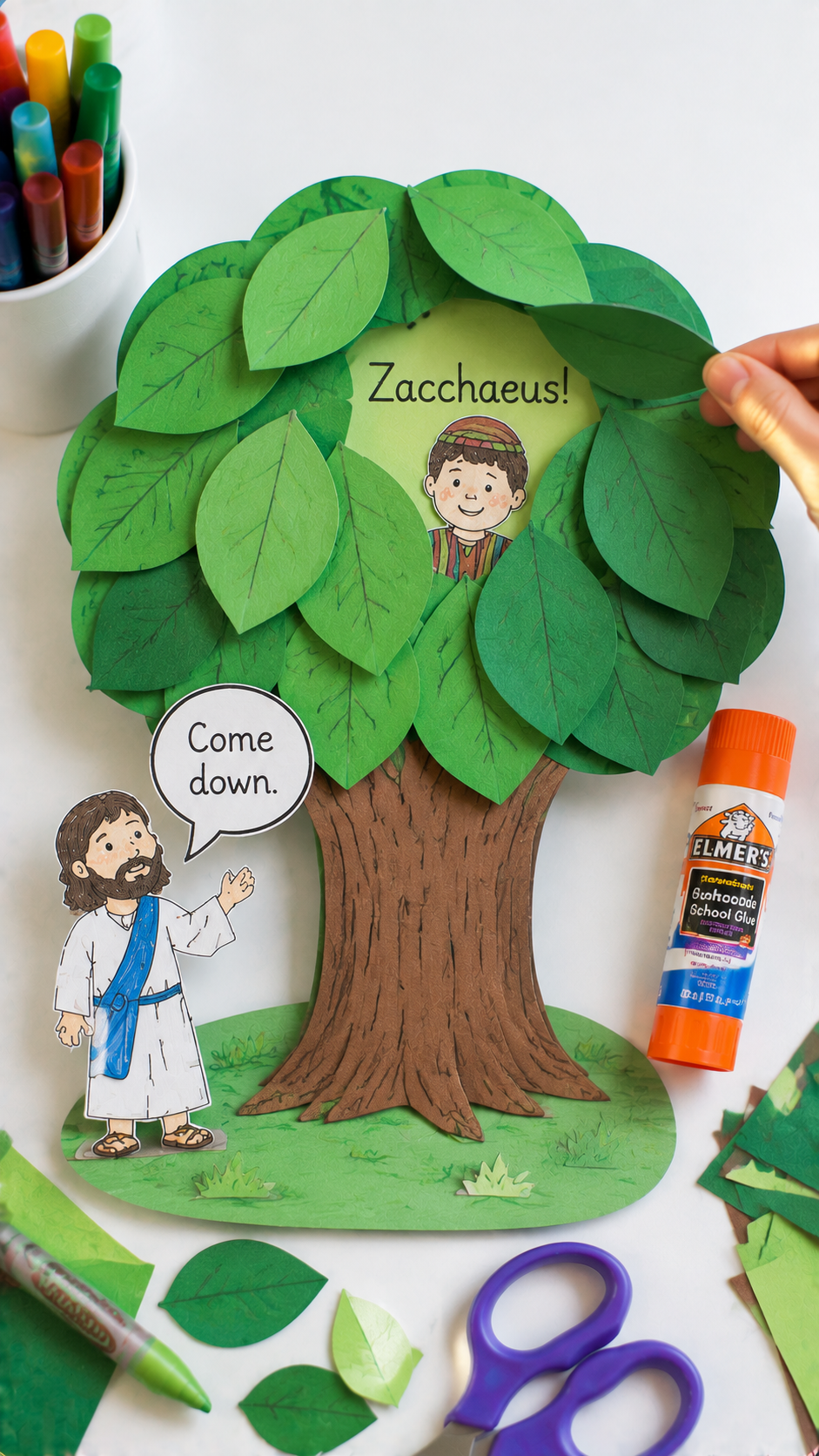
Zacchaeus climbed the tree because he wanted to see Jesus. But the next part of the story changes the direction of the scene: Jesus saw Zacchaeus too. Luke says Jesus looked up, called him by name, and told him to come down because he intended to stay at his house that day.
Zacchaeus then came down and welcomed him gladly.
This makes a simple name-reveal craft meaningful: the child starts by looking for Zacchaeus, then discovers that Jesus already knew where he was.
What You Need
- Green cardstock or construction paper
- Brown cardstock
- Flesh-toned or colored paper for the figure
- Scissors
- Glue
- Markers or crayons
- A small paper flap or leaf-shaped pieces
- Paper fastener, optional
How to Make It
- Cut a simple tree trunk and branches from brown cardstock.
- Add several green paper leaves, but leave one larger section loose so it can work as a flap.
- Make a small Zacchaeus figure and place him among the branches.
- Cover Zacchaeus partly with the leaves.
- On the flap, write “Who is Jesus looking for?”
- When the child lifts the leaves, reveal Zacchaeus with his name underneath: “Zacchaeus!”
- Add a small speech bubble beside Jesus that says “Come down.”
What Children Can Learn
The point is not simply that Jesus could see Zacchaeus in the tree. Jesus addressed him personally. The story moves from Zacchaeus trying to see Jesus to Jesus stopping, looking up, and calling Zacchaeus down.
That gives parents and teachers a useful question to ask:
“What happened after Jesus noticed Zacchaeus?”
Children can follow the story: Zacchaeus came down and welcomed Jesus, and the encounter continued at his house.
This also helps avoid a common shortcut in Zacchaeus crafts, turning the story into only “Jesus saw a little man in a tree.”
The tree gets Zacchaeus into the scene, but the encounter between Jesus and Zacchaeus is what moves the story forward.
Put those broken crayons to use with Melted Crayon Art for Kids: What to Do With Broken Crayon Pieces.
5. The Open-Door House Craft
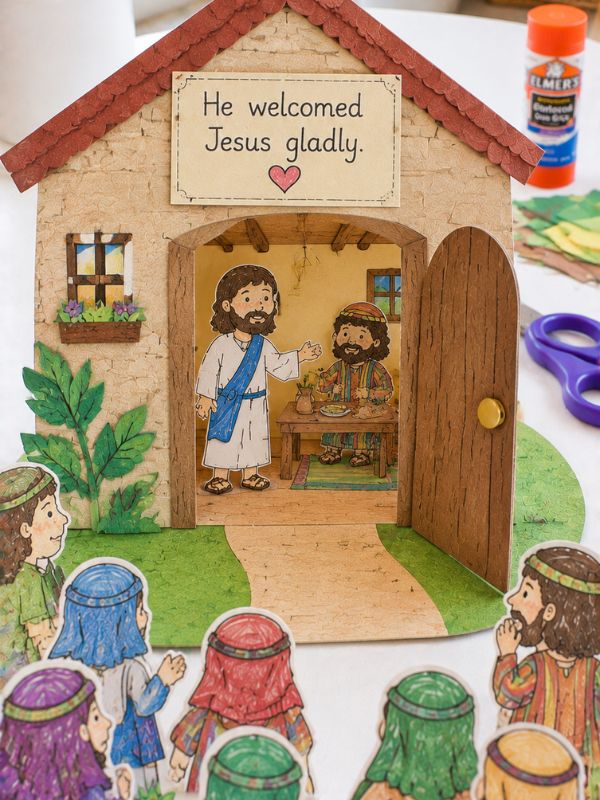
The tree gets most of the attention, but Zacchaeus’ story doesn’t end when his feet touch the ground. Jesus tells him that he intends to stay at his house, and Zacchaeus welcomes him gladly.
The crowd, however, reacts very differently and complains that Jesus has gone to stay with a sinner.
An opening-door house craft lets children see that contrast without turning it into a vague lesson about “being nice.”
What You Need
- Cardstock or construction paper
- Scissors
- Glue
- Markers or crayons
- Small paper figures of Jesus and Zacchaeus
- Optional: paper fastener
How to Make It
- Fold a piece of cardstock in half.
- Draw a simple house on the front.
- Cut three sides of a rectangle to create a door that opens and closes.
- Write “Zacchaeus’ House” above the door.
- Inside, glue a small table and two simple paper figures representing Jesus and Zacchaeus.
- On the outside, add a few paper figures representing the crowd.
- On the inside of the door, write: “He welcomed Jesus gladly.”
What Children Can Learn
There are two very different responses in this part of the story.
Zacchaeus welcomes Jesus, while the crowd grumbles about Jesus being a guest in the home of someone they regarded as a sinner.
This gives you a chance to talk about judging someone by their reputation without pretending that the Bible says Zacchaeus was innocent of wrongdoing.
Luke later records Zacchaeus speaking openly about giving to the poor and repaying anyone he had cheated.
Ask:
“Why do you think the crowd was surprised that Jesus went to Zacchaeus’ house?”
Then let the child look back at the story rather than giving them a quick, ready-made answer.
The house becomes more than a paper building. It helps children notice that Jesus’ decision to enter Zacchaeus’ home was the moment that made the crowd react, and that Zacchaeus’ response did not stop at simply welcoming a guest.
Add an early-learning element with Train Craft Ideas for Kids That Make Learning the Alphabet Fun With Things You Already Have.
6. The Half of My Possessions Giving Pocket
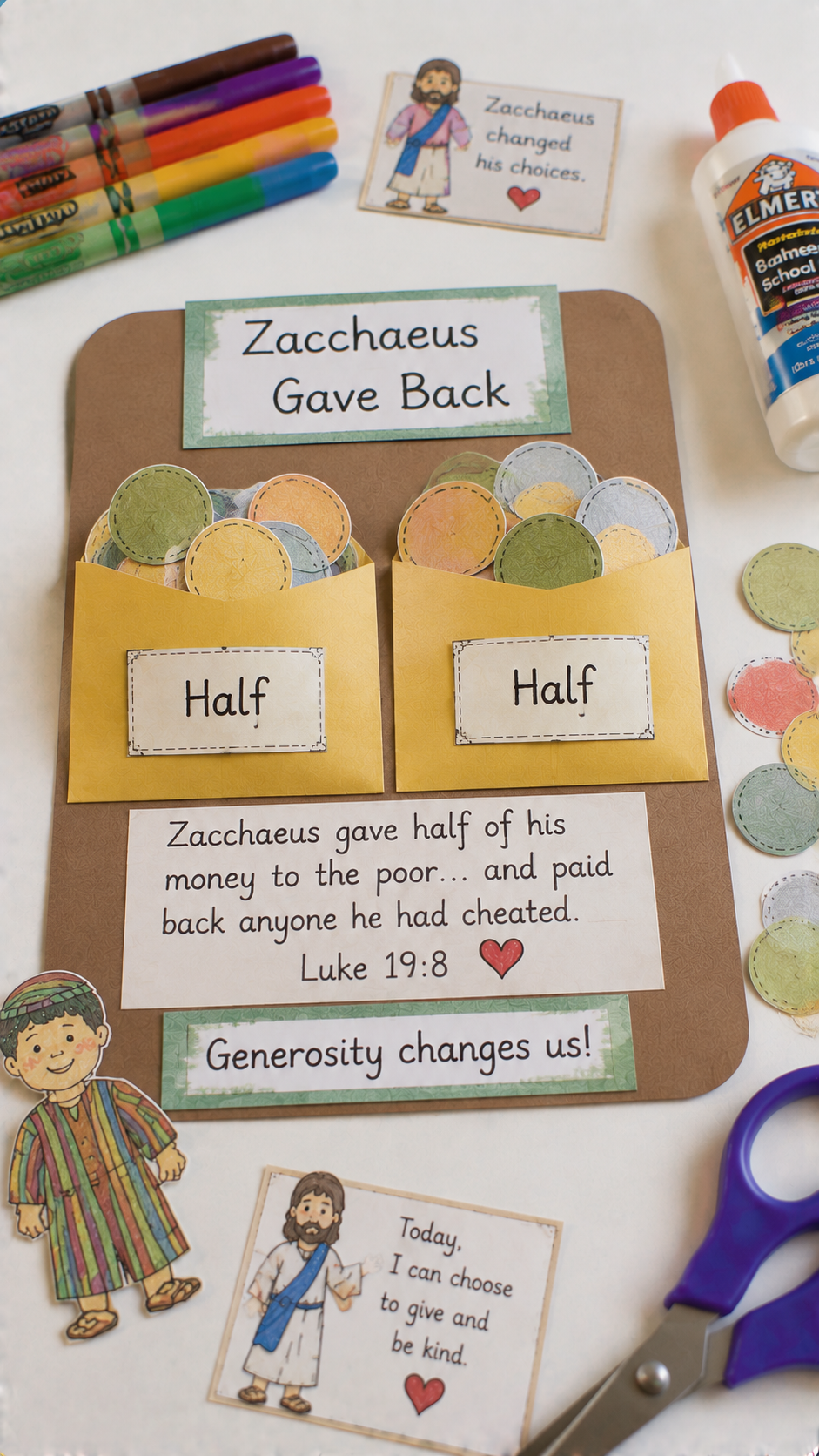
Zacchaeus’ response to Jesus was not described only in terms of feelings. Luke records a very specific decision about his possessions: he said he would give half of what he had to the poor.
This craft turns that detail into something children can actually see and discuss, without reducing it to a simple “sharing is good” lesson.
What You Need
- Two sheets of cardstock
- Colored paper for the coins
- Scissors
- Glue
- Markers or crayons
- Ruler, optional
How to Make It
- Fold one sheet of cardstock in half to make a simple pocket.
- Glue along the two sides and bottom, leaving the top open.
- Cut several paper coins and place them inside.
- Draw a line down the front of the pocket to divide it into two sections.
- Label one side “Half” and the other “Half.”
- Write “Zacchaeus’ response” across the top.
- Let the child remove the paper coins and physically divide them into two groups.
What Children Can Learn
This is a good opportunity to explain that the passage is not simply saying Zacchaeus decided to share his toys or give away a few spare coins. He was talking about half of his possessions and specifically mentioned giving to the poor.
You can ask:
“Why do you think the story tells us exactly what Zacchaeus planned to do with his possessions?”
The answer should come from the passage itself: his response involved a significant change in how he intended to use his wealth.
Also make an important distinction for children: having money is not presented as the sin in this story. Luke tells us Zacchaeus was wealthy; the significant detail is what he said he would do with his possessions after his encounter with Jesus.
For an easy process-art activity, try Bubble Wrap Painting: The Easy Texture Trick That Turns Bored Kids Into Little Artists.
7. The Make It Right Fourfold Repayment Craft
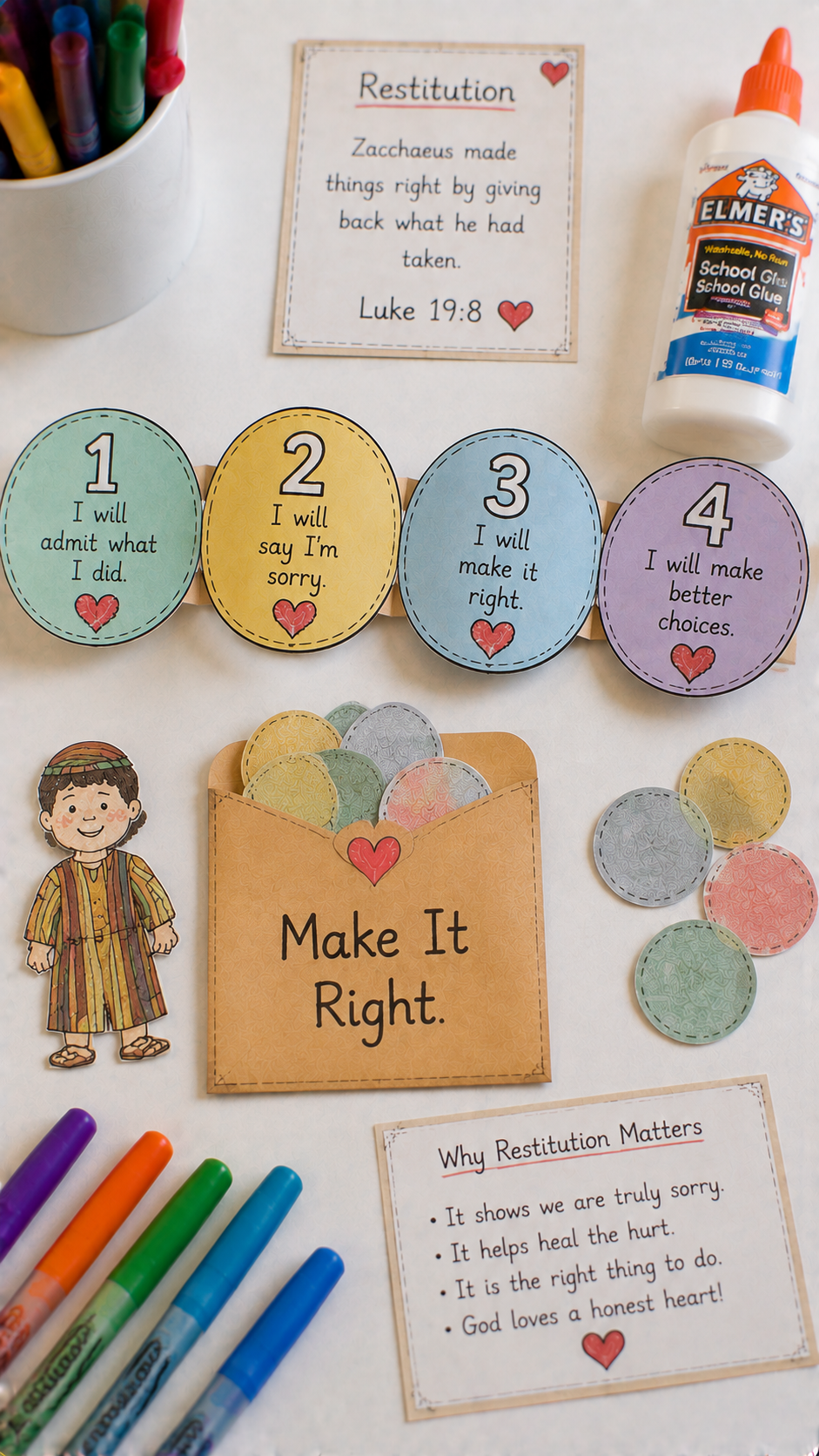
This may be the most important craft in the post because it introduces a word children may hear but not fully understand: restitution.
Zacchaeus said that if he had cheated anyone, he would pay back four times the amount. Luke records this as part of his response to Jesus.
Rather than simply telling children that Zacchaeus “became good,” this craft lets them examine what making things right can actually involve.
What You Need
- Cardstock or construction paper
- Scissors
- Glue
- Markers
- Four small paper circles for each example
- A small envelope or paper pocket
How to Make It
- Cut four large paper circles to represent four coins.
- Write “What was taken” on the first circle.
- Write “1”, “2”, “3”, and “4” across the four circles.
- Glue the circles together in a row or attach them with a paper fastener so they can open like a small accordion.
- Add a paper pocket underneath labelled “Make It Right.”
- Put the four paper coins inside the pocket when the craft is finished.
What Children Can Learn
Explain restitution in simple language:
Restitution means trying to repair the harm caused by a wrong, often by returning what was taken or replacing what was lost.
Zacchaeus did not merely say, “I’m sorry.” He specifically said he would repay four times what he had taken from anyone he had cheated.
Give children a simple example:
“If you take something that belongs to someone else, saying sorry does not make the object magically come back. Making things right may mean returning it.”
Then make an important distinction: don’t teach children that every wrong must automatically be repaid four times. The fourfold repayment is the particular commitment Zacchaeus makes in this passage.
And don’t claim that Luke gives us a list of everyone Zacchaeus had cheated. The text simply records Zacchaeus’ statement that if he had cheated anyone, he would repay four times.
That detail makes the craft more than a lesson about saying sorry. It helps children see that when we have caused harm, taking responsibility can sometimes mean doing something concrete to repair it.
Help children explore art and culture with 12 African Art Projects for Kids That Teach Culture, Not Just Craft.
8. The What Changed? Zacchaeus Story Board
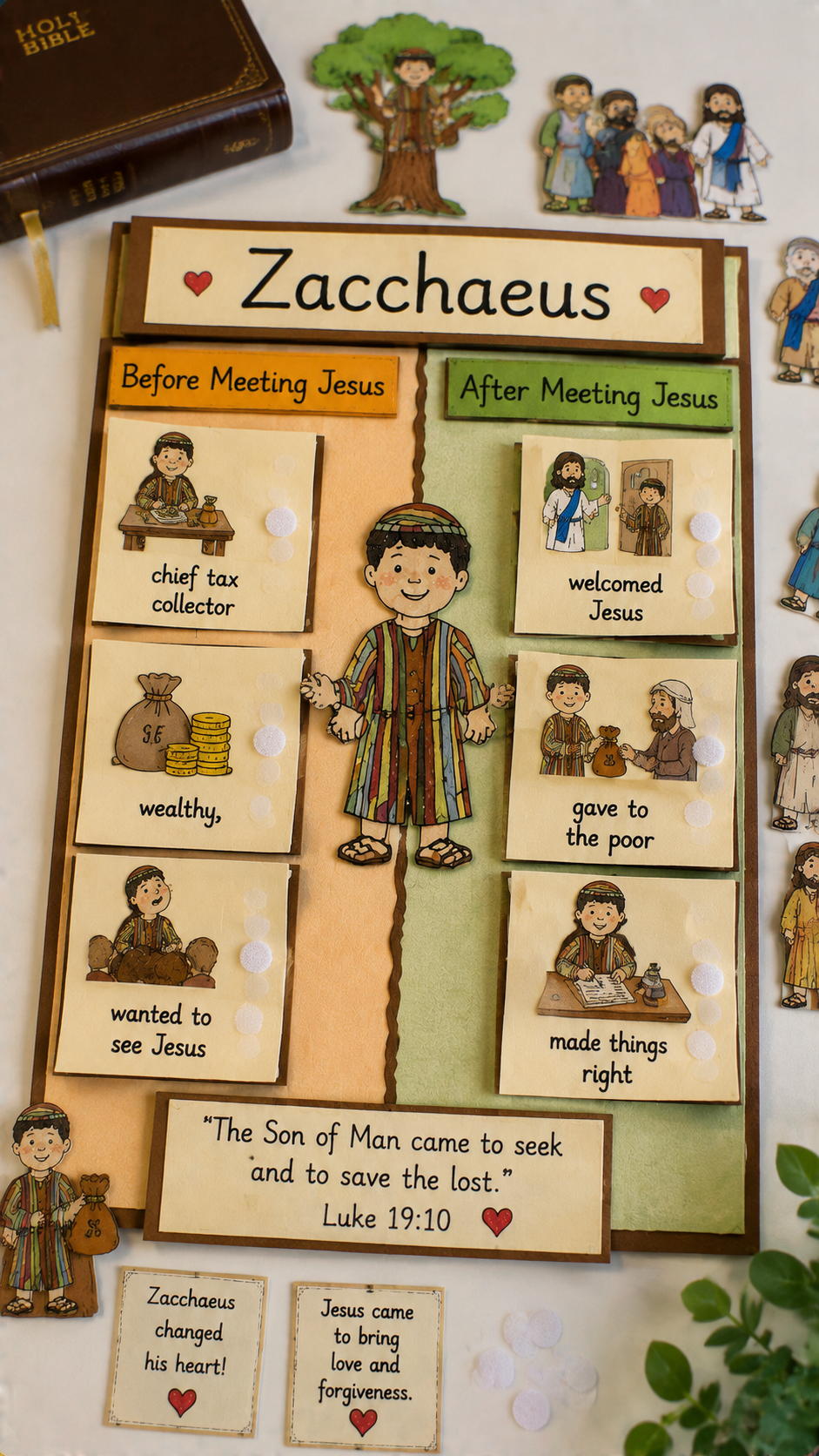
After making the tree, the house, and the money crafts, it can be tempting to sum up Zacchaeus by simply saying, “He changed.” But Luke 19 gives us something more useful: specific things Zacchaeus said and did.
This final Zacchaeus craft brings those details together so children can separate what the Bible actually tells us from assumptions we sometimes add to the story.
What You Need
- A sheet of cardstock
- Colored paper
- Scissors
- Glue
- Markers or crayons
- Small paper pieces for the story details
- Optional: reusable adhesive or Velcro dots
How to Make It
- Divide the cardstock into two sections.
- At the top, write “Zacchaeus: What We Know”.
- On separate paper pieces, write facts from Luke 19:
- Chief tax collector
- Wealthy
- Wanted to see Jesus
- Climbed a sycamore-fig tree
- Welcomed Jesus
- Promised to give half his possessions to the poor
- Promised fourfold repayment to anyone he had cheated
- Mix the pieces up and let the child place each one on the board.
- Add a final question at the bottom:
“What do his choices tell us?”
What Children Can Learn
This activity teaches children to look at a Bible story carefully instead of remembering only its most famous picture.
Zacchaeus is remembered for the tree, but the passage gives us several other details that matter.
His encounter with Jesus was followed by specific statements about his possessions and how he would respond to people he had cheated. Jesus then declared that salvation had come to his house and spoke about his mission to seek and save the lost.
As children arrange the pieces, ask:
“Which part of Zacchaeus’ story surprised you most?”
There is no need to force a particular answer. The goal is to help them notice that a Bible story can contain more than the detail they first remember.
That is what makes these Zacchaeus crafts more meaningful: the child isn’t only recreating a scene from Luke 19—they are learning to pay attention to what the passage actually says and what Zacchaeus actually chose to do.
For another hands-on sensory activity, Safe and Easy Slime Craft Ideas for Kids — Non-Toxic Projects That Keep Them Busy for Hours offers more ideas.
Conclusion
The tree may be the part children remember first, but Zacchaeus’ story doesn’t end there. His encounter with Jesus opens up bigger conversations about reputation, wealth, responsibility, and making things right.
These Zacchaeus crafts give children something they can see and handle while thinking about those details in a way that goes beyond simply making a paper tree.
Choose the craft that fits your child’s age or lesson, gather a few simple supplies, and let the conversation grow naturally as you make it together.
Sometimes the best Bible lesson begins with a small question asked around the craft table.
Add a colorful nature-themed project with Coffee Filter Butterfly Craft for Kids.
For a low-mess material that offers plenty of possibilities, see 13+ Pipe Cleaner Crafts for Kids That Are Simple, Fun, and Completely Mess-Free.
FAQs
-
What was a chief tax collector in Zacchaeus’ time?
A chief tax collector was a person who held a senior position in the tax-collection system under Roman rule. Luke also tells us that Zacchaeus was wealthy. The passage does not explain exactly how he accumulated his wealth, so it is better not to automatically describe all of it as stolen money.
-
Was Zacchaeus a thief?
Luke does not simply call Zacchaeus a thief. He identifies him as a chief tax collector and records Zacchaeus saying that, if he had cheated anyone, he would repay four times what he had taken. That distinction matters when teaching the story accurately.
-
Why did Zacchaeus offer to give half his possessions to the poor?
Luke presents this as part of Zacchaeus’ response during his encounter with Jesus. He said he would give half his possessions to the poor and make fourfold repayment to anyone he had cheated. The passage does not give a separate explanation for why he chose exactly half.
-
What does “pay back four times” mean in the Zacchaeus story?
It means Zacchaeus said he would repay four times the amount he had taken from anyone he had cheated. It is a specific commitment Zacchaeus made in this account, not a statement that Christians must always repay every wrong fourfold.
-
Did Jesus approve of what Zacchaeus had done?
The passage does not say that Jesus approved of Zacchaeus’ past actions. Instead, Jesus chose to enter his home, while Zacchaeus responded by describing concrete steps involving his wealth and people he said he had cheated. Jesus then declared that salvation had come to his house.
-
What does Zacchaeus’ story teach children about making things right?
It shows that taking responsibility can involve more than saying “sorry.” Zacchaeus’ response included giving to the poor and promising to repay people he had cheated. That gives children a concrete example of repairing harm rather than only expressing regret.