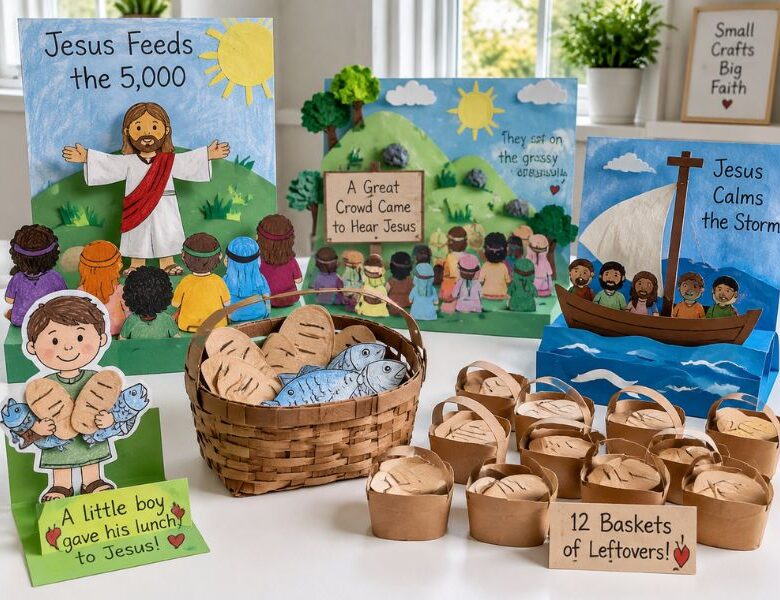
What can a child do with five loaves and two fish when thousands of hungry people are waiting for food?
That question sits at the heart of the Feeding of the 5,000, and it gives these crafts somewhere to go beyond the usual bread-and-fish cutouts.
The story has details worth stopping over: a boy carrying the food, five barley loaves, Philip worrying about the cost of feeding the crowd, people being arranged in groups, and twelve baskets of pieces gathered after everyone had eaten.
Those details make room for crafts that let children count, piece together the story, spot Bible facts, and see what actually happened rather than simply making something that looks like bread and fish.
The ten ideas below take their starting point from the Gospel accounts, with simple projects for turning those details into something children can make and talk about while learning the story.
Zacchaeus is more than the familiar man in the tree, and Creative Zacchaeus Crafts: More Than Just a Man in a Tree gives children more ways to connect with his story.
What Each Gospel Tells Us About the Feeding of the 5,000
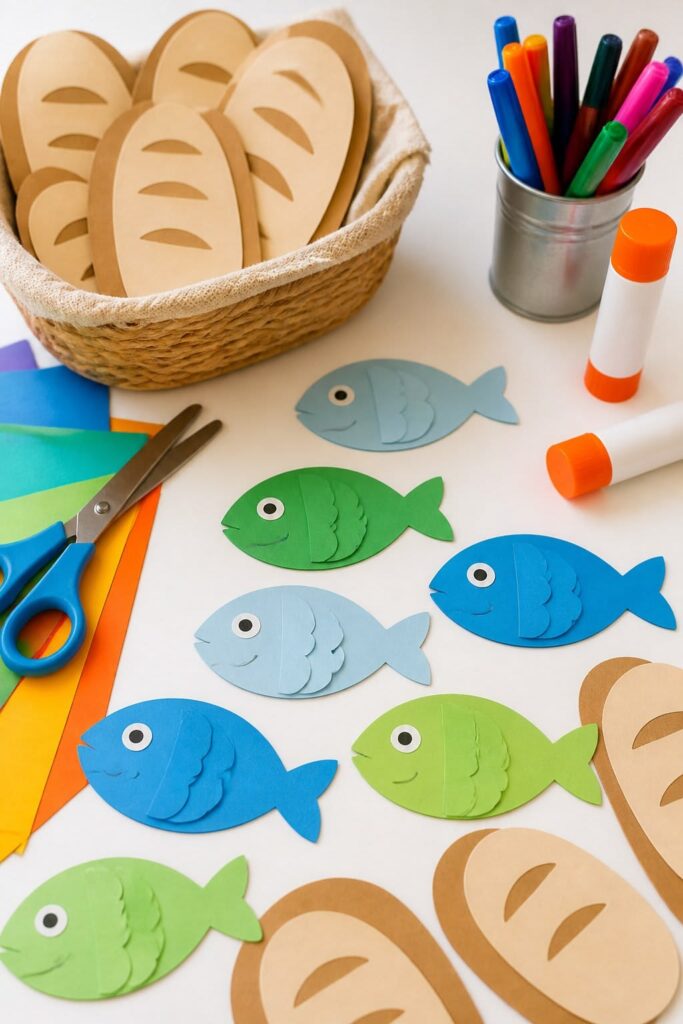
Reading the four accounts before starting a Five Loaves and Two Fish craft can clear up a few details that are easy to mix together. Matthew, Mark, Luke, and John all record the Feeding of the 5,000, but each account gives the reader something slightly different to notice.
Matthew 14:13–21 tells us that Jesus saw the large crowd, healed their sick, and later fed them.
>Matthew also says about 5,000 men ate, besides women and children.
So it is more accurate to say that about 5,000 men were counted than to teach children that exactly 5,000 people were there.
Mark 6:30–44 gives a useful detail for children who enjoy counting and arranging things. Before the food was distributed, the people were seated in groups of hundreds and fifties.
Mark also describes the setting as green grass, giving a little more detail about what the scene looked like.
Luke 9:10–17 also describes the crowd being seated in groups, this time as about fifty.
Luke places the event near Bethsaida and includes the disciples’ concern about finding enough food for the crowd.
John 6:1–15 gives several details that are especially useful for five loaves and two fish crafts for kids. John tells us that a boy had the food, that the five loaves were barley loaves, and that there were two fish.
Philip is also the disciple who considers the cost of buying enough bread, while Andrew points out the boy’s small supply. After everyone has eaten, Jesus tells the disciples to gather the remaining pieces so that nothing is lost.
That means a craft based on this Bible story does not have to stop at making bread and fish.
The boy, barley loaves, crowd arrangements, Philip’s calculation, and twelve baskets of leftovers are all real details from the Gospel accounts that can give children something specific to make, count, arrange, or discuss.
Bring the Christmas story to life with 12 Nativity Crafts That Walk Kids Through the Story of Jesus’ Birth, at Home or Sunday School.
Five Loaves and Two Fish Crafts
1. Across the Sea: Feeding of the 5,000
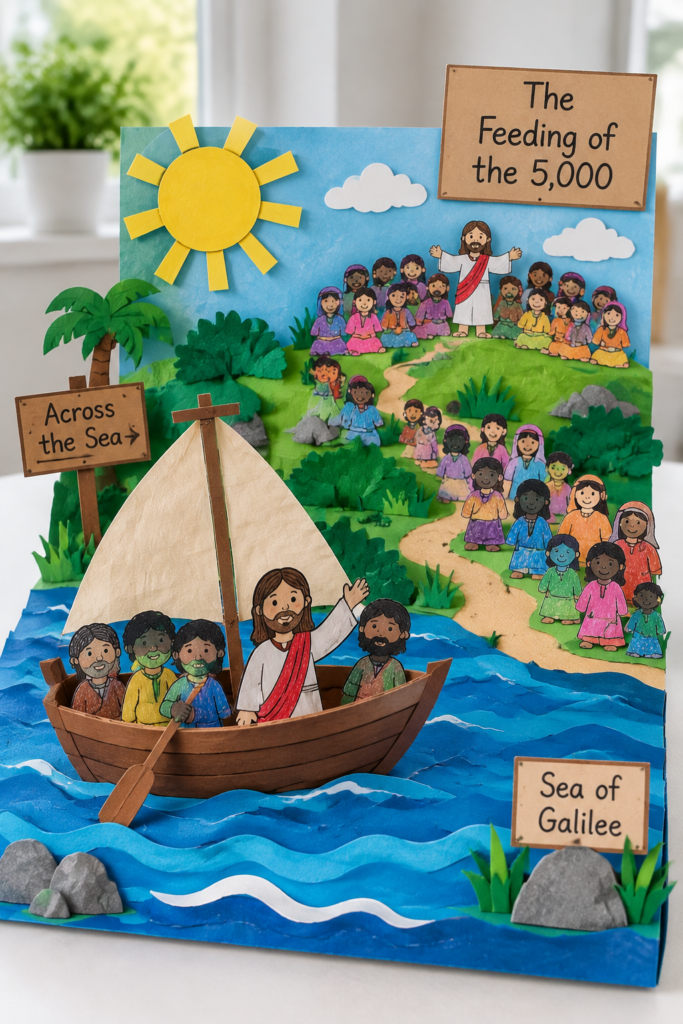
John opens the story with a journey. Jesus crossed to the other side of the Sea of Galilee, and a large crowd followed him because they had seen the signs he did for the sick.
Matthew and Mark add how everyone travelled: Jesus went by boat, and the crowd went on foot and got there ahead of him.
In this craft, children build a shoebox scene with water, a boat, a path for the crowd, and a grassy hillside.
Ages: 6 to 10.
Materials
- A shoebox or shallow cardboard box
- Blue paper for the water
- Green paper for the grass
- Brown paper or cardstock for the hillside
- Cardstock for a small boat and paper people
- Glue, scissors, markers or crayons
- Optional: torn paper scraps for the shoreline
How to Make It
- Turn the box on its side so the inside becomes the scene.
- Cover the front third of the floor with blue paper. Label it “Sea of Galilee.” John also calls it the Sea of Tiberias, so add that name in smaller letters.
- Cover the rest of the floor with green paper for the grass.
Fold or layer brown cardstock against the back wall to make a hillside, and label it “hillside.” - Cut out a small paper boat and set it on the water. Matthew and Mark say Jesus and the disciples went by boat.
- Make a path from a narrow paper strip that leads from the edge of the scene toward the hillside.
Add a row of paper people walking along it. Matthew says the crowds followed on foot from the towns, and Mark says they got there ahead of Jesus. - Place a small paper figure with a few smaller ones on the hillside.
John says Jesus went up on the mountain and sat down with his disciples, and then he looked up and saw a large crowd coming toward him. - Read John 6:1–5, then Mark 6:32–34 if you want the boat and the crowd on foot.
- Tell the children this is a model, not a map, and that the Gospels don’t give enough detail to rebuild the exact place.
What Children Learn
- John says Jesus crossed to the other side of the Sea of Galilee, which John also calls the Sea of Tiberias.
- The crowd followed because they had seen the signs Jesus did for the sick.
- Jesus and his disciples went by boat, and the crowd went on foot and arrived first.
- John notes that the Passover was near, and that there was plenty of grass.
Talk About
- “What two names does John give the water?” (The Sea of Galilee and the Sea of Tiberias.)
- “Why did the crowd follow Jesus?” (They had seen the signs he did for the sick.)
- “How did Jesus travel, and how did the crowd travel?” (Jesus went by boat, and the crowd went on foot.)
- “Is this an exact picture of the place?” (No. It is a simple model based on the details the Gospels give.)
Esther’s story gives children plenty of moments to turn into hands-on lessons, from her crown to the events surrounding Purim, with Esther Craft Ideas: 13 Crafts That Retell Her Story for Kids, From Her Crown to Purim.
2. How Much Would It Cost?” Philip’s Bread Problem Craft
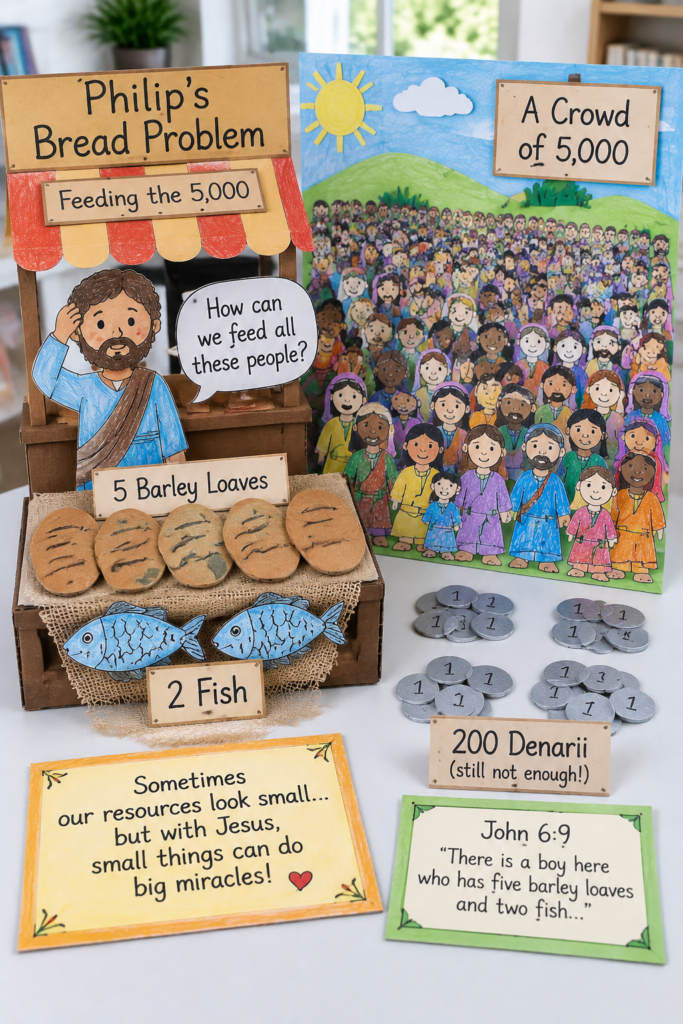
Feeding a crowd of about 5,000 men raised a practical question before anyone ate: where would enough bread come from?
In John 6:5–7, Jesus asks Philip where they could buy bread, and John explains that Jesus was testing him because he already knew what he was going to do. Philip answers that 200 denarii worth of bread would not be enough for everyone to have even a little.
Mark also records the disciples mentioning 200 denarii when they question whether enough bread can be bought for the crowd.
The exact price of bread is not given, so this craft does not try to invent one.
Instead, children use 200 pretend denarii to see the size of the amount Philip was talking about, then compare it with the size of the crowd.
Ages: 7–11. Younger children can make and count the coin cards, while an adult can lead the discussion about the numbers.
Materials
- A table or cardboard box for a pretend bread stall
- Paper sign marked “BREAD”
- 20 index cards or paper rectangles
- Brown or tan paper for five loaf tokens
- Paper for two fish tokens
- A large sheet of paper for the crowd
- Pencil, markers and scissors
How to Make It
- Set up the cardboard box or table as a pretend bread stall and add the “BREAD” sign.
- Make 20 coin cards. Draw 10 circles on each card and label each card “10 denarii.” Together, the 20 cards represent 200 denarii, the amount Philip mentioned.
- On the large sheet of paper, write “About 5,000 men, plus women and children.” Matthew gives this fuller description of the crowd, so it is better not to describe the crowd as exactly 5,000 people.
- Let the children count all 20 cards and confirm that they represent 200 denarii. Explain that the Bible does not tell us how much one loaf of bread cost, so there is no need to make up a price for the activity.
- Place the five barley-loaf tokens and two fish tokens beside the stall. Read John 6:8–13 and point out that John identifies these as the food brought forward.
- Ask the children to compare the two situations: Philip was thinking about how much money would be needed to buy food for the crowd, while John later records the small amount of food that was actually available.
What Children Learn
- Jesus asked Philip where bread could be bought for the crowd and John says He did this to test him.
- Philip estimated that 200 denarii worth of bread would not be enough for everyone to have even a little.
- Mark also records the disciples mentioning 200 denarii when discussing the cost of feeding the crowd.
- A denarius is used in the New Testament in connection with a day’s wage for a laborer, although the Bible does not give a modern currency equivalent for the 200 denarii in this story.
- John identifies the food as five barley loaves and two fish.
Talk About
- “Why did Jesus ask Philip where they could buy bread?”
John says Jesus was testing Philip because He already knew what He was going to do. - “What did Philip say about 200 denarii?”
He said that amount of bread would not be enough for everyone to have even a little. - “What food did they actually have?”
John says there were five barley loaves and two fish. - “What happened to the food?”
Jesus gave thanks and distributed it to the people, and everyone ate as much as they wanted.
That question about why everyone else kept walking past is a natural opening for 7 Good Samaritan Craft Ideas for Kids Who Ask “Why Didn’t Anyone Else Stop?”.
3. Five Loaves and Two Fish Craft
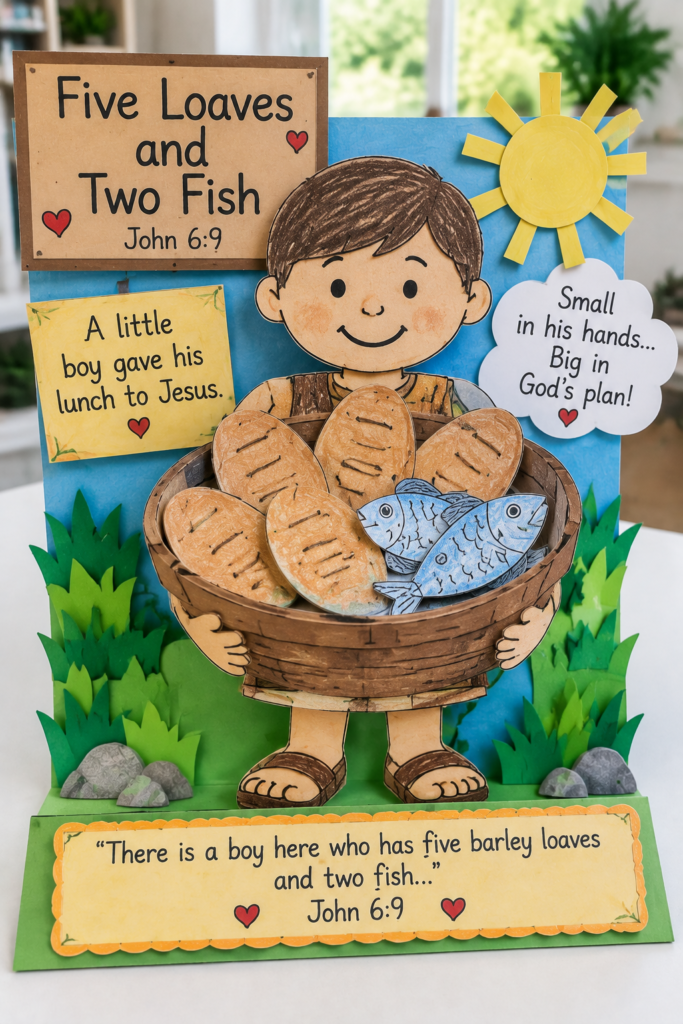
John 6:8–9 gives children something very concrete to make: five barley loaves and two fish.
John also tells us that a boy had the food, and Andrew pointed it out to Jesus. Mark 6:38 adds that Jesus asked the disciples to find out how many loaves they had.
For this craft, children make five loaves and two fish from paper and arrange them on a decorated cardstock mat.
Add simple Bible facts around the food as children read the passage. The finished mat gives them a clear picture of the small amount of food mentioned at the beginning of the story.
Ages: 5–9. Younger children can make the loaves and fish while an adult writes the labels.
Materials
- One sheet of light cardstock
- Brown or tan paper for the loaves
- Gray, silver, or colored paper for the fish
- Scissors
- Glue
- Markers or crayons
How to Make It
- Fold the cardstock in half like a book. Label the left side “What the Bible says” and the right side “What the Bible doesn’t say.”
- Cut out five loaves and two fish.
For a simple visual, children can trace a hand to create each fish shape, but explain that this is only a craft representation, not the actual size of the fish in the Bible. - Glue the five loaves and two fish on the left side. Add the label: “5 barley loaves and 2 fish — John 6:9.” Some Bible translations describe the fish as “small,” while others simply say “two fish.”
- Under the food, write: “Andrew told Jesus about a boy who had the food. — John 6:8–9.”
- Add another card or label: “Jesus told the disciples to go and see how many loaves they had. — Mark 6:38.”
- On the right side, draw four large question marks. Beside them, write:
- How large were the loaves?
- What kind of fish were they?
- Why did the boy have the food?
- What did the boy say?
- Read John 6:8–9 and Mark 6:38 together. Ask children to point to the details that come directly from the passages and the questions Scripture does not answer.
What Children Learn
- John records five barley loaves and two fish and identifies a boy as the person who had the food.
- Andrew was the disciple who brought the boy and his food to Jesus’ attention.
- Andrew questioned what such a small amount could do among such a large crowd.
- Mark records Jesus telling the disciples to check how many loaves they had.
- The Bible does not give the boy’s name, age, reason for carrying the food, or what he said.
- Scripture also does not give the exact size of the loaves or identify the species of fish.
Where translations differ over whether the fish are described as “small,” it is better not to turn that translation detail into an exact measurement.
Talk About
- Who told Jesus about the food? Andrew.
- Who had the food? A boy, according to John’s account.
- How many loaves were there? Five.
- What kind of bread were they? Barley loaves.
- How many fish? Two.
- What did Andrew wonder? How such a small amount could serve so many people.
- What did Jesus tell the disciples to do in Mark’s account? Go and see how many loaves they had.
- What details does the Bible leave unanswered? The boy’s name and age, why he had the food, what he said, the exact size of the loaves, and the type of fish.
Bible Passages: John 6:8–9; Mark 6:38.
Noah’s story has several parts worth slowing down for, and Noah’s Ark Crafts for Kids: 9 Ideas That Walk Through the Whole Story, One Craft at a Time follows those moments through craft projects.
4. Who Sat Where? Feeding the 5,000 Crowd Groups Craft
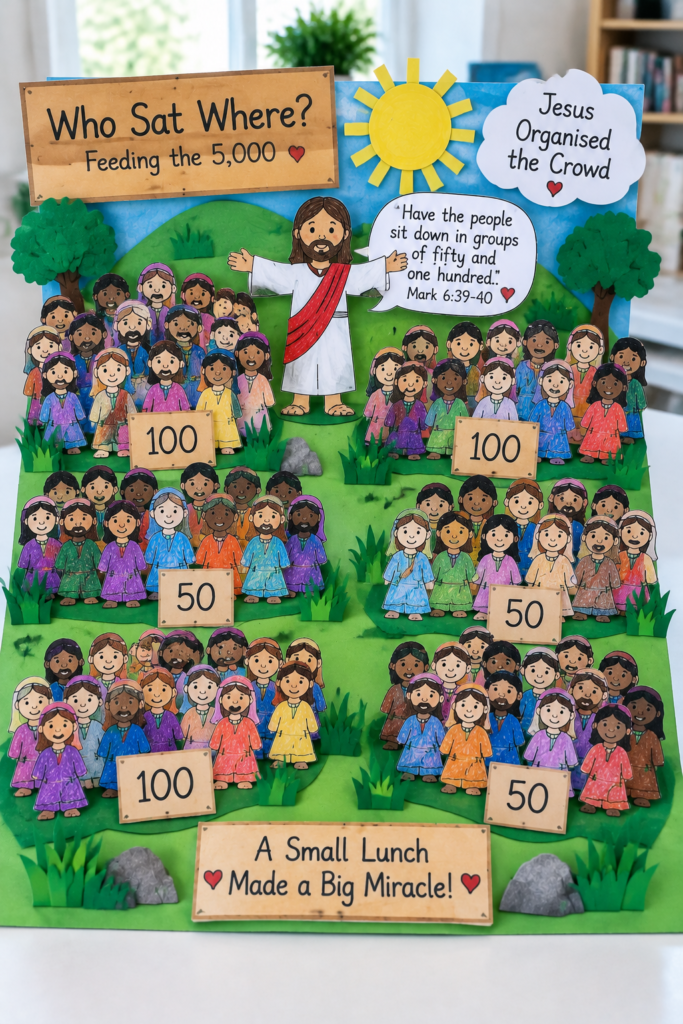
Before the food was distributed, the crowd was organized into groups. Mark 6:39–40 says Jesus told the people to sit down on the green grass in groups of hundreds and fifties.
Luke 9:14–15 describes groups of about fifty and says Jesus instructed the disciples to have the people sit down.
This Feeding of the 5,000 craft for kids turns that detail into a simple scale model.
Children arrange paper people into groups and use numbers to see how a very large crowd can be organized on a small sheet of paper.
Ages: 5–9. Younger children can make and glue the paper people. Older children can work with the group numbers.
Materials
- One large sheet of green paper for the grass
- About 35 small paper circles for the people
- Number cards marked 50 and 100
- Glue
- Scissors
- Markers
How to Make It
- Explain that one paper circle will stand for 10 men. This is only a scale for the craft; the circles do not represent the actual number of people in the crowd.
- Draw simple faces on the paper circles.
- Arrange five circles together and place the 50 card beside them. Explain that five circles represent 50 men at this scale.
- Arrange ten circles together and place the 100 card beside them. Make several groups of different sizes to represent the hundreds and fifties Mark mentions.
- Use the numbers to talk about the size of the crowd. Matthew records about 5,000 men, besides women and children.
Luke says the groups were about fifty each.
The craft is not an exact map of the crowd; it is a way to visualize how the people could be organized into smaller groups. - Read Mark 6:39–40 and Luke 9:14–15. Ask the children to find the details about the green grass, the groups and the disciples seating the people.
- Continue reading the story to see what happened after the people were seated: Jesus took the available food, gave thanks, and the disciples distributed it to the crowd.
What Children Learn
- Mark describes the crowd as being seated in groups of hundreds and fifties.
- Luke describes groups of about fifty.
- Matthew records about 5,000 men, while also noting women and children.
- The Gospel accounts do not give an exact seating map, so the paper model is a way to visualize the description rather than recreate the actual arrangement.
- A large crowd can be easier to organize when it is divided into smaller groups.
Talk About It
- “What group sizes does Mark mention?”
Hundreds and fifties. - “What does Luke say about the groups?”
They were about fifty each. - “Who told the disciples to have the people sit down?”
Jesus did. - “Does the Bible tell us exactly why the people were arranged in groups?”
No. The reason is not stated, so ideas about making the crowd easier to serve or manage should be presented as possibilities, not Bible facts.
Daniel’s experience in the lions’ den can lead to a meaningful Sunday School conversation alongside Daniel and the Lion’s Den Craft: A Sunday School Activity for Kids That Teaches Courage and Faith.
5. Took, Blessed, Broke, Gave: Table Blessing Card
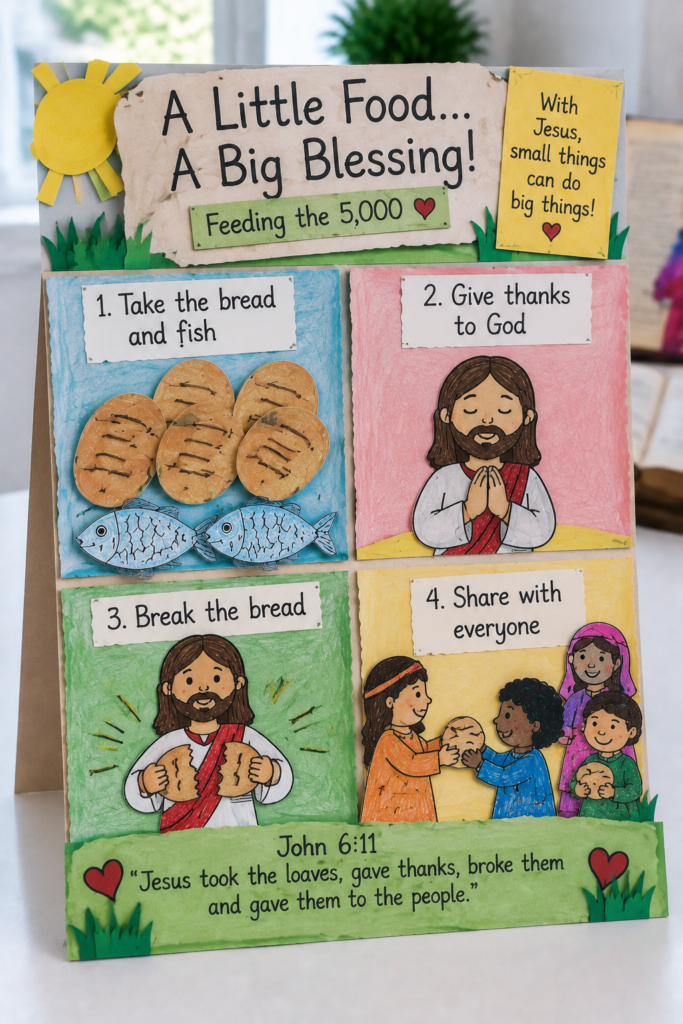
Before anyone ate, Jesus did four things with the food.
Mark says he took the five loaves and two fish, looked up to heaven, said a blessing, broke the loaves, and gave them to the disciples to set before the people, and he divided the two fish among them all. John says he gave thanks.
In this craft, children make a table card with those four actions on it, then use it at a real meal.
Ages: 4 to 9. Younger children can draw the pictures, and an adult can write the words.
Materials
- One sheet of light cardstock
- Markers or crayons
- Scissors
- Optional: stickers or a small scrap of brown paper for a loaf
How to Make It
- Fold the cardstock in half so it stands like a tent on the table.
- On the front, write four lines and leave room for a small drawing beside each: TOOK, BLESSED / GAVE THANKS, BROKE, GAVE.
Both “blessed” and “gave thanks” are on the card because the Gospels use both words. - Draw a picture for each line: five loaves and two fish, a face looking up, a loaf torn apart, and two hands passing bread along.
Don’t count the pieces in the torn loaf, because no Gospel says how many pieces there were. - Write “Matthew 14:19” at the bottom of the front.
- On the back, write: “The Bible doesn’t tell us Jesus’ words. Write your own thank-you:” and add two or three lines.
- At a family meal, read the four lines out loud. Then let the child say thanks in their own words.
What Children Learn
- The Gospels record four actions: took, blessed (or gave thanks), broke, and gave.
- Matthew says Jesus gave the loaves to the disciples, and the disciples gave them to the people. Jesus used helpers.
- The Gospels record that Jesus gave thanks. They don’t record what he said.
Talk About It
- “What was the first thing Jesus did with the loaves and fish?” (He took them.)
- “Who did he give the food to?” (The disciples, who passed it to the people.)
- “Do the Gospels tell us the words Jesus said when he gave thanks?” (No.)
- For older children: “Does this order of actions sound familiar?” Luke 22:19 describes the Last Supper with the same steps: he took bread, gave thanks, broke it, and gave it to them.
Present this as something the Bible’s wording shows, and leave the deeper meaning to your teaching.
Halloween can stay cute and playful without filling the room with creepy faces, thanks to Halloween Crafts for Kids Who Don’t Like Scary Decorations: 15 Cute Ideas Without the Creepy Stuff.
6. Twelve Baskets Left Craft
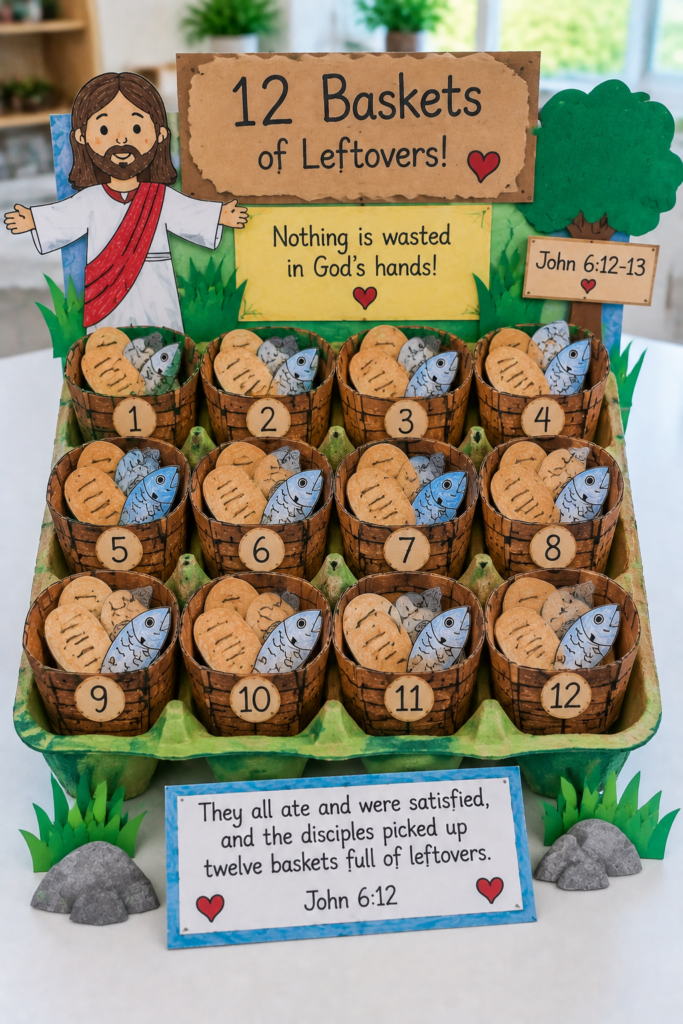
The crowd had eaten until everyone was satisfied, but the story did not end there. John 6:12 says Jesus told the disciples to gather the remaining pieces so that nothing would be lost.
When they collected them, they filled twelve baskets. Mark also records that the baskets contained pieces of fish.
For this five loaves and two fish craft for kids, a 12-cup cardboard egg carton becomes twelve small baskets.
Children fill each cup with paper pieces as they read the part of the Feeding of the 5,000 that happened after the meal.
Ages: 4–8. Younger children can paint, color and tear the paper, while an adult can handle the cutting and write the Bible reference.
Materials
- One clean, dry, empty 12-cup cardboard egg carton — not foam
- Brown or tan paint or markers
- Scrap paper in brown, tan and gray
- Scissors
- Glue
- One small index card
How to Make It
- Keep the egg carton whole so all twelve cups remain together. Paint or color the carton brown or tan.
- Draw simple criss-cross lines on the outside of the cups to give them a woven-basket look.
- Tear the scrap paper into small pieces. Use brown and tan for bread pieces and a little gray for fish pieces.
- Let the children place the paper pieces into the twelve cups. Each cup represents one basket. Count the cups together from one to twelve.
- Write this on the index card:
“Gather the pieces so that nothing would be lost. — John 6:12” - Place the card beside the egg-carton baskets and read John 6:12–13 and Mark 6:42–43 together.
- Ask the children what happened after everyone had eaten. Let them find the answer in the Bible rather than simply repeating the craft instructions.
What Children Learn
- Everyone ate and was satisfied, and food remained afterward.
- Jesus told the disciples to gather the remaining pieces so that nothing would be lost.
- John says the twelve baskets were filled with pieces of the five barley loaves.
- Mark also mentions pieces of fish in the baskets.
- The Gospels tell us that twelve baskets were filled, but they do not tell us how large the baskets were or how much each one contained.
Talk About It
- “Who told the disciples to gather the remaining pieces?”
Jesus. - “Why were they told to gather them?”
John says it was so that nothing would be lost. - “What did the baskets contain?”
John mentions pieces of the barley loaves, while Mark also mentions pieces of fish. - “How many baskets were filled?”
Twelve. - “Does the Bible tell us what the twelve baskets represented?”
No. It records the twelve baskets but does not give a symbolic meaning for the number.
Bible passages: John 6:12–13; Mark 6:42–43.
A sunny craft can brighten up an ordinary afternoon with Sunflower Crafts for Kids: The Suncatcher and 14 More Easy Ideas They’ll Beg to Make Again.
7. After the Meal: What the Crowd Planned and What Jesus Did
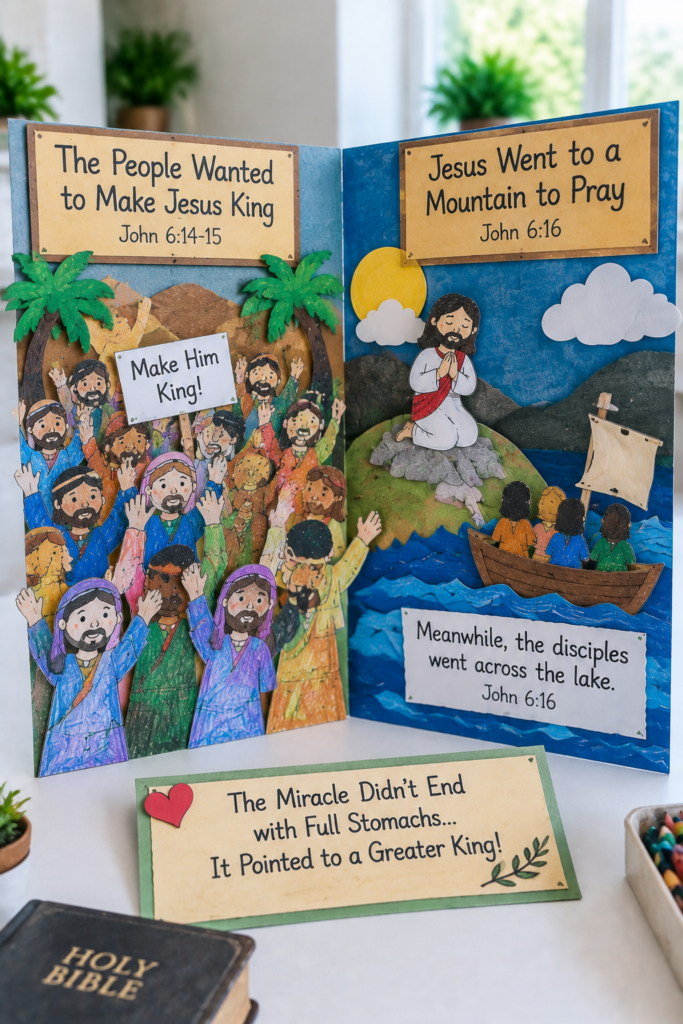
Among these five loaves and two fish crafts for kids, this feeding of the 5,000 craft picks up where the meal ends.
John says the people saw the sign Jesus had done and began saying he was the Prophet who was to come into the world.
Jesus realized they were about to come and make him king by force, so he withdrew again to a mountain by himself. Matthew and Mark add that Jesus made his disciples get into the boat and go ahead while he dismissed the crowd, and that he then went up on the mountain to pray.
In this Bible craft for kids, children make a fold-out card that shows what the crowd planned on one page and what Jesus did on the other.
Ages: 7 to 11, for Sunday school, homeschool, or home.
Materials
- One sheet of light cardstock
- Brown paper for the mountain
- Scrap paper for a small boat and paper people
- Scissors, glue, markers or crayons
How to Make It
- Fold the cardstock in half like a book. On the cover, write “After the Meal.”
- On the left page, glue a group of small paper people. Above them, write: “The people said Jesus was the Prophet who was to come into the world.” (John 6:14)
- Under the crowd, write: “They were about to come and make him king by force.” (John 6:15)
- On the right page, glue a brown paper mountain with one small paper figure alone at the top. Write: “Jesus withdrew to a mountain by himself.” (John 6:15)
- Beside the mountain, add: “He went up to pray.” (Matthew 14:23, Mark 6:46)
- At the foot of the right page, glue a small paper boat. Write: “He sent the disciples ahead by boat while he dismissed the crowd.” (Mark 6:45)
- Read John 6:14–15 and Mark 6:45–46 together.
Optional: If your class made the setting diorama, move the boat away from the shore and place the Jesus figure alone on the hillside.
What Children Learn
- After the meal, the people said Jesus was the Prophet who was to come into the world.
- John says Jesus realized they were about to make him king by force, and he withdrew to a mountain by himself.
- Matthew and Mark say he sent the disciples ahead by boat, dismissed the crowd, and went up the mountain to pray.
- John records no words from Jesus at this moment. What the Gospels record is what he did.
Talk About:
- “What did the people say about Jesus after they ate?” (That he was the Prophet who was to come into the world.)
- “What were they about to do?” (Come and make him king by force.)
- “What did Jesus do?” (He withdrew to a mountain by himself.)
- “What did Matthew and Mark say he did on the mountain?” (He prayed.)
- “Does John tell us anything Jesus said at that moment?” (No.)
Learning letters does not have to stop at worksheets; Train Craft Ideas for Kids That Make Learning the Alphabet Fun With Things You Already Have turns the alphabet into a hands-on activity.
Art can open a door to conversations about culture, and 12 African Art Projects for Kids That Teach Culture, Not Just Craft goes beyond simply making something colourful.
Conclusion
Whether you’re teaching Sunday school, sitting at the kitchen table, or planning a homeschool Bible lesson, I hope these five loaves and two fish crafts for kids help the Feeding of the 5,000 feel real to the children in your life.
Start with one craft, read the verses together, and let the questions come. You don’t need to do all ten.
Which craft will you try first? Tell me in the comments.
If this post helped, save it for your next lesson and share it with a teacher or parent who could use it. And if your group enjoys Bible crafts for kids, our other bible crafts are a good one to try next.