Help children understand the First Commandment with these Ten Commandments crafts for kids, using a simple heart craft to teach them to love God and put Him first.
Your child can say all ten commandments. You stand there feeling proud. Then you ask, “What does covet mean?” and they look at you with a blank face.
If that has happened, don’t worry. Learning the words and understanding their meaning are two different things. Some commandments use language children rarely hear in everyday conversation, making them harder to explain or remember.
Ten Commandments crafts for kids can help bridge that gap. As children make something connected to each commandment, they have an opportunity to discuss what it means and how it relates to everyday life.
The craft alone won’t guarantee they’ll remember everything, but pairing it with a simple explanation and a thoughtful question gives the lesson more purpose.
Below, you’ll find one craft for each commandment, with a short line to say aloud and a question to discuss together. The projects use simple materials, so you can adapt them to your child’s age, your Sunday school class or the time you have available.
One important note before you begin: Jewish, Catholic, Lutheran and other Protestant traditions differ in how they group and number the commandments.
These crafts focus on the biblical teachings in Exodus 20:1–17, so check the wording and numbering used by your family or church when preparing each project.
Help children remember the Bible story of the tax collector who climbed a tree to see Jesus with these Creative Zacchaeus Crafts: More Than Just a Man in a Tree, which offer hands-on ways to explore Zacchaeus’s encounter with Jesus and the changes that followed.
Which Ten Commandments List Do These Crafts Follow?
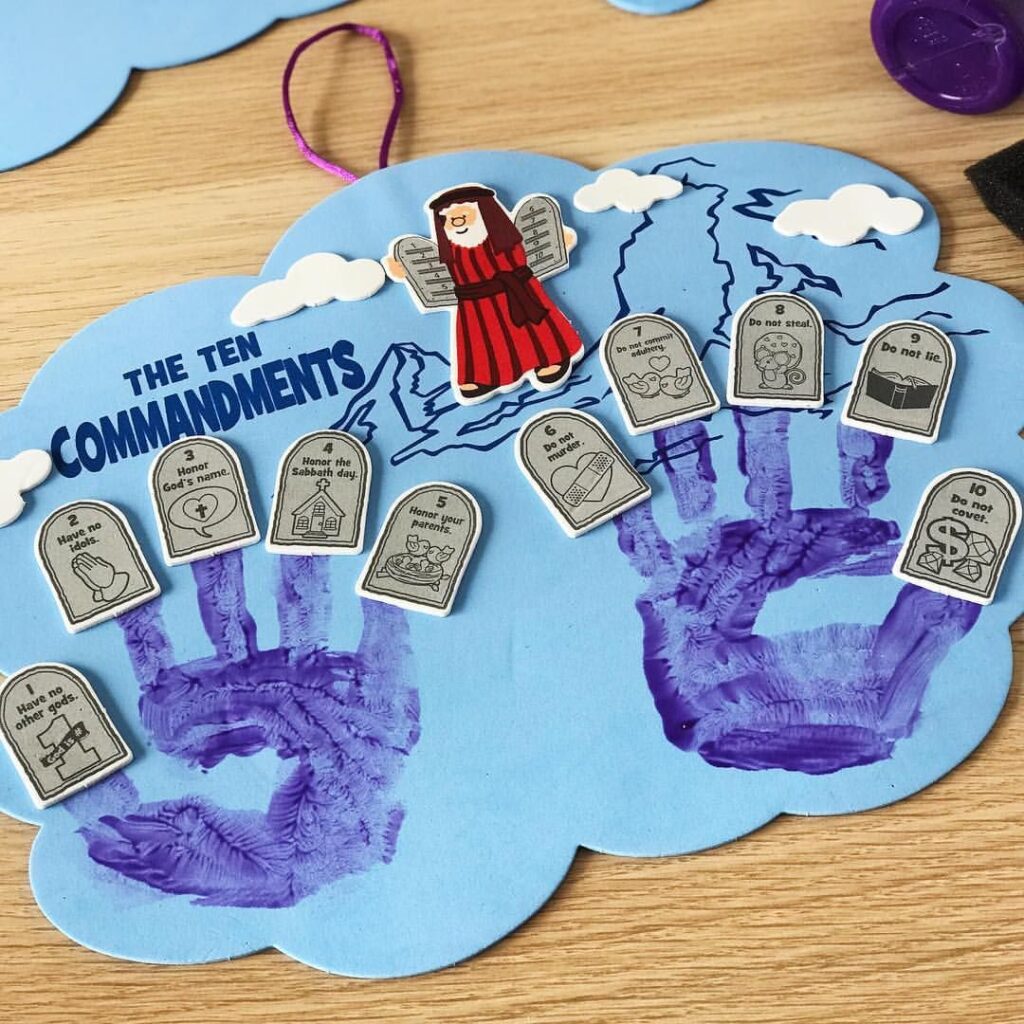
If your child learns the Ten Commandments in church or school, the list may not match the one you see online.
That is normal. The Bible gives the commandments twice, in Exodus 20:2–17 and in Deuteronomy 5:6–21, but it never numbers them. Over the years, different traditions have counted them in different ways.
The Ten Commandments crafts for kids in this post follow the Exodus 20 order used in most Protestant and Orthodox churches. Here is the short wording I use for each one:
- No other gods before me.
- Do not make or worship idols.
- Do not misuse God’s name.
- Remember the Sabbath day.
- Honor your father and mother.
- Do not murder.
- Do not commit adultery.
- Do not steal.
- Do not give false testimony against your neighbor.
- Do not covet.
The two Bible versions say almost the same thing. The biggest difference is the Sabbath. Exodus says to “remember” the day and points back to creation.
Deuteronomy says to “observe” it and points back to being freed from slavery in Egypt. I used the Exodus wording because it is the one most children learn first.
Your church may count differently, and that is fine. Catholic and Lutheran lists join “no other gods” and “no idols” into one commandment, then split the last one about coveting into two. Catholics put the neighbor’s wife as the ninth and the neighbor’s goods as the tenth.
Lutherans put the house as the ninth and the rest as the tenth. Jewish numbering starts with the words “I am the Lord your God, who brought you out of Egypt” (Exodus 20:2) as the first. Then “no other gods” and “no idols” share the second.
So you can use every craft here, whatever list your child knows. The words of each commandment stay the same. Only the number changes. If your list is different, match each craft to the wording, not the number, and you will not miss any.
The feeding of the five thousand gives children a memorable lesson about Jesus providing for a crowd. These Five Loaves and Two Fish Crafts for Kids: 7 Easy Ideas From the Feeding of the 5,000 help bring the story into craft time.
Ten Commandments Crafts for Kids That Make Each Commandment Easier to Learn and Remember
1. First Commandment: You Shall Have No Other Gods Before Me
Before this commandment, God says, “I am the Lord your God, who brought you out of Egypt” (Exodus 20:2). So the first rule comes from someone who already set the people free. A child can understand that. It is not “obey me or else.” It is “I rescued you, so put me first.”
Some translations say “before me” and some say “besides me.” Both point to the same idea: nothing should take God’s place.
What this craft teaches
Kids love many good things: family, friends, sports, games, a favorite show. None of that is wrong. This craft shows that whatever sits at the bottom of our life is what holds everything else up.
What you’ll need
Plain wooden blocks work best, because kids can write on them with markers. Small cardboard boxes or paper cups also work, and they are cheaper.
You’ll also need washable markers and a pack of blank labels or stickers. For children under five, three blocks are enough.
What to make: a block tower
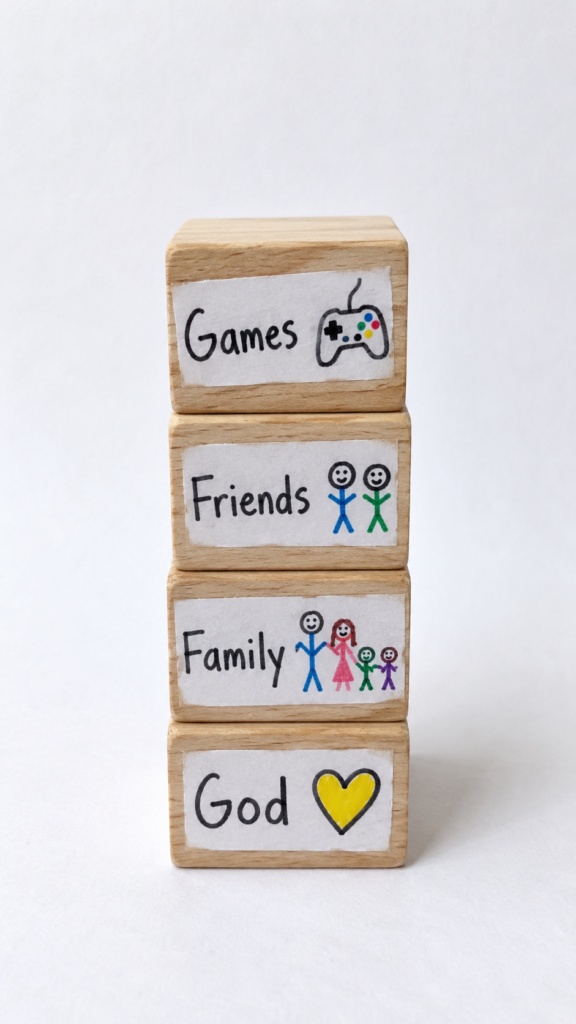
Each child writes or draws things they love on blocks. They stack the blocks with one of those things at the bottom, such as “my game.” Then you gently slide the bottom block out and the tower wobbles or falls.
Next, they build again with a block marked “God” at the bottom, and the tower stands steady.
How to do it:
- Talk first. Ask, “What are the things you love most?” and write each answer on a small label.
- Stick one label on each block. Keep one block for “God.”
- Build the first tower with a toy or game on the bottom.
- Pull out the bottom block and watch what happens.
- Rebuild with the “God” block at the base.
This is an illustration, not a line from the Bible. Tell the children that, so they know it is a picture to help them think.
Say: “God comes first.”
Ask: “What is at the bottom of your tower?” Let them answer in their own words. Try not to correct them. This is about what they think, not about a right answer.
Turn pinecones, twigs, and other suitable outdoor finds into seasonal projects with these 12 Christmas Nature Crafts for the Kids Who Keep Bringing Pinecones and Winter Finds Home.
2. Second Commandment: You Shall Not Make Idols
This commandment is about worship, not art. Exodus 20:4–6 says not to make a carved image and bow down to it or serve it.
The same book tells Moses to put carved angels on the ark (Exodus 25:18–22), so making an image is not the problem. Treating it like a god is.
Here is a detail most Ten Commandments crafts for kids leave out. Deuteronomy 4:15 reminds the people that they saw no shape or form when God spoke at Sinai. They saw fire and heard a voice. That gives you a real answer when a child asks, “What does God look like?”
Churches and families differ on how far this commandment reaches, for example on pictures and statues in worship. This craft stays with what the text says and leaves that debate alone.
What this craft teaches
Kids don’t see statues in daily life, so the word “idol” can feel far away. The prophet Isaiah makes it simple. A man cuts down a tree. He burns some of the wood to keep warm and bake bread, then carves the rest into a god and bows to it (Isaiah 44:14–17).
Isaiah asks how half a log can be a god. Children catch the joke fast, and the point stays with them.
What you’ll need
Jumbo craft sticks, non-toxic paint, and small brushes. A plastic bowl and a spoon are needed for the pretend cooking. Look for a non-toxic art-materials label on the paint, such as ASTM D-4236 in the US. A pack of 100 sticks covers a small group, so check the count before you buy.
What to make: two sticks from the same tree
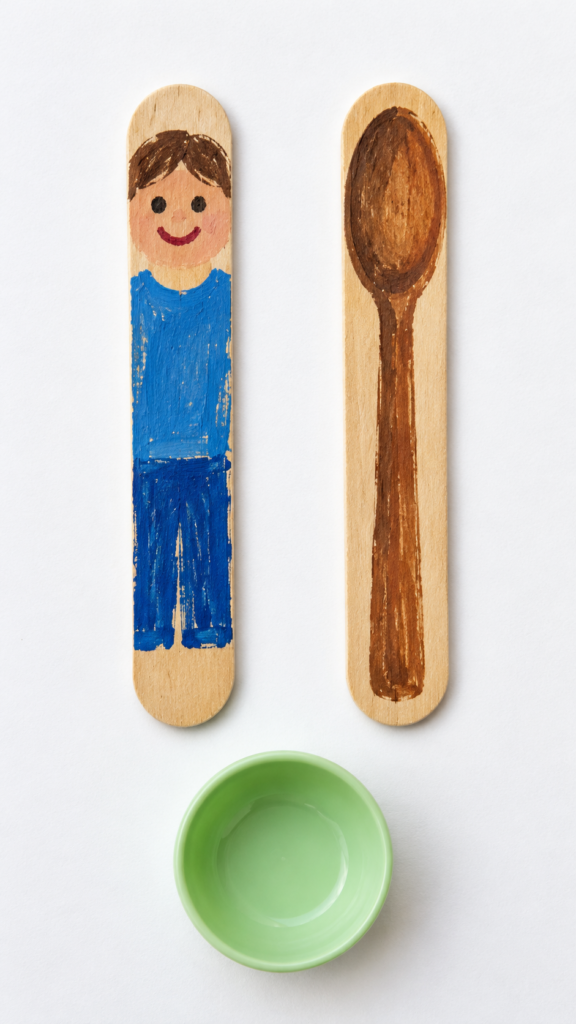
Each child paints one craft stick as a small figure with a face and clothes. They paint a second stick as a cooking spoon and use it to stir pretend soup. Set the two sticks side by side. They came from the same tree, but only one can stir the soup.
How to do it:
- Give each child two jumbo craft sticks.
- Tell the Isaiah story in two or three sentences. A man used one piece of wood for his fire and the other for a statue.
- Let them paint one stick as a little figure.
- Let them paint the other stick as a spoon.
- Have them stir pretend soup in the bowl with the spoon. Then ask the figure to stir it.
- Place the two sticks side by side.
Do not use real fire. The paint tells the story.
Say: “Only God is God.”
Ask: “Which stick can help you? Which one can hear you?” Then ask, “What do people sometimes treat like the most important thing, even though someone made it?” Older children may say phones, money or being popular. Let them name it themselves.
A note for parents: The verses after this command talk about God being “jealous” and about children and grandchildren (Exodus 20:5). These lines are heavy for young kids.
For children under about eight, read the hopeful ending in Exodus 20:6, about showing love to a thousand generations, and answer questions as they come.
Help children remember how Jesus called His first disciples with these Fishers of Men Crafts for Kids: 9 Ideas That Follow Jesus Calling the First Disciples, which connect hands-on activities with the Bible story.
3. Third Commandment: You Shall Not Take the Name of the Lord Your God in Vain
Most children hear this as “don’t say bad words.” That is part of it, but the Hebrew points to more. The verb translated “take” usually means to lift, carry or bear.
The word for “in vain” means empty, worthless or false. So the wording is closer to “do not carry the name of the Lord your God in an empty way.”
Scholars do not agree on every detail. Jewish tradition has long read it as a ban on false or empty oaths.
Some Christian teachers add careless speech, saying “God told me” about something he did not say, or claiming his name while living in a way that shames it.
All of these readings agree on one thing: God’s name should be used with care and meaning, never as filler.
What this craft teaches
Because the Hebrew word means “carry,” a bag is a good picture. A child carries God’s name by what they say and how they live. This craft helps them think about when and how they use it.
What you’ll need
Plain canvas tote bags and fabric markers. Multipacks of blank totes are easier for groups. You’ll also need index cards, or a small piece of felt and glue for a pocket. Many fabric markers need heat-setting with an iron after drawing, so read the pack and add that step for parents.
What to make: a “carry it well” tote bag
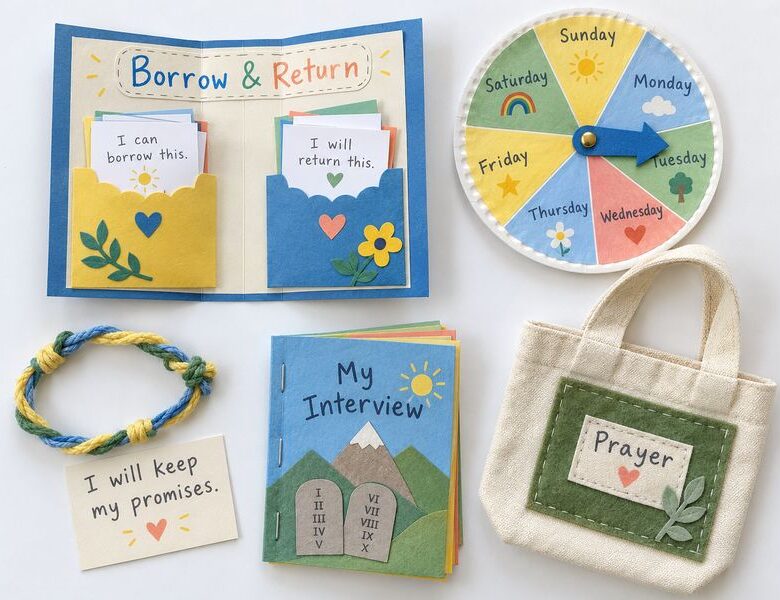
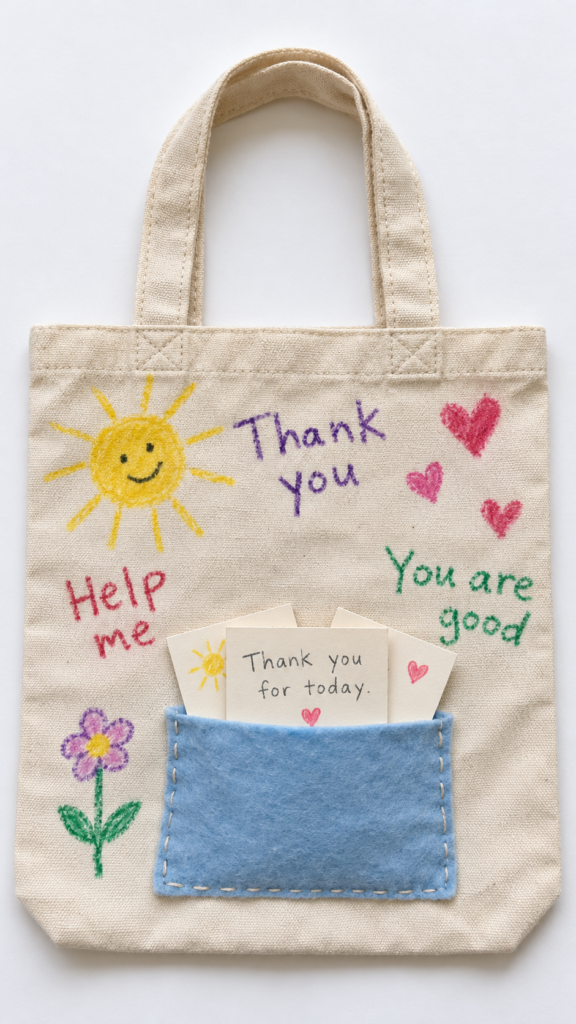
Each child decorates a tote bag with words about God and things they can say to God, like “thank you,” “help me,” “you made this,” and “you are good.” A small pocket on the front holds three cards with their own short prayers.
Some families, including many Jewish families, avoid writing God’s name on things that can get dirty or be thrown away. Words about God, instead of the name itself, avoid that problem and work for everyone.
How to do it:
- Talk first. Ask, “What are good things to say to God?” Write their ideas on a board.
- Give each child a tote bag and fabric markers.
- They write or draw words about God on the bag. They can add pictures too.
- Glue a felt pocket or a small envelope on the front.
- They write or draw three short prayers on index cards and slip them inside.
- Heat-set the markers if the pack says to.
Say: “I will use God’s name with care.”
Ask: “When is a good time to say God’s name?” Help them see that prayer, thanks and honest talk all count. Then ask, “What can you say when you’re surprised or upset?”
A note for parents: If a child says “Oh my God” because they heard it somewhere, a lecture can make it a bigger deal.
Try asking calmly, “Were you talking to God just now?” That connects the words to who they are about. Then give them something else to say, like “Wow!” or “Oh no!”
When snowy weather keeps children indoors, these 17 Snow Day Crafts Kids Can Make When the Power Goes Out offer creative activities to prepare for a day at home.
4. Fourth Commandment: Remember the Sabbath Day
The word Sabbath comes from a Hebrew word that means to stop. So the commandment is really about stopping. Exodus 20:8–11 says to work for six days and rest on the seventh.
Then it adds something parents often miss: the rest is for everyone in the home, including children, workers and even the animals.
The two Bible versions give different reasons. Exodus points back to creation, when God rested on the seventh day.
Deuteronomy 5:12–15 says to “observe” the day and points back to Egypt, where the people were slaves with no day off. Rest was part of being free.
Families keep this day differently. Jewish families keep it from Friday evening to Saturday evening, and many Christians keep it on Sunday. Your readers will fit this craft to their own day.
Among the Ten Commandments crafts for kids, this one is easy to use again every week.
What this craft teaches
Rest is not only a rule. It is a gift, and kids can learn to look forward to it. The craft shows a week with six busy days and one day that is left open on purpose.
What you’ll need
Sturdy paper plates, markers, a brass paper fastener, and a strip of cardstock for the arrow. A ruler helps with drawing seven equal wedges. For the optional rest box, use any small box with a lid.
What to make: a six-plus-one week wheel
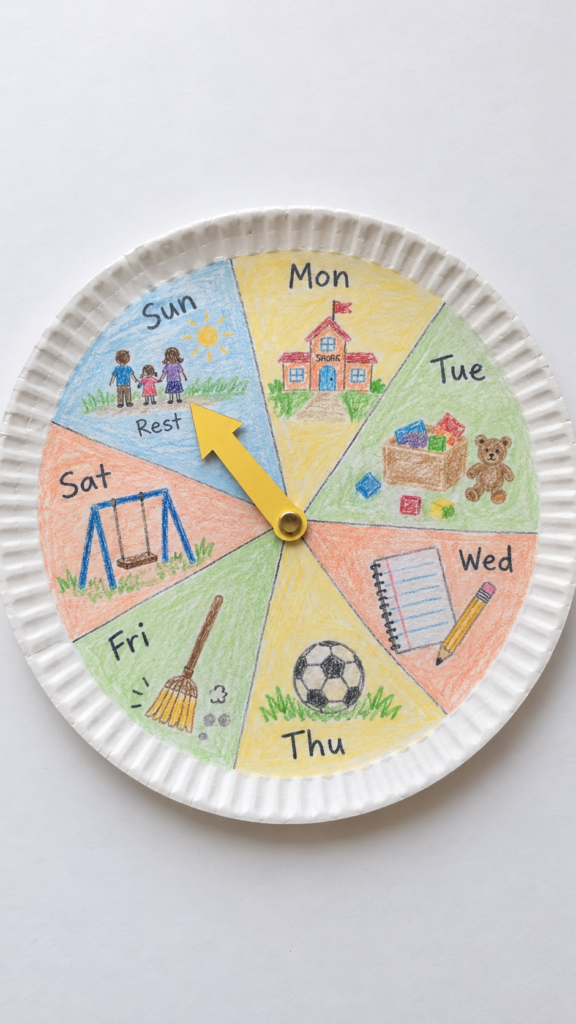
Each child divides a paper plate into seven wedges. Six wedges show busy things, like school, chores, sports and homework. The seventh wedge stays mostly empty, with one picture of how their family rests.
How to do it:
- Draw seven wedges on the plate and label them with the days of the week.
- Ask, “What does your week look like?” Let the child draw something for six of the days.
- Leave the seventh wedge for rest. Ask what they would love to do, like a walk, a long meal together, a nap, or going to worship.
- Push a paper fastener through the center and attach an arrow cut from cardstock.
- Spin the arrow each morning to see where the week stands.
- Optional: decorate a small box. On rest day, the family puts devices or homework inside until the day is over, if that fits your family.
Say: “God gave us a day to rest.”
Ask: “What would make your rest day feel good?” Try not to answer for them.
A note for parents: Children hear “no” all week, so try to make this day feel like something to enjoy and not a list of things they can’t do. Start small. Even one hour that the whole family keeps free is a good start.
Families who want a simpler December routine can try these Elf on the Shelf Alternatives for Parents Tired of Coming Up With Ideas Every Night: 9 Low-Effort Traditions Kids Still Love for festive fun without nightly preparation.
5. Fifth Commandment: Honor Your Father and Your Mother
Exodus 20:12 says, “Honor your father and your mother, so that you may live long in the land the Lord your God is giving you.”
Deuteronomy 5:16 adds that it may “go well” with you. The Bible writer Paul calls this the first commandment with a promise (Ephesians 6:2).
The word honor in Hebrew comes from a word that can mean heavy or weighty.
So to honor someone is to treat them as important. That is a good thing for a child to hear, because it is about how we treat people, not only about doing what we are told.
This is one of the Ten Commandments crafts for kids that makes a lovely gift, so it works well for a grandparent’s visit or a holiday.
What this craft teaches
Honor starts with knowing someone. When a child asks a grown-up about their life, they learn who that person is and the grown-up feels seen.
What you’ll need
Cardstock or plain paper, a stapler, pens or markers, and a few small stickers if you like. A small blank notebook also works. Count one booklet for each child, and add a few extras for kids who want to interview more than one person.
What to make: an honor interview booklet
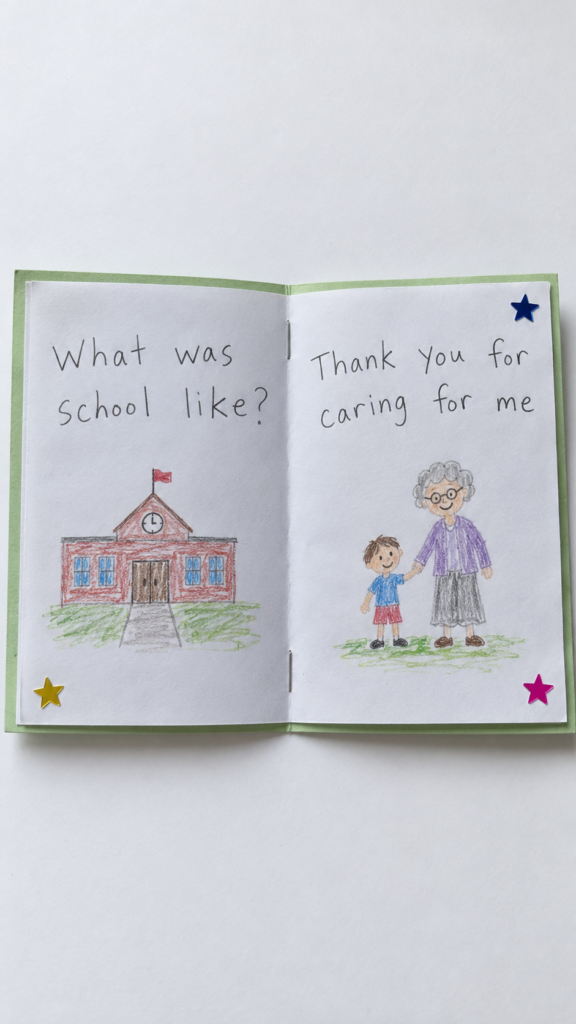
Each child makes a small booklet with one question on each page. They ask a parent, grandparent or other grown-up who cares for them and write or draw the answers.
How to do it:
- Fold four sheets of paper in half and staple the fold. Write “A book about ___” on the cover.
- Write one question at the top of each page. Try: “What did you want to be when you were my age?”, “What was your favorite food as a kid?”, “What was school like?”, “What are you proud of?” and “What do you hope for me?”
- Sit with a grown-up and let the child ask each question.
- The child writes or draws the answer on the page.
- On the last page, they write one thing they thank that person for.
- Give the booklet to that person, or mail it if they live far away.
Say: “I honor the people who care for me.”
Ask: “What did you learn about them that you didn’t know?”
A note for parents: Not every child lives with a mother and a father, so use “the grown-ups who raise you” in your post and invite readers to include foster parents, grandparents and guardians.
Also, honor does not mean putting up with harm. If a child feels unsafe at home, they should tell a trusted adult. This commandment never asks a child to stay quiet about being hurt.
To help children follow the events surrounding Jesus’ birth, explore these 12 Nativity Crafts That Walk Kids Through the Story of Jesus’ Birth, at Home or Sunday School.
6. Sixth Commandment: You Shall Not Murder
Exodus 20:13 is short. Some Bible versions say “kill” and others, like the NIV and ESV, say “murder.” The Hebrew word most often refers to unlawful killing, which is why newer translations use “murder.”
For most children under about eight, this word is heavy. A simple way to say it is: God made every person, so we do not hurt people (Genesis 1:27). You can say more as they grow.
For older children, Jesus talked about anger in Matthew 5:21–22. He taught that the heart matters too, not only the act.
That is why this craft focuses on anger. Anger is not the sin. The Bible says, “In your anger do not sin” (Ephesians 4:26). So this is one of the Ten Commandments crafts for kids that deals with big feelings, and it gives children something to do with them.
What this craft teaches
Kids can learn to notice their anger before it gets too big and to choose a next step. Parents and teachers often use feelings thermometers like this to help children name big feelings.
What you’ll need
Cardstock, markers, a ruler, scissors, and a small piece of felt or a paper strip for the slider. A brass paper fastener works if you prefer a dial. You also need index cards and a small envelope for the “next step” cards.
What to make: an anger thermometer with a next-step pocket
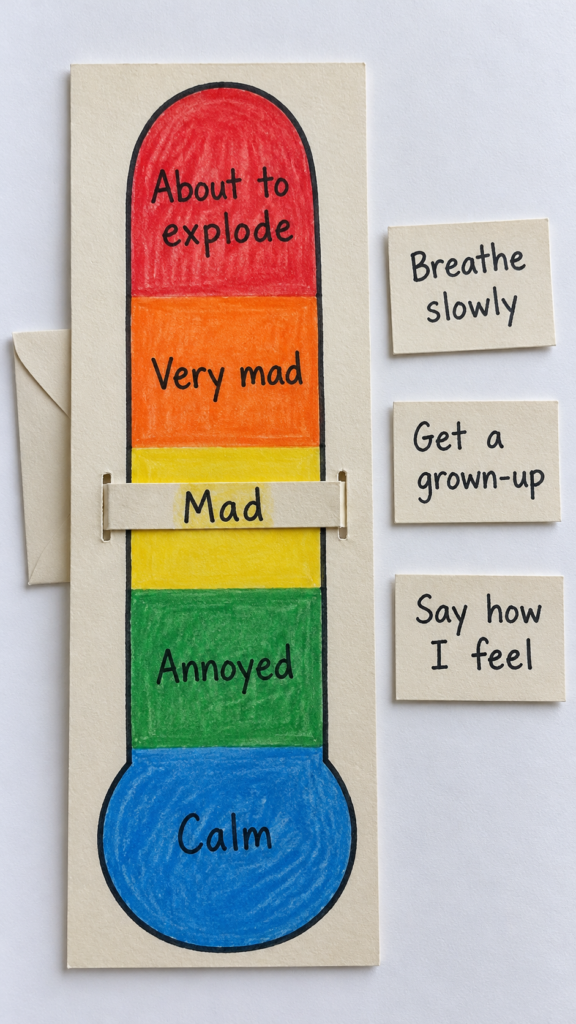
Each child draws a tall thermometer on cardstock with five levels, from calm to very mad. A slider moves up and down to show how they feel. A small pocket on the back holds three “what I can do next” cards.
How to do it:
- Draw a tall thermometer and mark five levels: calm, annoyed, mad, very mad, and about to explode.
- Cut a slit on each side of the thermometer and thread a paper strip through it, so it slides up and down.
- Let the child color each level and write how it feels in the body, such as hot face, tight hands, or fast heart.
- Glue a small envelope on the back.
- Write three cards together and put them inside. Try: “Take five slow breaths,” “Walk away and get a grown-up,” and “Say: I’m mad because…”
- Keep it where the child can reach it.
Say: “I can be angry and still be kind.”
Ask: “What helps you when your thermometer goes up?”
A note for parents: Try not to use this craft as a punishment. It works best when it is made on a calm day, so the child can use it later when they are upset.
Teach children about Esther’s courage and her role in saving her people through these Esther Craft Ideas: 13 Crafts That Retell Her Story for Kids, From Her Crown to Purim.
7. Seventh Commandment: You Shall Not Commit Adultery
This is the commandment parents worry about most, so say plainly what it means. Exodus 20:14 is about faithfulness in marriage.
Adultery is when a married person has a relationship with someone who is not their husband or wife.
There is no honest way to turn it into something else for small children, so this lesson works in two steps, depending on age.
For children under about seven, start with the closest idea they can understand: being faithful means keeping a promise to someone you love.
That is a bridge, not the whole meaning, and it is fine to tell your child that there is more to learn when they are older.
For ages eight and up, you can say that marriage is a promise between two people to stay loyal to each other, and that this commandment protects that promise. Answer what they ask and no more.
This is one of the Ten Commandments crafts for kids where the parent matters more than the project. The craft gives you a calm moment to talk, and it needs no pictures or stories you’d have to explain.
What this craft teaches
Promises hold things together. A knot in a cord is a good picture, because it holds when you pull on it. Children can also see that a broken promise can be mended, which matters for kids who have felt let down.
What you’ll need
Hemp or cotton cord, about 30 cm (12 inches) per bracelet, and a few large wooden beads. Small beads are a choking risk, so use large ones and stay close with children under three. Scissors and a marker for labeling a card.
What to make: a promise-knot bracelet
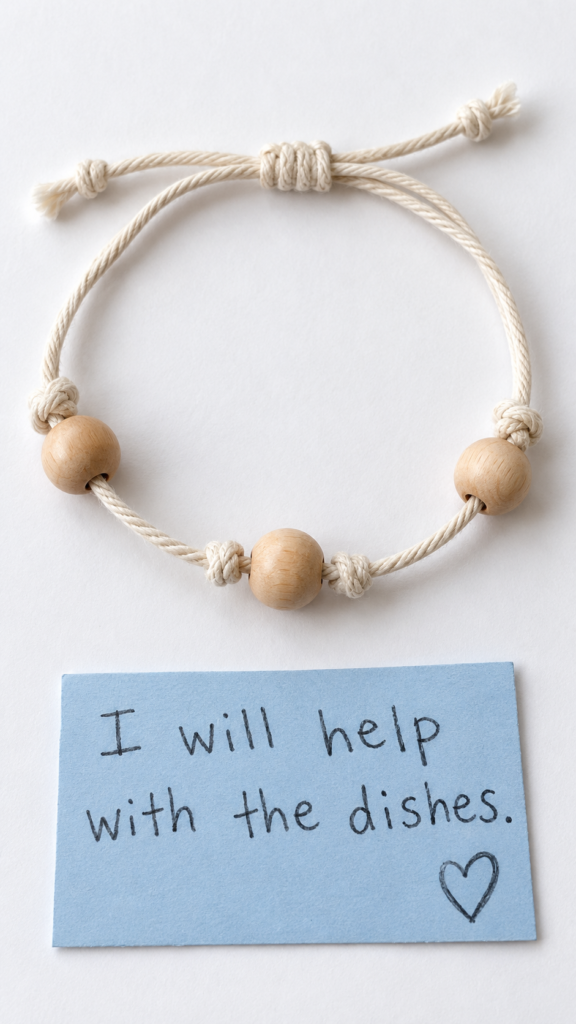
Each child picks one promise they want to keep, such as “I’ll help with dinner dishes this week.” They tie the bracelet with a loose loop, then tie a knot for each day they keep the promise. By the end of the week, the cord shows how many times they followed through.
How to do it:
- Talk first. Ask, “What is a promise you’ve made or someone made to you?”
- Cut the cord and tie the ends to make a loop that fits the wrist.
- Write the child’s promise on a small card.
- Each time they keep it, they tie one knot and slide on one bead.
- If they miss a day, they say sorry to the person and keep going. The bracelet stays.
Say: “I keep my promises to the people I love.”
Ask: “How does it feel when someone keeps a promise to you?”
A note for parents: Many children live with divorce or a parent who broke a promise. If your child says, “That happened in our family,” stay calm and tell them it is not their fault and not their job to fix. This commandment is not a judgment on any child’s home.
Children often have questions about kindness and helping others. These 7 Good Samaritan Craft Ideas for Kids Who Ask “Why Didn’t Anyone Else Stop? can support a conversation about compassion and the parable Jesus told.
8. Eighth Commandment: You Shall Not Steal
Exodus 20:15 is the shortest commandment in the list, and children usually understand it quickly. What they often miss is the second half of the Bible’s teaching, which is about making it right.
Exodus 22:1 says a person who steals must pay back more than they took, and Leviticus 19:11 puts “do not steal” next to “do not deceive” and “do not lie.”
In Luke 19:8, a tax collector named Zacchaeus meets Jesus and promises to give back four times what he took.
So the idea is not only “don’t take.” It is “give back, and put it right.” Some ancient Jewish teachers also read this short commandment as being about kidnapping, with property theft covered in the other laws.
You do not need to go into that in the post, but it shows how much sits behind two words.
What this craft teaches
Children under about four often do not yet grasp that things belong to someone, so “mine” and “yours” come first. This craft gives them a simple system, and it gives older kids a way to fix a mistake.
What you’ll need
A sheet of poster board or a large piece of cardstock, library card pockets, and index cards. A pen and some tape or glue. Sold in packs, the pockets and cards are inexpensive, which makes this a good group activity for a class.
What to make: a borrow board
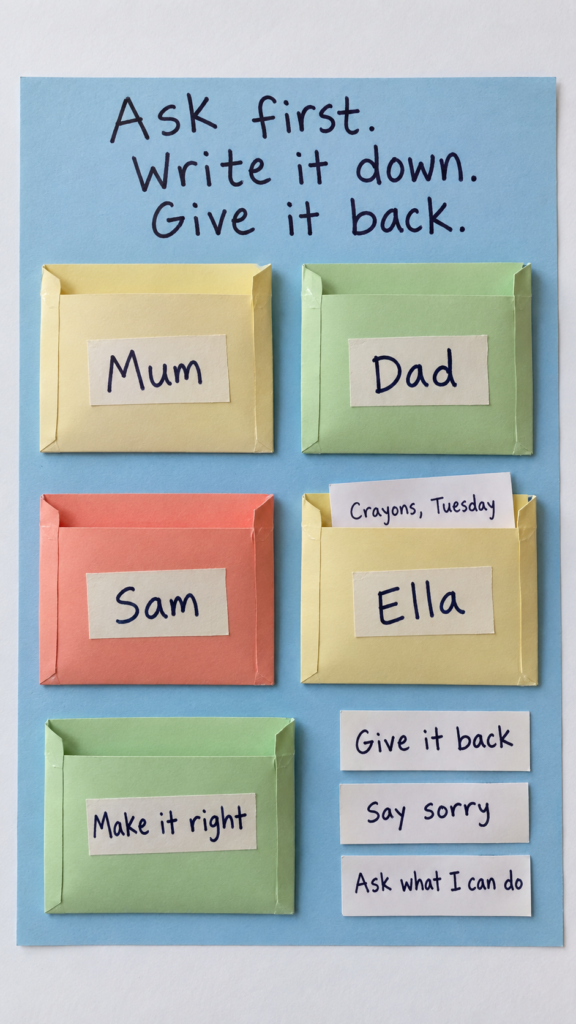
Make a board with one library pocket for each family member’s belongings, or one pocket for each child in a class.
When someone borrows something, they write the item and date on a card and slip it in the owner’s pocket. When they return it, the card comes out.
How to do it:
- Glue one pocket for each person on the poster board and write their name on it.
- Write the rule at the top: “Ask first. Write it down. Give it back.”
- Practice with a toy. One child borrows a crayon box and writes “crayons, Tuesday” on a card for the owner’s pocket.
- Add a fifth pocket called “Make it right.” Inside, put cards that say: “Give it back,” “Say sorry,” and “Ask what I can do.”
- Keep the board where everyone can see it.
Say: “I ask first, and I give back.”
Ask: “What can you do if you took something and feel bad about it?”
A note for parents: If your child takes something from a shop, try not to shame them. Go back together, let them hand it over and say sorry to the staff. A child who fixes the mistake with you nearby learns more than one who only gets a lecture.
Guide children through the key events of Noah’s story with these Noah’s Ark Crafts for Kids: 9 Ideas That Walk Through the Whole Story, One Craft at a Time.
9. Ninth Commandment: You Shall Not Give False Testimony Against Your Neighbor
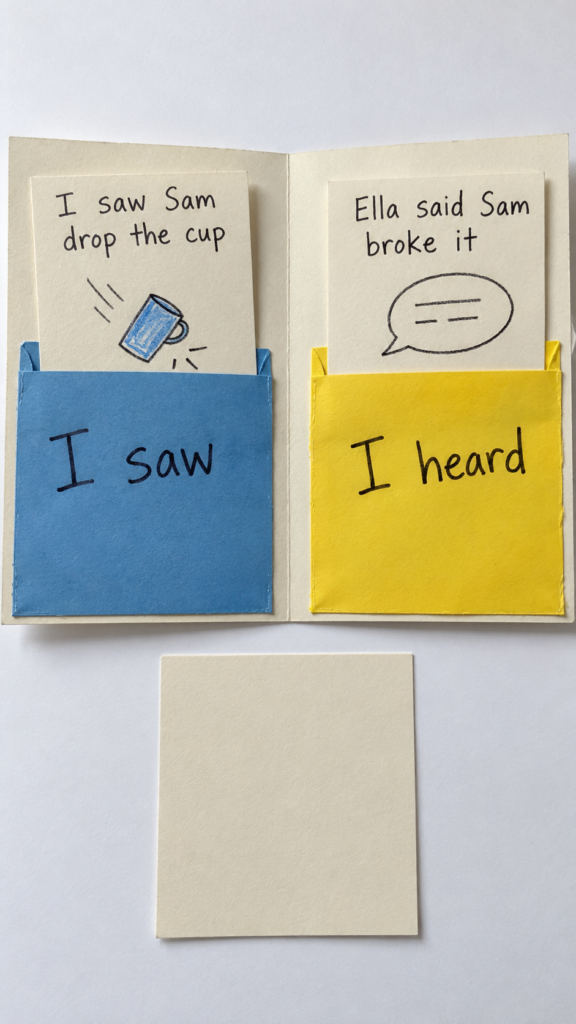
Most children hear this as “don’t lie.” The words are narrower and, in some ways, harder. Exodus 20:16 is set in a courtroom: a witness who speaks falsely against someone else can destroy them. Exodus 23:1 adds, “Do not spread false reports.”
Deuteronomy 19:15 asked for more than one witness before anyone could be found guilty, so one person’s word was not enough.
That makes this commandment useful for the situations parents see most, like “He hit me first,” “She took my pencil,” and “Everyone says she’s mean.” It teaches children to tell the difference between what they saw and what they heard.
What this craft teaches
A good witness says what they actually saw. A rumor is something you only heard. This craft helps children sort the two, which is a skill they will need online as well.
What you’ll need
Two-pocket paper folders, index cards or sentence strips, markers, and a stack of simple pictures or short story prompts. Folders in two bright colors make it easier for children to tell the pockets apart.
What to make: an “I saw” and “I heard” folder
Label one pocket “I saw” and the other “I heard.” You read short statements, and the child sorts each card into the right pocket.
How to do it:
- Write “I saw” on one pocket and “I heard” on the other.
- Write a set of cards, such as: “I watched Sam drop the cup.” “Ella told me Sam broke the cup.” “I saw the dog in the garden.” “My friend said the dog dug up the garden.”
- Let the child read each card and place it in a pocket.
- For each “I heard” card, ask, “Can we be sure it’s true? What could we do to find out?”
- Add a blank card for the child to write one of their own.
Say: “I tell what I saw, and I don’t spread what I only heard.”
Ask: “What would you do if you heard something unkind about a friend?”
A note for parents: When siblings blame each other, ask each child, “What did you see?” before asking “Who did it?” This gives children practice in being a careful witness and takes some heat out of the moment.
A lesson about Daniel can help children discuss faith and courage when facing frightening situations. These Daniel and the Lion’s Den Craft: A Sunday School Activity for Kids That Teaches Courage and Faith offers a hands-on way to reinforce the Bible story.
10. Tenth Commandment: You Shall Not Covet
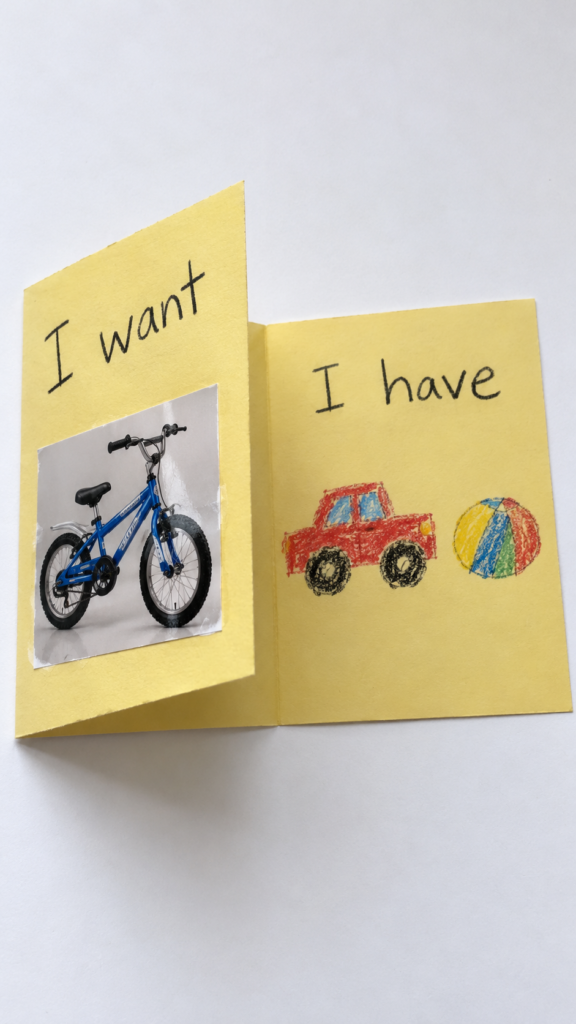
The word “covet” is what children stumble on, so say it simply: to covet is to want what belongs to someone else so much that it takes over your thinking.
The Hebrew word is about desire, and the Bible often shows it growing into action. In Joshua 7:21, Achan says, “I coveted them and took them.” Micah 2:2 says people covet fields and seize them.
That helps with a real parent question: is it wrong to notice that a friend has a nice toy? No. The commandment is about what happens when wanting turns into resentment or grabbing.
It is also the commandment most tested by advertising, which is why it fits the Ten Commandments crafts for kids that readers can finish and use again after a trip to the store or a scroll through videos.
What this craft teaches
The opposite of coveting is gratitude, and children can practice it with their hands. This craft shows both sides of a card: what I want and what I already have.
What you’ll need
Old toy flyers or store catalogs, safety scissors, a glue stick, cardstock folded in half, and markers. If you don’t have flyers, children can draw the things they want.
What to make: a want-and-have Flip Card
Each child folds a card in half. On the front, they glue a picture of something they want. Inside, they draw something they already have and love. On the back, they write one way to be glad for a friend who has something they want.
How to do it:
- Look through a flyer together and let each child cut out one thing they want.
- Glue it on the front of the folded card.
- Open the card. On the inside, they draw something they already have that they enjoy.
- On the back, they finish the sentence: “I can be happy for my friend by…”
- Keep it near their bed or on a shelf.
Say: “I can be thankful for what I have.”
Ask: “How can you be glad for someone else when they get something you wanted?”
A note for parents: Say out loud when you feel the pull to want something, like a neighbor’s new car or a friend’s trip. Children learn this commandment mostly by watching how you handle it.
Introduce children to African artistic traditions through these 12 African Art Projects for Kids That Teach Culture, Not Just Craft, with activities that can encourage conversations about cultural expression.
How to Help Kids Remember All Ten (Not Just Make Them)
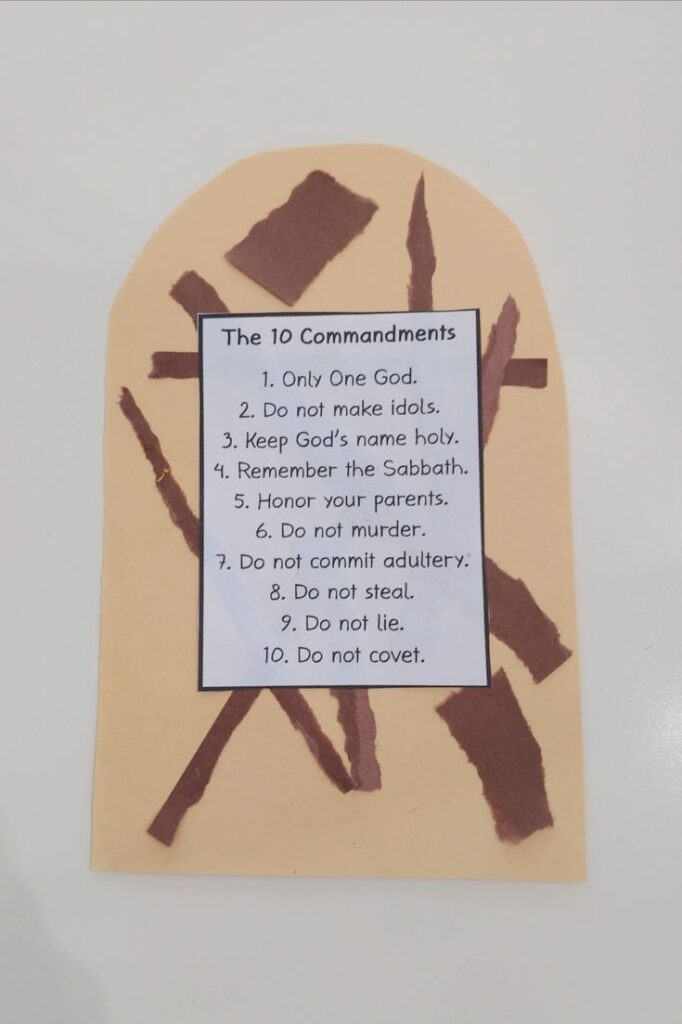
Making the crafts is the first half. The second half is what happens in the weeks after. A craft that goes on a shelf teaches very little.
A craft that gets picked up, held and talked about is what helps a child remember each commandment. Here is how to make your Ten Commandments crafts for kids last.
✅ Hang the Crafts as a Two-Tablet Display
The commandments were written on two tablets (Exodus 31:18), so a display with two groups is a simple way to show how they fit together.
- What you need: Twine, mini clothespins, and removable wall hooks so you don’t damage paint. Hang it at your child’s eye level, not an adult’s.
- How to group them: There’s more than one way to split ten into two, and each has a long history. Many Christians see four commandments about God and six about people, which matches the crafts in this post. Jewish tradition and many Reformed Christians put five on each tablet. The Catholic and Lutheran count is usually described as three and seven. Pick the split your church uses.
- Add two labels: “Love God” and “Love people.” Jesus gave these two as the heart of the law (Matthew 22:37–40), so they give children a simple frame for all ten.
- Add a number card to each craft, but also keep the short wording on it. If your church counts differently, the wording still matches.
✅ Play “Show Me” Once or Twice a Week
You don’t need flashcards. The finished crafts do the job.
- Craft to words: Hold up the borrow board and ask, “Which commandment is this?” Let the child say it from memory.
- Words to craft: Say, “You shall not steal,” and let them point to the right craft.
- Fill in the blank: “You shall not ____ your neighbor’s goods.”
- Add the why: After they say it, ask the one question from that craft, like “What can you do if you took something and feel bad?” This is how they learn the meaning and not only the words.
If your child gets stuck, give the first word as a clue. If they still can’t remember, say the commandment together and come back to it later in the week.
✅ Why Asking Works Better Than Rereading
In a well-known 2006 study, Roediger and Karpicke had college students read a passage. Some then reread it and others took a recall test. A week later, the students who had been tested remembered more than the ones who reread.
Later work found the same kind of benefit in young children, including preschoolers learning new words, and found that spacing the practice out over days works better than doing it all at once.
That’s why the plan below spreads things out. Keep in mind that these studies were not about the Ten Commandments, so treat them as good support for the method, not a promise of results.
✅ A Simple Five-Week Plan
Keep each round to about five minutes, such as after dinner or at bedtime.
- Week 1: Practice commandments 1 and 2.
- Week 2: Practice 3 and 4. Quickly recall 1 and 2.
- Week 3: Practice 5 and 6. Quickly recall 1 to 4.
- Week 4: Practice 7 and 8. Quickly recall 1 to 6.
- Week 5: Practice 9 and 10, then say all ten together.
After week five, pick one commandment each week and ask, “What did this one look like in our week?” That keeps the memory fresh and ties it to real life.
Preparing children for a school Christmas play can be easier with costumes made from clothes and simple materials already at home. These 15 Nativity Costumes for Toddlers and Kids You Can Make From Clothes at Home for School Plays offer practical inspiration for dressing little shepherds, angels, and other Nativity characters.
Start With One Craft This Week
You don’t have to do all ten at once. Pick the commandment your child struggles with most, or the one that fits what happened in your home this week, and start there.
A kid who makes the block tower and says “God comes first” at dinner will remember it far longer than one who only heard it read.
Ten Commandments crafts for kids work best when they stay in sight and in conversation. Hang them up, ask the one question, and come back to them over the weeks.
The words will stay with your child because they were connected to something they made and talked about with you.
Which commandment will you start with? Leave a comment below and tell me which craft you’re trying first. If this post helped, pin it to your Bible crafts board or share it with a friend who teaches Sunday school.
Bring a little sunshine into craft time with these Sunflower Crafts for Kids: The Suncatcher and 14 More Easy Ideas They’ll Beg to Make Again, featuring ideas for colourful, nature-inspired creations.
Frequently Asked Questions About Ten Commandments Crafts for Kids
✅ What were the Ten Commandments written on, and why did Moses break them?
They were written on two stone tablets (Exodus 31:18), and the writing was on both sides (Exodus 32:15). Moses threw them down and broke them when he saw the people worshiping a golden calf (Exodus 32:19).
God then had him cut a second set, which Moses brought down (Exodus 34:1–4, 28) and later put in the ark (Deuteronomy 10:1–5). The Bible does not describe the shape of the tablets.
✅ Do Christians still follow the Ten Commandments?
Most Christian churches teach them as moral guidance today. Jesus said he came “not to abolish” the law but to fulfill it (Matthew 5:17).
Churches differ on the Sabbath, for example on whether it is kept on Saturday, on Sunday, or as a principle of rest.
✅Why are the Ten Commandments also called the Decalogue or the “Ten Words”?
“Decalogue” is Greek for “ten words.” The Hebrew Bible calls them “ten words” in Exodus 34:28 and Deuteronomy 4:13. Jewish tradition often calls them the “Ten Statements” for the same reason.
✅ How do I turn these crafts into a lesson plan?
Use one commandment per session, so each lesson has three parts: read the verse together, make the craft, then say the line and ask the question. For ten weeks, follow the order in this post.
For a one-day class or camp, group them in pairs and do five short rounds with a break in between.
✅ Which crafts work for younger kids and which suit older ones?
This is a judgment based on the steps, not a rule. Crafts 1, 2, 7 and 10 need little reading or writing, so they suit ages three to six with help from a grown-up.
And crafts 5, 6 and 9 need reading and writing, so they suit about six and up. Lastly, crafts 3, 4 and 8 sit in the middle and work for both with a little help.