Got family costume plans but no idea how to make them work together? These family Halloween costumes bring fun, easy ideas for every age.
The easiest way to make a family Halloween costume look intentional is to stop trying to make everyone match.
Start with one world.
Once you do that, the choices become much easier. A parent can be the gardener while a child is a sunflower and a toddler is a little bee. Dad can be a paleontologist while the children become dinosaurs.
One child can be Dorothy, another the Tin Man, while the parents step into the roles of the Scarecrow and Glinda. Nobody is wearing the same costume, but put them together and the idea is instantly clear.
That matters when your children aren’t the same age. A toddler needs freedom to walk, sit, eat, and move without wrestling with a costume. An older child may want a character that feels more grown-up.
You and your partner may prefer something that can be built from clothes you already own rather than a costume you’ll wear once.
A good family theme gives you room for all of that.
The 17 ideas below are chosen with that in mind: one shared idea, different roles, and enough flexibility to make the costumes work for the actual people wearing them.
If your group wants costume ideas that put comfort and fit first, Plus-Size Group Halloween Costumes: 11 Costume Ideas That Fit the Group, Not Just the Theme is a useful place to start.
Before You Commit to a Family Costume, Test the Theme

You may love a costume idea when you see it online, but that doesn’t necessarily mean it will work for your family. Before you buy anything, picture your actual family wearing it.
Start with the youngest person. Can your toddler take part without a stiff costume, uncomfortable shoes, a mask, or accessories they will pull off after five minutes? If the answer is no, you may need to change that role rather than abandon the entire theme.
Then think about your older child. Will they feel good wearing the costume, or will they spend Halloween wishing they had been allowed to choose something else? Giving them a character they genuinely like can make the difference between a family photo everyone enjoys and a costume they refuse to wear.
Do the same for yourself and your partner. You don’t both need elaborate costumes. One strong piece, a hat, apron, jacket, wig, or other recognizable detail, can establish an adult character without making the evening uncomfortable.
There is one more test worth trying before you spend money: remove the extras. Take away the props, makeup, wigs, and accessories and look at the basic costumes together. Can you still see the connection between them?
If you can, you’ve probably found a theme that is strong enough to survive real life, not just a perfectly styled Halloween photograph.
Want to make some of your Halloween decorations yourself? Halloween Craft Ideas for Adults Who Don’t Want a Big Mess or Anything That Takes All Day has simple projects that won’t take over your day.
Family Halloween Costumes
1. The Addams Family

The Addams Family works especially well when you want everyone to have a distinct costume without losing the family connection.
You don’t have to make every outfit elaborate because the characters are recognizable through a few defining details.
Mom: Morticia Addams — a long black dress, dark hair, and simple, dramatic styling.
Dad: Gomez Addams — a dark suit, white shirt, tie, and the character’s signature moustache.
Older child: Wednesday or Pugsley.
Toddler: Pugsley can work well for a younger boy, while a little girl can dress as Wednesday. A toddler who won’t tolerate a wig or complicated accessories can still fit the theme with a simple black outfit and a few recognizable details.
What makes this theme particularly useful for a family is the range of characters. You aren’t trying to squeeze everyone into the same costume.
Each person gets a role that can be adapted to their age and comfort level, while the black-and-white palette helps the group look connected in photographs.
For a toddler, keep the costume simple and avoid small detachable accessories that could become a choking hazard.
A comfortable outfit that captures the character is more useful than an elaborate costume the child won’t keep on.
2. The Wizard of Oz

This one gives you a lot of freedom because everyone can take on a completely different character and still look as though they belong together.
That makes it a particularly practical choice when you have a toddler who needs something simple and an older child who wants more say in what they wear.
Mom: Dorothy or Glinda
Dad: The Scarecrow, Tin Man, or Wizard
Older child: Dorothy, Scarecrow, Tin Man, Cowardly Lion, or Wicked Witch
Toddler: Dorothy, a Munchkin, Cowardly Lion, or another simple character
You can let each family member choose a character rather than assigning roles based on age or gender. The connection comes from the shared Oz world, not from making the outfits identical.
For family Halloween costumes, this is also a good theme to simplify. Dorothy can be recognizable through a blue dress and red shoes, while the Tin Man can be built around metallic-looking clothing and the Scarecrow around a few straw-colored details.
You don’t need every movie detail for people to understand the theme.
With a toddler, keep the costume easy to walk and sit in, and don’t rely on a hat, mask, or prop that the child may remove.
The theme should still make sense when the simplest version of the costume is all they are willing to wear.
3. Toy Story
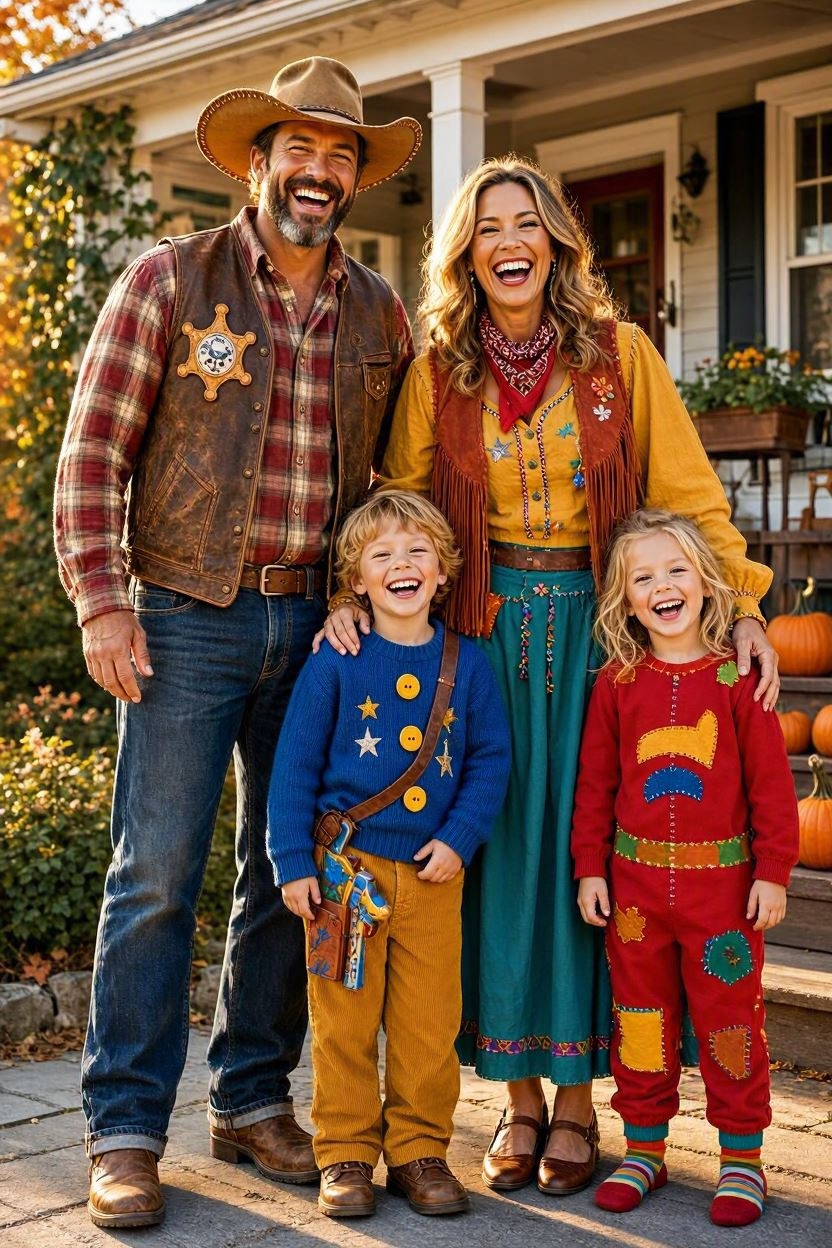
A large cast is what makes this theme so useful for a family with children at different ages. You can give everyone a character they actually like instead of trying to make four people wear variations of the same outfit.
Mom: Jessie or Bo Peep
Dad: Woody or Buzz Lightyear
Older child: Jessie, Buzz, Woody, Rex, or another favorite
Toddler: Forky, Alien, Woody, Jessie, or a simple toy-inspired character
This is one of those family Halloween costumes where personality can guide the choices. Your dinosaur-loving child can be Rex, your toddler can be a little Alien, and an adult who doesn’t want an elaborate costume can use recognizable Woody or Bo Peep details with ordinary clothes.
You can also keep the spending under control by building each costume around one or two unmistakable details rather than buying a complete character outfit.
A cowboy hat and vest can do a lot of the work for Woody; a simple green-and-white color combination can suggest Buzz.
For a toddler, prioritize movement and comfort over getting every detail right. If the costume works only when the child keeps a bulky accessory on, it probably needs simplifying.
The character should still be recognizable when the accessory comes off.
4. The Incredibles

The strength of this theme is its simplicity: everyone belongs to the same superhero family, so you don’t have to invent separate costumes that somehow connect afterward.
Mom: Elastigirl
Dad: Mr. Incredible
Older child: Violet or Dash
Toddler: Jack-Jack or a simplified Parr family costume
You can use the characters’ recognizable red superhero look as the visual link between everyone. The children can have their own character identities without needing completely different colors or complicated accessories.
For a family costume, this is also easy to simplify. A red top with the recognizable Incredibles emblem can communicate the idea without requiring a full superhero bodysuit.
For a toddler, that simpler approach can be more practical than a costume with a cape or several separate pieces.
One thing to remember is that the Incredibles’ black eye masks are part of the character look, but your child doesn’t need to wear one for the costume to work.
If a mask interferes with vision, feels uncomfortable, or won’t stay in place, leave it out. The costume should still be recognizable from the clothing and emblem alone.
5. Super Mario Family

The Mario universe gives each member of the family a recognizable character, which makes it easier to accommodate different ages and preferences without making everyone dress alike.
Mom: Princess Peach or Princess Daisy
Dad: Mario or Luigi
Older child: Luigi, Mario, Yoshi, Toad, Bowser, or another favorite character
Toddler: Toad, Yoshi, a simple Mario-inspired outfit, or another character they enjoy
The characters have their own colors and visual details, but they all come from the same recognizable game world.
That gives your older child room to choose a character they actually want while your toddler can have a much simpler version.
You can also avoid buying a complete costume for every person.
For example, Mario’s red shirt, blue overalls, cap, and moustache are strong character cues, while Luigi can be created with the corresponding green-and-blue combination. A child who doesn’t want a hat can still participate through the colors and clothing.
For toddlers, skip accessories that are likely to become annoying or get dropped during the evening. If the character is still obvious without the prop, you’ve made the costume easier to wear without losing the theme.
6. Peter Pan / Neverland

Neverland works particularly well when you want everyone to have a different role. Instead of matching outfits, your family becomes a small cast from the same story.
Mom: Wendy or Tinker Bell
Dad: Peter Pan or Captain Hook
Older child: Peter Pan, Wendy, Captain Hook, or a Lost Boy
Toddler: Lost Boy, Tinker Bell-inspired character, or another simple Neverland character
The variety gives each person more freedom to choose what feels comfortable.
Your older child might prefer Peter Pan or Captain Hook, while a toddler can have a much simpler costume without needing to reproduce a detailed character outfit.
You can also build the theme around recognizable clothing rather than relying on elaborate costumes.
A pirate-style outfit can establish Captain Hook, while green clothing and a pointed hat can suggest Peter Pan. Wendy’s look can similarly be kept simple.
For a toddler, be cautious with accessories such as toy weapons, hooks, or small detachable pieces. Keep the main costume comfortable and let the story come from the clothing rather than from accessories the child has to carry all night.
If you’re planning to share Halloween treats with friends or neighbors, Halloween Treat Bags for Neighbors: What to Put Inside for a Thoughtful Halloween Surprise has ideas for putting together a thoughtful little surprise.
7. The Flintstones

The Flintstones gives you a family theme where the adults and children already have natural character roles, so you don’t have to force a connection between unrelated costumes.
Mom: Wilma or Betty
Dad: Fred or Barney
Older child: Pebbles or Bamm-Bamm
Toddler: Pebbles, Bamm-Bamm, or a simple Stone Age-inspired outfit
The visual identity is easy to recognize: simple prehistoric-looking clothing, bold shapes, and the familiar characters. You can also adapt the costumes to what each person is comfortable wearing rather than trying to recreate the cartoon outfits perfectly.
For family Halloween costumes, this is a useful choice when you want something recognizable without needing complicated props.
Fred’s look can be built around an orange tunic and dark tie, while Wilma’s character is strongly associated with a simple white dress and red hair. The children’s costumes can be simplified further.
One practical advantage is that the theme doesn’t depend on masks or elaborate accessories. That makes it easier to adapt for younger children, who may be happier in ordinary clothing with a few costume-specific details.
8. A Garden Family

You don’t need a movie franchise or famous characters to create memorable family Halloween costumes. A garden theme gives everyone a different role while keeping the whole group connected to one setting.
Mom: Gardener
Dad: Gardener, groundskeeper, or scarecrow
Older child: Sunflower, butterfly, ladybug, or another garden element
Toddler: Bee, flower, or another simple garden creature
The parents can start with clothes they already own and add a few recognizable details, while the children take on the more playful parts of the garden.
That makes the theme particularly adaptable when one family member doesn’t want to wear a traditional costume.
You can also make the connection stronger through repeated colors and materials. Green clothing for the adults and bright floral or insect-inspired colors for the children can make the group look intentional without requiring matching outfits.
For a toddler, a simple flower or bee costume can work better than one with lots of separate pieces. Keep wings, antennae, hats, and other accessories secure and age-appropriate, and don’t make the entire costume dependent on them staying in place.
9. A Farm Family
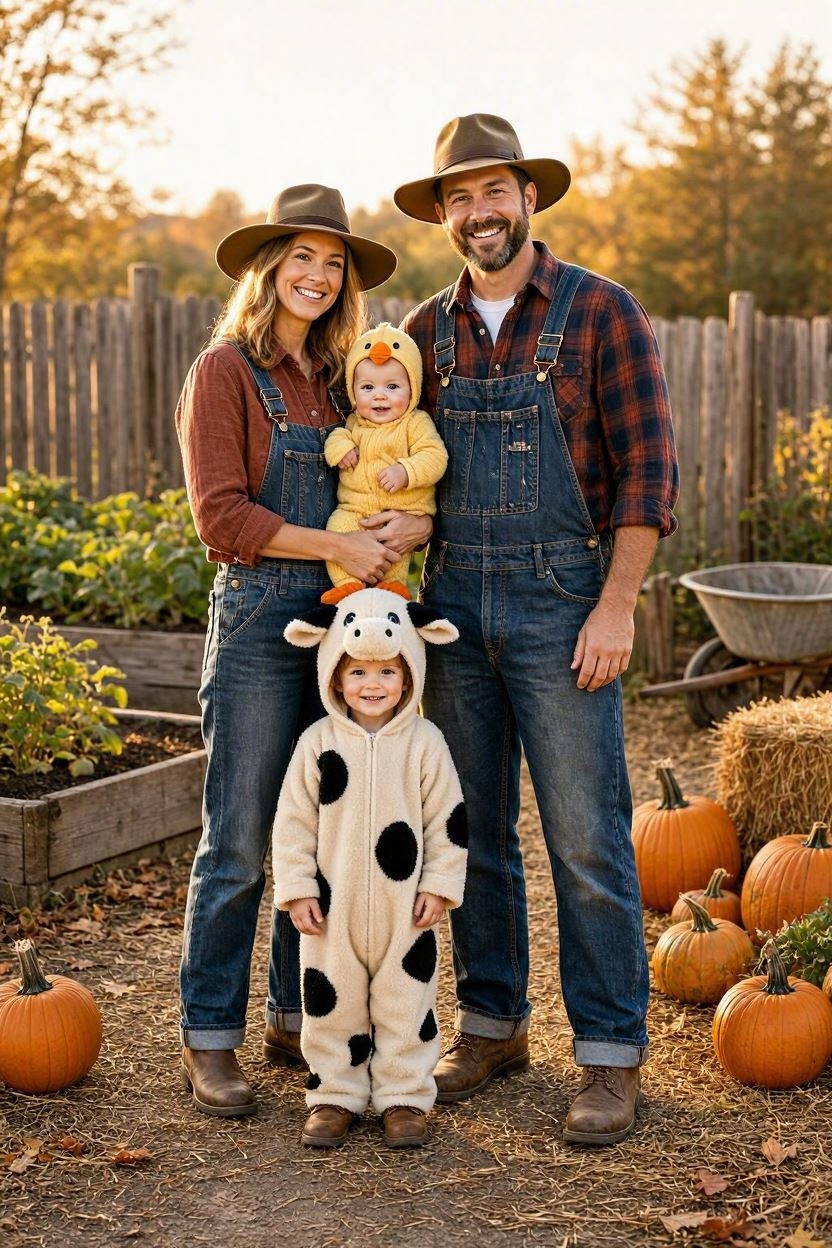
A farm theme gives you another way to create family Halloween costumes without putting everyone into the same type of outfit. The adults can represent the people who work on the farm while the children become the animals.
Mom: Farmer
Dad: Farmer or farmhand
Older child: Cow, chicken, pig, sheep, or another farm animal
Toddler: Piglet, chick, lamb, or another simple farm animal
This works particularly well for families with young children because the roles are easy to understand and can be adapted to different levels of costume effort.
The adults can use everyday clothing such as jeans, a checked shirt, boots, and a hat, while the children get the more playful animal roles.
You don’t need to turn the costumes into detailed animal replicas.
For a child dressed as a cow, for example, black-and-white clothing with simple cow-inspired details can communicate the idea without making the outfit bulky or difficult to move in.
The same principle helps with toddlers. A comfortable animal-themed outfit is often more practical than a costume with a large headpiece, long tail, or several pieces that can come loose.
If the child can still walk, sit, play, and move naturally, the costume has a much better chance of lasting through the evening.
10. Space Mission

A space theme gives you a useful advantage: everyone can have a different role without the family looking disconnected. You can build the group around astronauts, space exploration, and the things you might encounter on a mission.
Mom: Astronaut
Dad: Astronaut, flight director, or mission-control character
Older child: Astronaut, robot, alien, or planet-inspired character
Toddler: Little astronaut, alien, or simple planet costume
You don’t need to turn every costume into a replica of a real NASA spacesuit.
A simple astronaut look can be built around a white outfit with clearly visible space-themed details, while the rest of the family can use related colors and symbols to establish the theme.
If you want a more educational angle, you can even make the costumes reflect different parts of a space mission. One parent could represent mission control while the children become astronauts exploring the “planet.”
That gives everyone a role without requiring four expensive costumes.
For younger children, keep the costume light and easy to move in. Bulky cardboard “spacesuits,” oversized helmets, or accessories that obstruct vision may look impressive in a photograph but can become frustrating once the child starts walking around.
For families with younger children who prefer cute over creepy, Halloween Crafts for Kids Who Don’t Like Scary Decorations: 15 Cute Ideas Without the Creepy Stuff offers plenty of friendlier Halloween projects.
11. Classic Storybook Family

Instead of choosing characters from one particular film, you can build the family around children’s storybook characters and fairy-tale imagery. This gives you much more freedom when everyone has different costume preferences.
Mom: Storybook character, fairy, queen, or another recognizable figure
Dad: King, woodsman, storyteller, or another character
Older child: Favorite fairy-tale or storybook character
Toddler: Little red riding hood, animal, fairy, bear, or another simple character
The important part is to establish a clear storybook connection rather than randomly combining characters that have nothing in common.
You could choose a woodland-story theme, for example, and have the adults as storybook characters while the children become the animals.
You can also make the costumes less expensive by starting with ordinary clothing. A cape, crown, apron, basket, or other defining piece can often communicate a character more effectively than adding lots of unnecessary details.
For a toddler, choose a character that still makes sense without complicated props. A child dressed as a little bear or woodland animal can participate fully without needing to carry anything or wear an uncomfortable accessory.
12. A Circus Family

Circus theme lets everyone have a different role, which makes it particularly useful when your family members don’t want identical costumes.
Mom: Ringmaster, acrobat, or circus performer
Dad: Ringmaster, strongman-inspired performer, or clown
Older child: Acrobat, juggler, clown, or circus performer
Toddler: Circus animal, clown, or another simple performer
The theme becomes clearer when you repeat a few visual elements across the group, such as bold patterns, theatrical accessories, or a shared color palette, rather than trying to make every costume identical.
You also don’t need to recreate a traditional circus in every detail. A parent can use an existing jacket with a bow tie or other costume details to suggest a ringmaster, while a child can use a simple performer-inspired outfit.
One thing I’d be careful about is props. A circus theme can tempt you to add toy juggling equipment, canes, oversized accessories, or other objects that are difficult for young children to manage.
For a toddler, the costume itself should do most of the work. Keep anything they carry lightweight, age-appropriate, and optional rather than making the prop essential to the character.
Need a costume without buying a whole new outfit? DIY Oktoberfest Costume: 7 Outfits You Can Make From Clothes Already in Your Closet shows how to put one together using pieces you may already have.
13. Dinosaurs + Paleontologists

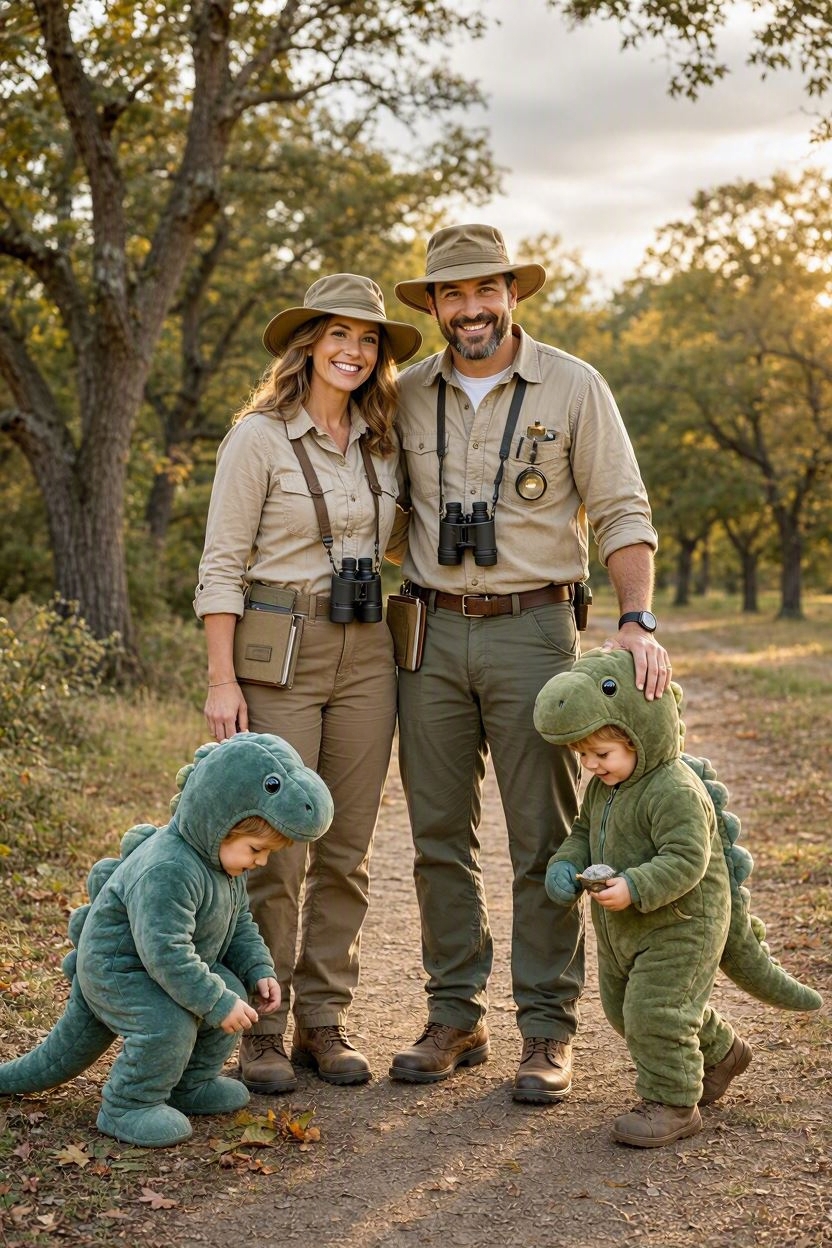
This is a clever choice when your children want to be dinosaurs but you still want the adults to feel like part of the costume rather than simply standing beside them in unrelated outfits.
The adults can become the people studying the creatures, while the children take on the prehistoric roles.
Mom: Paleontologist
Dad: Paleontologist or field researcher
Older child: T. rex, Triceratops, Velociraptor, or another dinosaur
Toddler: Baby dinosaur, dinosaur egg, or a simple dinosaur costume
The theme also gives you an easy way to make the family look connected without matching. Neutral outdoor clothing, a field hat, boots, and a toy or homemade “fossil” can establish the adults’ roles, while the children’s dinosaur costumes provide the playful part.
For family Halloween costumes, this is particularly useful because the adults don’t need elaborate costumes.
You can also use the theme to teach children something while preparing for Halloween: a paleontologist studies ancient life, including dinosaurs and other organisms preserved in the fossil record.
Just be careful not to describe paleontologists as people who “bring dinosaurs back to life”, their work involves studying fossils and evidence from Earth’s past.
For toddlers, choose a dinosaur costume that allows normal movement and doesn’t rely on a large headpiece. A simple dinosaur hoodie or comfortable one-piece can communicate the idea without making the child struggle with the costume.
14. Bees, Beekeepers and a Garden

This theme works because the roles naturally belong to the same environment. Instead of dressing everyone as bees, you can let the adults represent the people caring for the garden or keeping bees while the children become part of that world.
Mom: Beekeeper or gardener
Dad: Beekeeper or gardener
Older child: Bee, butterfly, flower, or ladybug
Toddler: Little bee, flower, or another simple garden character
For family Halloween costumes, the visual connection can come from the colors and setting rather than identical clothing. Yellow-and-black details can suggest bees, while green and floral elements can tie the whole group back to the garden.
There is also a small educational opportunity here. Bees are important pollinators, and many flowering plants depend on animal pollinators to reproduce. That gives the theme more substance than simply putting everyone in black-and-yellow costumes.
One detail I’d avoid is making the costume look too much like actual beekeeping equipment. Real beekeepers use protective clothing and equipment because bee stings are a genuine occupational concern; your costume only needs to suggest the role.
For a toddler, keep wings, antennae, and other decorative pieces secure and optional. A yellow-and-black outfit can still communicate “bee” even after the accessories come off.
15. Classic Monsters

A monster theme gives every member of the family a distinct character while keeping the overall look unmistakably Halloween.
You can choose from classic horror figures such as Dracula, Frankenstein’s monster, the Mummy, a werewolf, or the Bride of Frankenstein.
Mom: Bride of Frankenstein, vampire, witch, or another classic monster
Dad: Dracula, Frankenstein’s monster, werewolf, or mummy
Older child: Vampire, mummy, werewolf, or another age-appropriate monster
Toddler: Friendly mummy, little vampire, ghost, or simplified monster
The important thing with younger children is tone. You don’t have to make the toddler genuinely frightening just because the adults are dressed as classic monsters.
A soft mummy costume or friendly ghost can keep the child within the theme without introducing frightening makeup, fake wounds, or frightening props.
For family Halloween costumes, this theme also gives you plenty of room to work with clothing you already have. A dark suit and cape can suggest a vampire, while white or neutral fabric can create a simple mummy effect.
The goal is to use a few recognizable visual cues rather than covering everyone in complicated makeup.
And because some traditional monster costumes involve props or imitation weapons, keep those out of the hands of young children.
The CPSC recommends avoiding sharp or rigid costume accessories for children and choosing flexible alternatives instead.
For toddlers especially, you can skip masks altogether. A costume can communicate the character through clothing, colors and simple accessories without covering the child’s face or restricting their vision.
16. The Camping Family

You don’t need a famous movie or cartoon to make a family costume work. A camping theme gives each person a different role while keeping everyone inside the same little outdoor world.
Mom: Camper, hiker, or park ranger
Dad: Camper, park ranger, or outdoorsman
Older child: Bear, forest ranger, camp counselor, or another woodland character
Toddler: Little bear, raccoon, squirrel, or campfire-inspired costume
What makes this idea work is the relationship between the roles. The adults can look as though they are on a camping trip while the children become part of the forest around them.
You can also keep the adult costumes simple by using clothing you might already have—jeans, a flannel shirt, hiking-style shoes, a vest, or a backpack.
For the children, you don’t need an elaborate animal costume. A hoodie with simple ears or an animal-inspired outfit can establish the character without making it difficult to walk or sit.
There’s also room to make the theme feel more cohesive in family photographs. Repeating earthy colors, adding small outdoor details, or carrying one harmless camping accessory can visually connect everyone.
Just don’t turn the costume into a collection of bulky props.
A real camping trip already involves enough things to carry, and a Halloween outing with young children is no different. Keep anything you bring lightweight and easy to put down.
If you enjoy making things and want to turn the Halloween season into an income opportunity, check out Halloween Crafts to Make and Sell: 21 Ideas to Cash In on the Spookiest Season.
17. Breakfast / Diner Family
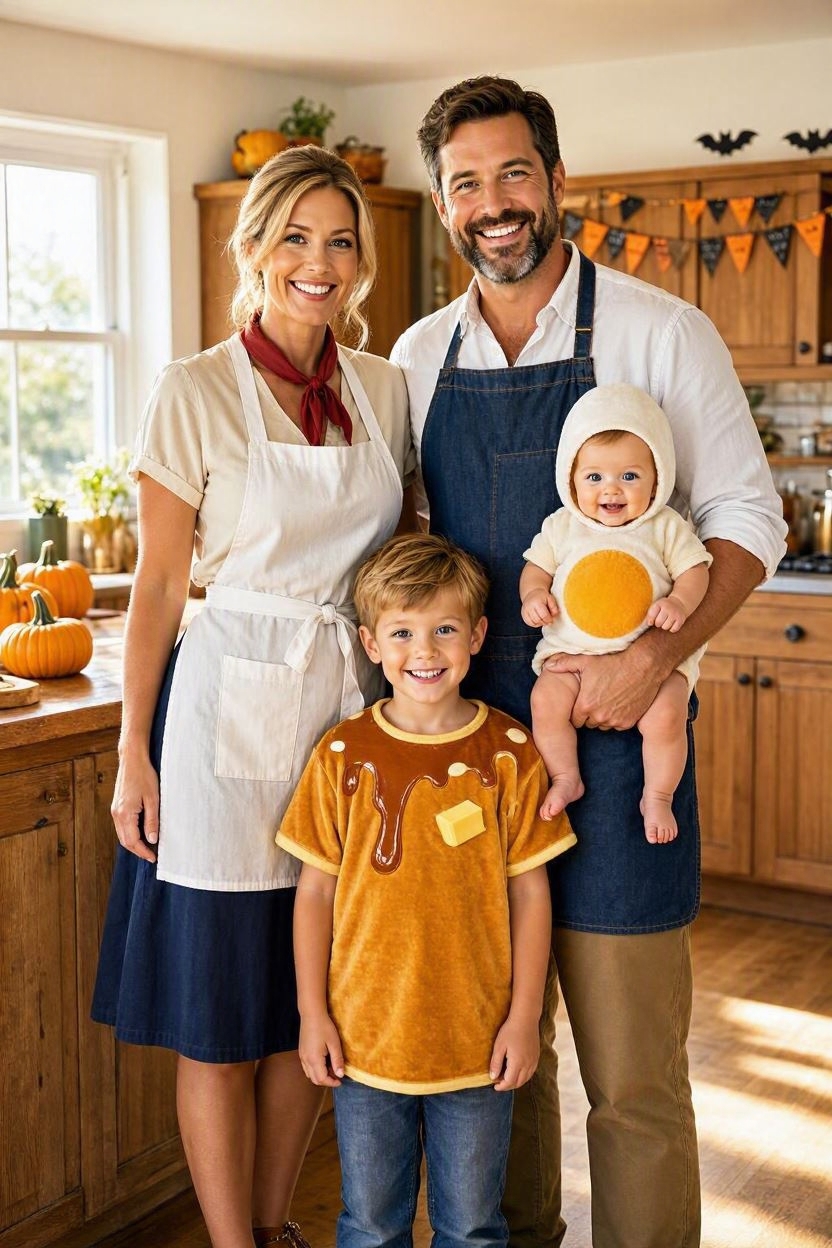
If your family would rather make people laugh than dress as another movie family, this one gives you a completely different direction.
Mom: Diner waitress, chef, or café owner
Dad: Cook, waiter, or diner customer
Older child: Pancake, cereal, toast, milkshake, or another breakfast food
Toddler: Egg, toast, fruit, cereal, or a simple food-inspired costume
The idea works because the costumes belong to the same breakfast or diner setting. You can make the adults look like they work at the diner while the children become the food that might appear on the menu.
It also gives you plenty of room to decide how far you want to take the costumes.
A parent could use an apron and ordinary clothing rather than buying a complete uniform, while a child’s costume can use a recognizable food shape or color without needing elaborate construction.
For a toddler, I’d keep the food costume soft, lightweight, and easy to move in. Avoid turning the costume into a large cardboard structure that restricts the child’s arms or vision.
A simple sweatshirt, hat, or soft padded shape can communicate the idea without making the child carry their costume around.
And if you want the whole group to photograph well, choose one food theme rather than mixing breakfast with completely unrelated foods.
Pancakes, eggs, toast and a diner chef tell one story; pizza, sushi and ice cream start to look like three different ideas.
How to Make the Family Look Coordinated Without Making Everyone Identical

You don’t need to put everyone in the same shirt or use the same costume in four different sizes. What you need is one or two visual details that keep appearing across the group.
The easiest place to start is color. If your family is dressing as characters from the same story, look for colors that naturally connect the costumes. You might repeat red in one person’s hat, another person’s shirt, and a child’s accessory.
The costumes remain different, but the repeated color helps them photograph as a group.
You can also coordinate through materials or clothing style. Denim, plaid, black-and-white clothing, overalls, aprons, or simple neutral pieces can quietly connect costumes without making them look like uniforms.
Another option is to give everyone one small shared detail. It could be a bow, hat, badge, scarf, flower, cape, or another accessory that makes sense within the theme. This works particularly well when one family member doesn’t want a full costume.
Then consider the visual weight of the costumes. If one person is covered in an elaborate costume while everyone else is wearing ordinary clothes, the group can look disconnected.
You don’t need equal levels of detail, but each person should have at least one feature that clearly identifies their role.
And don’t forget the simplest coordinating tool of all: the setting of the characters. A gardener, sunflower, bee, and butterfly naturally belong together even though none of them looks alike. The relationship between the costumes does the work for you.
Before you buy anything, lay out everyone’s basic pieces together. You are looking for a connection, not four costumes that compete for attention.
The Safety Details to Check Before Leaving the House
Before you head out in your family Halloween costumes, take one quick look at how everything fits and moves. A costume that looks great in a photo can become uncomfortable or unsafe once you’re walking around outside.
-
Check the Fit
Make sure children can walk, sit, and move their arms without stepping on long fabric or getting caught in loose pieces. Proper fit helps reduce tripping risks.
-
Keep Faces Clear
Masks shouldn’t block a child’s vision or make breathing difficult. For toddlers, a simple costume without a mask is often easier to manage.
-
Watch the Accessories
Avoid sharp, rigid, or easily detachable accessories, particularly for young children. Keep small pieces away from toddlers who may put them in their mouths.
-
Think About Visibility
If you’ll be outside after dark, reflective details or small lights can help other people see your children more easily.
-
Do a 30-Second Movement Test
Before leaving, have everyone walk, sit, bend, and raise their arms. If something gets in the way now, it will probably become more annoying once you’re out.
Once Halloween is over, don’t let the pumpkins go straight to waste. What to Do With Leftover Pumpkins After Halloween: 9 Uses Before They Rot has practical ideas for using them up.
What to Do When One Family Member Doesn’t Want to Dress Up

Not everyone in a family will want the same level of Halloween participation. A toddler may refuse a costume, while an older child or adult may simply prefer ordinary clothes.
The American Academy of Pediatrics specifically advises allowing toddlers who don’t want to participate to opt out rather than forcing the issue.
1. Keep the Theme, Simplify the Costume
A person who doesn’t want a full costume can still fit into the family Halloween costumes through one recognizable detail. A farmer can wear jeans, a checked shirt, and a hat; a beekeeper can wear everyday clothes with a simple bee-themed accessory.
2. Let the Person Have a Say
Older children can choose their character or decide how much of the costume they are comfortable wearing. That keeps the family theme intact without turning Halloween into an argument over what someone has to wear.
3. Have a Backup for Little Ones
Toddlers can change their minds, spill something on a costume, or simply become uncomfortable. The AAP recommends having a Plan B costume and notes that a child who doesn’t want to participate doesn’t need to be forced.
If you want to get more wear from the clothes you already own, 13 Capsule Wardrobe Pieces That Work Across Three Seasons Without Buying New Clothes has practical ideas for building more outfits from fewer pieces.
How to Build the Costumes Around What You Already Own

The most convincing part of a costume is often the one detail that makes the character recognizable, not a closet full of newly purchased pieces. Look at what is already in your family’s wardrobes before buying anything.
-
Start With the Base
Jeans, plain shirts, dresses, jackets, sweaters, aprons, boots, and other everyday clothes can become the foundation of many costumes. A checked shirt and jeans can form the basis of a farmer, while a black dress can work as the starting point for a witch or Morticia-inspired outfit.
-
Add One or Two Defining Details
Think about what makes the character or theme immediately recognizable. A cowboy hat can establish Woody, a crown can suggest a royal character, and an apron can turn ordinary clothes into part of a chef or diner costume.
This approach also makes family Halloween costumes easier to coordinate because you can repeat a color, pattern, or small detail across several outfits without buying four complete costumes.
-
Let the Theme Do the Work
A costume doesn’t need every detail from the original character to be understandable. Choose the pieces that communicate the idea most clearly, then stop. This keeps the costumes more comfortable, less expensive, and easier to put together.
For toddlers especially, prioritize a comfortable base they can move in and add only details they are happy to wear. A costume that stays on is more useful than one that looks impressive but gets removed after ten minutes.
And if you’re looking for outfit ideas that feel good while still reflecting your personal style, Plus Size Outfits for Women Who Want to Feel Confident and Express Their Personality is worth a look.
Conclusion
A good Halloween photo is great, but the better outcome is getting through the evening without anyone wishing they had worn something else.
That is the real advantage of choosing family Halloween costumes that leave room for different ages, personalities, and comfort levels. Pick the theme your family can have fun with, then give each person enough freedom to make their part of it their own.
Come Halloween night, the costumes don’t need to be perfect. They just need to feel like your family.
FAQ:
-
What is the most popular family Halloween costume?
There isn’t one universally “most popular” family costume, because preferences vary by age, country, current entertainment, and whether a family wants a character-based or DIY theme. Well-known groups such as The Addams Family, Toy Story, The Wizard of Oz, and The Incredibles remain recognizable choices because they provide several distinct characters.
-
What are good family Halloween costumes for a family of 4?
A family of four has plenty of options because many themes naturally provide four recognizable roles. The Addams Family, The Wizard of Oz, Toy Story, The Incredibles, and a farmer-and-animals theme can all be adapted for two adults and two children.
-
What are easy last-minute family Halloween costumes?
Start with ordinary clothes and build around one recognizable item or color. A farmer, gardener, diner worker, astronaut, or storybook character can often be suggested with clothing already at home plus a small number of accessories.
-
What should a family wear for Halloween in cold weather?
Layering is usually more practical than choosing a costume that provides all the warmth by itself. Base the costume around warm clothing where possible, then add costume details over it. This is particularly useful for children who will spend time outdoors.
-
How much should you spend on family Halloween costumes?
There is no fixed amount a family needs to spend. The cost depends on whether you buy ready-made costumes, make them yourself, or combine existing clothing with a few purchased pieces. Starting with what you already own can reduce the number of new items you need to buy.