Plus-size Oktoberfest outfits shouldn’t pinch or feel awkward. Find dirndls, lederhosen and practical fit tips for a comfortable festival day.
Shopping for a dirndl when you wear a US size 20 or above can get confusing fast.
One website may call a garment a German 48, another may put the same US size under a different number, and the measurements that matter most may not match the way you normally shop for clothes.
Then there is the question of whether the bodice actually fits your bust and waist, whether the skirt gives you enough room to sit comfortably, and whether lederhosen will feel as good across your thighs as they do when you’re standing in front of the mirror.
That is why choosing plus-size Oktoberfest outfits is not simply a matter of finding a dirndl or lederhosen in a larger size.
Traditional garments have their own construction and fit, and the wrong size or cut can become uncomfortable quickly when you’re spending hours walking, sitting, eating and moving around the festival grounds.
This guide focuses on the details that are easy to miss when shopping online, from reading a dirndl size chart correctly and checking the fit of the bodice to understanding how leather lederhosen should sit on the body.
The goal is simple: help you choose an Oktoberfest outfit that fits the body you actually have and still feels comfortable when the day is more than a few photographs.
Create an Oktoberfest look without buying a whole new outfit with DIY Oktoberfest Costume: 7 Outfits You Can Make From Clothes Already in Your Closet.
Dirndl vs. Lederhosen: Understanding the Two Main Oktoberfest Looks

The two outfits most closely associated with Oktoberfest are the dirndl and lederhosen, but they are not simply two versions of the same outfit.
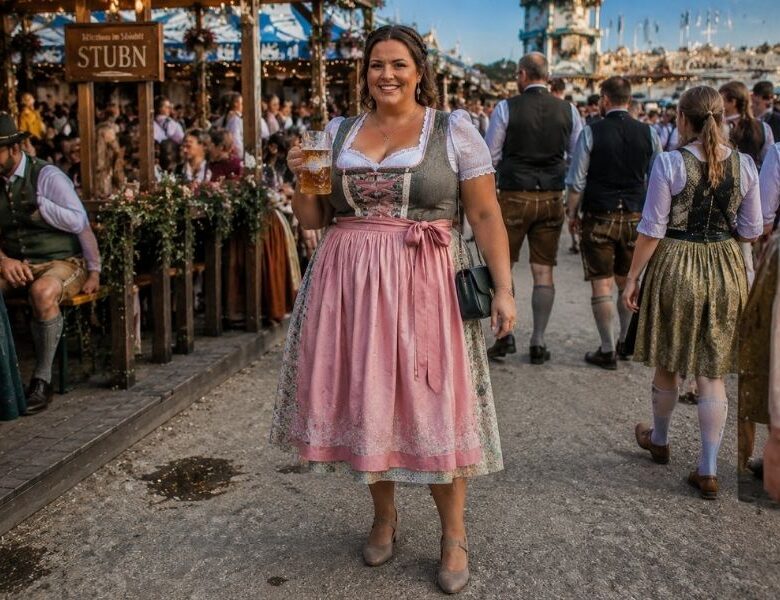
A dirndl is a traditional dress-based outfit made up of a bodice and skirt, normally worn with a blouse and an apron.
The bodice is designed to fit closely to the upper body, while the skirt can vary in length, fullness and fabric.
The blouse is a separate piece, and the apron is worn over the skirt. Necklines, sleeves and fabrics vary, so not every dirndl has the same appearance.
Lederhosen, meanwhile, are traditional leather breeches associated with Bavarian and wider Alpine dress. The name literally refers to leather trousers or breeches.
Traditional versions can be short or longer, and they are commonly worn with shirts or blouses, socks and sturdy shoes. Women’s lederhosen are also sold today, so a woman attending Oktoberfest does not have to choose a skirt simply because she wants to wear traditional-inspired clothing.
The difference is therefore more than dress versus trousers.
A dirndl gives you a structured bodice-and-skirt outfit with a separate blouse and apron, while lederhosen gives you a trouser- or short-based outfit that can be styled with different tops and traditional accessories.
Understanding What the Size Number Means

Seeing “size 20+” on an Oktoberfest shopping search does not give you a reliable dirndl size to order.
Traditional clothing is often sold using German or European sizing, and the conversion to US sizing is not consistent enough to treat one number as a universal equivalent.
That is easy to miss when shopping online. A retailer may list a German size, a US size, or both, but the actual measurements can differ between brands.
Current dirndl size charts, for example, do not all map a US 20 to the same German size. That is why the number on the label should be treated as a starting point, not the measurement you shop by.
For a size 20+ shopper, your body measurements and the individual brand’s size chart matter more than the number on the tag.
✅ Start With Your Bust and Waist
Dirndls are different from ordinary loose dresses because the bodice is a major part of the garment’s fit.
The bust and waist measurements are therefore particularly important when deciding which size to order.
Take your measurements without pulling the tape tight:
- Bust: Measure around the fullest part of your bust while wearing the bra you expect to wear with the dirndl.
- Waist: Measure around your natural waist rather than choosing the narrowest point of your torso simply because it gives a smaller number.
- Hips: Check the manufacturer’s instructions, particularly if the skirt is fitted rather than generously full.
- Height: Useful when the retailer provides garment lengths or when you are choosing between different skirt lengths.
Then compare those numbers with that retailer’s own size chart.
Do not assume that because you normally buy a US 20, every German size labelled as its equivalent will fit you.
And do not automatically size up because you are between two numbers. Look at where the difference occurs.
A garment that is generous through the hips but too small through the bust is a different fitting problem from one that is slightly loose at the waist.
Planning coordinated looks for everyone? Family Halloween Costumes: 17 Fun Ideas to Make Everyone Look Like a Team, From Toddlers to Parents has ideas for bringing the whole family into one theme.
The Dirndl Fit Test: Three Places That Tell You Whether It Actually Fits

A dirndl can close at the front and still be the wrong size. The better test is what happens to the garment when your body moves inside it.
Since the bodice is designed to fit closely, check these three areas before deciding that a dirndl works for you.
1. The Bust: Look at the Bodice, Not Just the Closure
Start with the fullest part of your bust. The bodice should sit firmly against your body without forcing the bust upward, flattening it uncomfortably, or creating obvious pulling between the closures.
Fasten the dirndl while standing normally, then take a deep breath and move your arms forward. Watch the fabric around the bust and underarms.
Signs the fit is working:
- The closures lie flat rather than straining.
- The fabric is not pulling strongly across the bust.
- You can breathe and move your arms normally.
- The neckline stays where it is supposed to sit.
Signs the bodice may be too small:
- Gaps appear between fastenings.
- Horizontal tension lines radiate from the bust.
- The armholes dig in when you move.
- The bodice feels restrictive even before you add the apron or blouse.
A larger body does not automatically need a larger size everywhere. If the bust needs more room but the waist fits correctly, look for a different cut or a retailer offering more suitable proportions rather than simply buying a much larger dirndl.
2. The Waist: Snug Is Different From Being Squeezed
The waist of a dirndl is supposed to have structure, so it may feel more fitted than an ordinary casual dress. That does not mean you should tolerate painful pressure.
Sit down in the dirndl for several minutes. This is where a borderline fit often becomes obvious.
The waistband or lower edge of the bodice should not dig sharply into your stomach when you sit. You should also be able to take a full breath without feeling as though the garment is restricting your middle.
Pay attention to where the pressure is coming from. If the waist feels uncomfortable only when sitting, the problem may be the shape or placement of the bodice rather than the overall size.
3. The Armholes and Shoulders: The Overlooked Test
A dirndl may fit around the bust and waist but still fail at the armholes.
Put your arms forward as though you were reaching across a table. Then raise them and turn your upper body from side to side.
The bodice should move with you without cutting sharply into the underarm area or pulling the entire garment upward.
This matters at Oktoberfest because you will not spend the day standing still. You may be carrying a bag, reaching for food, sitting beside other people or moving through crowded areas.
The Five-Minute Reality Check
Before keeping a dirndl, don’t judge it only while standing in front of a mirror.
Wear the complete outfit and:
- Sit on a firm chair.
- Stand up without adjusting the bodice.
- Reach both arms forward.
- Raise your arms above shoulder height.
- Take several deep breaths.
- Walk around for a few minutes.
Then check the same three areas again.
A dirndl that only looks right when you are standing perfectly still has not really passed the fit test.
For plus-size Oktoberfest outfits, comfort should be judged in motion, because that is how you will actually wear the clothes.
For more group costume inspiration where comfort and fit matter, see Plus-Size Group Halloween Costumes: 11 Costume Ideas That Fit the Group, Not Just the Theme.
Plus-Size Dirndl Outfits for Oktoberfest
A dirndl gives you more room to change the look than you might expect. The bodice, blouse, skirt and apron work as one outfit, but changing the blouse, skirt length, apron or layers can make the same basic combination feel quite different.
For a size 20+ wearer, the goal isn’t to find one supposedly “flattering” dirndl. It is to find a combination that suits your preferred coverage, the weather and the way you expect to spend your day at Oktoberfest, while still fitting properly.
Want styling ideas that create more definition around the waist? 13 Flattering Outfit Ideas That Hide Belly Fat and Make Your Waist Look Smaller explores different ways to work with your proportions.
1. Classic Dirndl With a Traditional Blouse and Apron

If you want the outfit that is most immediately recognisable as a traditional Oktoberfest look, start with the complete dirndl: bodice and skirt, dirndl blouse and apron.
The blouse is worn underneath the bodice and the apron over the skirt; these are not random accessories added after the fact but established parts of the outfit.
Official Oktoberfest guidance specifically discusses the blouse and apron as key elements of the dirndl.
For a size 20+ shopper, don’t assume that buying the dirndl in your usual dress size will automatically give you the right fit. The bodice is the part that deserves the most attention because it sits closely around the upper body.
Current plus-size dirndl guidance recommends using your bust measurement as a primary reference and checking the individual retailer’s measurements rather than relying only on a clothing-size conversion.
The blouse deserves attention too. It needs to fit comfortably across the bust and arms before the bodice is fastened over it.
If the blouse is already pulling or bunching, the finished outfit is unlikely to feel better once another fitted layer goes on top.
Then there is the apron. Its colour can coordinate with or contrast against the dirndl, but its length matters: official Oktoberfest guidance recommends an apron that comes to the hem of the dirndl rather than hanging below it.
The finished outfit:
Dirndl + blouse + apron + traditional-style shoes
This is a good starting point if you want the classic look and don’t want to spend time building an outfit from unrelated pieces.
2. Midi Dirndl With a More Covered Blouse

A midi dirndl is worth considering when you want more skirt coverage without moving away from the recognisable dirndl silhouette.
Knee-length styles are not some modern compromise invented specifically for plus-size women; the official Oktoberfest guide notes that knee-length dirndls are popular and that very short versions can become impractical.
Pair the skirt with a blouse that gives you the amount of coverage you actually prefer.
That could mean a conventional short-sleeved blouse or a style with more fabric around the neckline and shoulders.
The practical advantage of paying attention to length is what happens outside the mirror.
Sit down in the complete outfit. Walk up stairs. Check how much skirt you have around your legs when seated and whether your shoes work with the length.
There is no reason to tell every size-20+ woman that midi is the “most flattering” length. It isn’t a universal rule. The useful question is whether you like the proportion and can move comfortably in it.
The finished outfit:
Midi dirndl + blouse + apron + stable traditional-style shoes
3. Plus-Size Dirndl With a High-Neck Blouse

Not every dirndl has to come with the deep neckline that appears in many Oktoberfest photographs.
A high-neck blouse can give the same basic dirndl structure a more covered appearance.
Official Oktoberfest guidance specifically mentions high-necked blouses as an established and fashionable option alongside more open-neck styles.
This can also be a useful way to change the look of a dirndl you already own. Rather than buying another complete outfit, switching the blouse can alter the neckline and overall impression.
When shopping, check how much fabric gathers around the neck, shoulders and bust.
Once the fitted bodice goes over the blouse, excess material can become more noticeable. Try the two pieces together rather than judging the blouse by itself.
The finished outfit:
Dirndl + high-neck blouse + apron + closed traditional-style shoes
The result is still recognisably a dirndl; it simply doesn’t depend on showing a lot of the chest to create the look.
4. Plus-Size Lederhosen With a Traditional-Style Blouse

If skirts aren’t your thing, lederhosen give you another route into Oktoberfest dress.
Lederhosen are traditional leather breeches associated particularly with Bavaria and other Alpine regions, and they come in different lengths and constructions.
For a size 20+ outfit, the important thing isn’t simply finding a pair labelled “plus size.”
Look at how the leather garment sits across your waist, hips and thighs, and check the rise and leg opening where the retailer provides those measurements.
This is especially important because a pair that closes while you’re standing can still feel restrictive once you sit down.
Wear them with a traditional-style blouse or shirt, then add appropriate socks and shoes. The result is distinctly different from a dirndl without looking as though you simply swapped a skirt for ordinary shorts.
The finished outfit:
Lederhosen + blouse/shirt + socks + traditional-style shoes
For budget-friendly ways to create a polished wardrobe, Old Money Outfit Ideas from Thrift Flips That Look Rich (But Cost Almost Nothing) has plenty of inspiration.
5. Longer Lederhosen or Traditional Leather Trousers
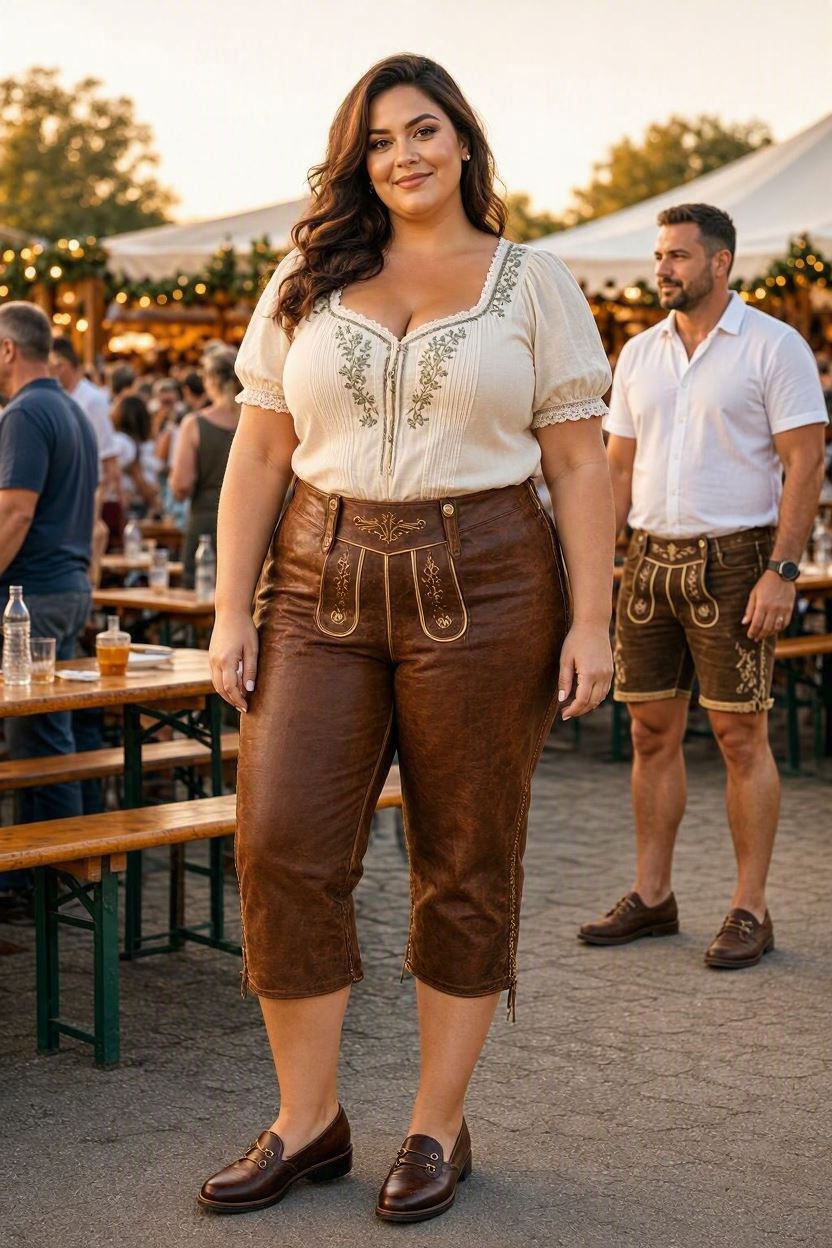
Short leather breeches are probably the image that comes to mind first when someone says “Oktoberfest,” but they are not the only length associated with lederhosen.
Historical and traditional forms include longer versions as well; the official Oktoberfest history of lederhosen describes variations ranging from long leather trousers to knee-length and shorter forms.
That gives you another option if you don’t want short leather shorts.
A longer pair can be combined with a blouse or shirt and appropriate footwear for a look that still draws from Alpine Tracht without reproducing the most familiar short-lederhosen image.
When buying, don’t choose the trousers on waist measurement alone. Check the hips, thighs, rise and leg opening as well. Leather garments need to allow you to sit and move without excessive pressure.
The finished outfit:
Longer lederhosen or leather trousers + blouse/shirt + socks + shoes
6. Lederhosen With a Trachten Waistcoat

Adding a waistcoat gives the lederhosen outfit more structure and another layer, which can be useful when the weather is cooler.
The key is to distinguish between an actual Trachten waistcoat and a generic vest being sold simply because it has Bavarian-looking decoration.
Traditional costume has its own regional variations, so not every waistcoat marketed as “Oktoberfest” represents a specific traditional style.
For a modern festival outfit, though, you can deliberately choose a Trachten-inspired waistcoat that coordinates with the leather trousers and blouse. Just make sure the additional layer doesn’t make the outfit restrictive around the bust or arms.
The finished outfit:
Lederhosen + blouse/shirt + Trachten-style waistcoat + appropriate shoes
It is a particularly useful combination if you want your outfit to feel more dressed-up than lederhosen and a shirt alone.
7. Dirndl Outfit for Cooler Oktoberfest Weather

Oktoberfest 2026 runs from September 19 through October 4, so your outfit may need to work in temperatures that are quite different from those of a summer event.
A practical cooler-weather combination could be:
Dirndl + blouse + tights/hosiery + closed shoes + removable outer layer
The important thing is where the extra warmth goes. You don’t necessarily want to put a thick sweater underneath a fitted dirndl bodice, because the additional bulk can change how the bodice sits and fastens.
Tights or hosiery can add warmth without taking up much room, while a cardigan or traditional jacket gives you something you can remove if you become warm inside a tent. The official Oktoberfest dirndl guide also recommends having a jacket for cooler evenings and mentions the traditional Janker as one option.
This is one situation where trying the complete outfit together matters. A layer that works with the blouse alone may feel completely different once the bodice is fastened.
Petite women can also find useful proportion tips in Outfit Problems Short Women Deal With — Which Ones Are Ruining Your Look?.
8. Tracht-Inspired Outfit Without Buying a Complete Dirndl

Maybe you like the look of Oktoberfest clothing but don’t want to spend money on a complete dirndl, or perhaps you simply don’t want to wear one.
You can build an Oktoberfest-inspired outfit from separate pieces: a traditional-style blouse with a full skirt or trousers, for example, combined with a waistcoat or another suitable layer.
The important distinction is terminology. A modern combination inspired by Bavarian or Alpine clothing isn’t automatically a traditional dirndl or authentic regional Tracht.
Calling it Tracht-inspired is more accurate.
And you don’t need to feel as though you’re breaking a dress code by choosing this route. Traditional clothing is strongly associated with Oktoberfest, but it isn’t required to attend.
The finished outfit:
Traditional-inspired blouse + skirt or trousers + optional waistcoat/cardigan + practical shoes
This is probably the most flexible option if your priority is creating an outfit around clothes you already own rather than purchasing a complete costume.
Before buying another themed outfit, take a look at 15 Genius Ways to Upcycle Old Clothes Into Trendy New Outfits for ways to give pieces you already own a fresh look.
How to Know Your Plus-Size Oktoberfest Outfit Will Still Feel Good After Hours

The first try-on can be misleading. A dirndl or pair of lederhosen may feel perfectly fine while you are standing in front of a mirror, but Oktoberfest involves much more than standing still for photographs.
Before settling on one of your plus-size Oktoberfest outfits, wear the complete outfit at home and put it through a few ordinary movements.
Sit down for several minutes, stand up, walk around, climb a few stairs and raise your arms. Keep your shoes on and carry the bag you plan to take with you.
Pay attention to the places that start complaining first. The dirndl bodice should not become painfully tight when you sit or breathe deeply.
The blouse should not pull across the bust or restrict your arms. Lederhosen should remain comfortable around the waist, hips and thighs when you sit rather than only fitting well while standing.
Your shoes deserve the same test. If they already pinch, rub or make your feet tired after a short walk around the house, a full day on your feet is unlikely to improve the situation.
It is also worth wearing the outfit long enough to notice smaller annoyances: an apron that keeps shifting, a waistband that digs in, a blouse that rides up or a seam that repeatedly rubs against your skin.
These may seem minor at first, but several hours of the same irritation can change how much you enjoy the day.
The best test is therefore simple: don’t ask only whether the outfit looks good. Ask whether you can forget you’re wearing it once the day gets busy.
Make the most of clothes you already own with 13 Capsule Wardrobe Pieces That Work Across Three Seasons Without Buying New Clothes.
What to Wear If You Don’t Want to Dress in Traditional Tracht (Plus-Size Oktoberfest Outfit Options)

Not everyone attending Oktoberfest wants to wear a full dirndl or lederhosen, and that is completely fine.
Traditional Tracht remains popular at the festival, but visitors do not have to wear it. You can still create a festive look that suits your personal style and feels comfortable throughout the day.
If you’re looking at plus-size Oktoberfest outfits but don’t want traditional Tracht, shift the goal from recreating a traditional outfit to putting together something that feels right for the setting and works for hours of walking, sitting and socialising.
One simple approach is to borrow a few Tracht-inspired elements without wearing a complete traditional outfit.
For example, pair a structured or embroidered blouse with a midi or full skirt for an Oktoberfest-inspired look without a dirndl bodice. A traditional-style blouse also works with trousers if you prefer trousers for walking and sitting.
You can also let accessories do some of the work. Start with clothes you already own, then add a waistcoat, an apron-inspired layer or traditional-style footwear to give the outfit a more festival-ready feel.
The important thing to remember is that Oktoberfest does not require visitors to follow a strict dress code. Traditional Tracht has strong cultural significance and remains a familiar part of the festival, but modern clothing also appears among visitors.
So if you choose not to wear Tracht, prioritise comfort, weather and practicality. Your outfit should let you walk, sit, eat and enjoy the festival without constantly pulling, tightening or readjusting something.
You don’t need a full traditional outfit to feel dressed for Oktoberfest. You simply need an outfit that feels like you and works for the day ahead.
Traditional clothing can also inspire everyday styling. How to Style Cultural Prints in Modern Outfits (Without Looking Old-Fashioned) shows how to give cultural pieces a more current feel.
Conclusion
The best plus-size Oktoberfest outfits aren’t about following one fixed formula. A well-fitted dirndl, comfortable lederhosen or a Tracht-inspired outfit can all work when the pieces suit your body, your plans and the weather.
Before you order, check the actual measurements, try the complete outfit together and make sure you can sit, walk and move without constantly adjusting something.
Found an outfit you like? Use these fit checks before you buy, then choose the one you can genuinely enjoy wearing from the first stein to the last song.