Not sure what to make for the host? These Thanksgiving hostess gifts are thoughtful, useful, and easy to make
A Thanksgiving invitation usually comes with one small question: what should you bring for the host?
You could pick something up on the way there, but a homemade gift can feel a little more personal. It just helps to choose something that suits the person you’re giving it to and that they can enjoy or use after Thanksgiving too.
That could be a batch of cookies they can save for later, a useful kitchen item, a reusable fabric piece, or a small gift made around something you already know they like.
So, if you have been invited to Thanksgiving dinner and want to make something instead of buying a gift, here are 17 Thanksgiving hostess gifts worth considering.
Some are quick to make, some are good for using up supplies you already have, and others take a little more time but can be personalized for the person you’re giving them to.
Make your outdoor space feel more inviting with 19 Outdoor Entertaining Ideas for Homebodies Who Love to Host
Thanksgiving Hostess Gifts Worth Making
1. A Reusable Fabric Bread Basket Liner

A bread basket liner is one of those small table pieces that can be useful without becoming another decoration to find a place for.
It sits inside the basket and gives bread or dinner rolls a clean surface to rest on while also making the basket look a little more finished when it reaches the table.
The fabric you choose matters more than it might seem. Cotton and linen are good starting points because they are washable and breathable, which is useful for a piece that will be used around bread.
You don’t want to make the liner from a fabric that sheds heavily, has a strong chemical finish, or is difficult to wash. Prewashing the fabric before sewing is also worth doing because cotton can shrink, and you don’t want the finished liner to become too small after its first wash.
You also don’t have to make it look specifically like Thanksgiving. A small check, stripe, neutral solid, simple floral, or muted autumn print can work for Thanksgiving and still look right on the table at other times of the year.
That makes the gift more useful than a liner covered in turkeys or holiday lettering.
The basket itself should determine the size of the liner. If you know which basket the host uses, measure its inside length and width rather than guessing from a standard bread-basket size.
For a simple rectangular or square basket, you can make the liner large enough to cover the base and come partway up the sides. A little extra fabric is useful because the liner needs to sit inside the basket rather than pull tightly across the opening.
For a round basket, measure across the inside of the basket and make the liner as a circle or use a square piece that folds naturally over the edges.
The shape doesn’t have to be complicated; what matters is that the finished piece sits comfortably inside the basket without bunching up underneath the bread.
One more thing to consider is how the bread will be served. A very thick liner may look substantial, but it can take up useful space in a smaller basket. A lighter washable fabric is usually easier to fold, remove and wash.
If you are giving this as a Thanksgiving hostess gift, you can fold it neatly and pair it with a small loaf of bread or a few rolls. But the liner itself should still be useful on its own, the host shouldn’t have to keep buying a particular type of bread just to use the gift.
2. Set of Cloth Cocktail Napkins

Cloth cocktail napkins work well as a hostess gift because they sit in that middle space between decorative and practical.
They are small enough not to feel like a burden to store, but useful enough to come out again for other gatherings after Thanksgiving.
Smaller napkins are also easier to give as a low-commitment gift. They don’t require a full dining set or a specific table setup, so the host can use them casually when serving drinks, snacks, or even small desserts.
Fabric choice matters here. Cotton and linen blends are the most reliable because they wash well and hold up after repeated use.
Very stiff or heavily coated fabrics tend to lose their softness after washing, which makes them less pleasant for something meant to be handled at the table.
Prewashing cotton before cutting is important because it prevents shrinkage after sewing, which can distort the finished edges and make a neatly cut set look uneven after the first wash.
A set of four or six usually feels complete.
Fewer than four can feel unfinished, while more than six starts to feel like a full household item rather than a small gift. The goal is something that feels intentional but not excessive.
Emily Post also notes cocktail napkins as an appropriate type of hosting gift because they are practical and easy for the host to incorporate into future gatherings without any extra effort.
3. Handmade Recipe Card Holder

Recipe card holders solve a small but often overlooked kitchen problem: keeping a recipe visible while cooking without it slipping into spills, drawers, or cluttered countertops.
There are several simple ways to make one depending on the materials you already have:
- A small wooden block with a metal clip attached on top
- A clay base with a wire or metal stand inserted before it fully hardens
- A painted wooden stand with a simple groove to hold cards upright
- A repurposed photo frame with a clip or string added to hold the recipe
Each version does the same thing, so the focus is less on complexity and more on stability. The holder needs to sit flat and keep the card visible at a comfortable angle while someone is cooking.
The more thoughtful part of this gift is what it carries. The holder becomes the practical piece, while the recipe card itself can be personal.
A handwritten recipe from your own kitchen adds meaning without needing decoration or holiday themes. It turns a simple object into something the host can actually use, especially during or after the holiday season.
Instead of making something purely decorative, this kind of gift works because it fits into a real kitchen routine.
4. Small Fabric Bowl Cozy
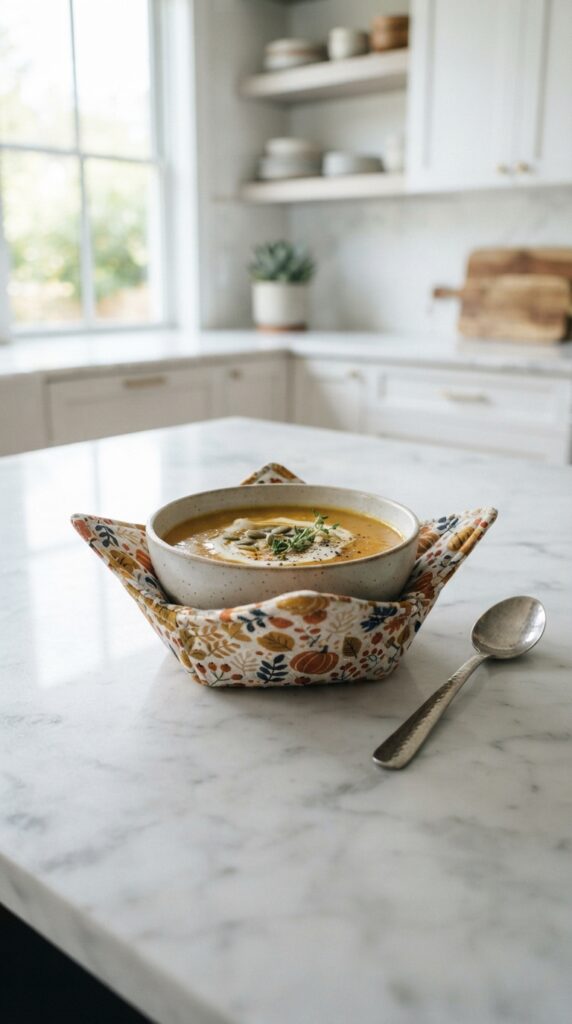
Hot bowls can be awkward to pick up when the outside is too warm to hold comfortably, while a bowl straight from the refrigerator can be unpleasantly cold on the hands.
A fabric bowl cozy sits underneath and around the bowl to make handling it easier.
The important part is choosing the materials for how the cozy will be used.
Cotton fabric is a sensible choice for a washable cozy, but the batting, thread, interfacing and any other materials inside it also need to be suitable for the intended use. This matters especially if the recipient plans to put the whole cozy in the microwave.
A common mistake is assuming that because the outer fabric is cotton, the finished cozy is automatically microwave-safe. It isn’t. Some batting, metallic threads, embellishments, trims and other components are not suitable for microwave use.
If you are making one specifically for microwave use, follow the safety instructions supplied with the materials and avoid anything metallic.
For a Thanksgiving hostess gift, you can also make the cozy without designing it around the holiday.
A plain, checked, floral or muted autumn fabric will be useful for soup, oatmeal, leftovers and other meals throughout the year. That makes it a more practical gift than something that only comes out in November.
5. Handmade Set of Reusable Produce or Bread Bags
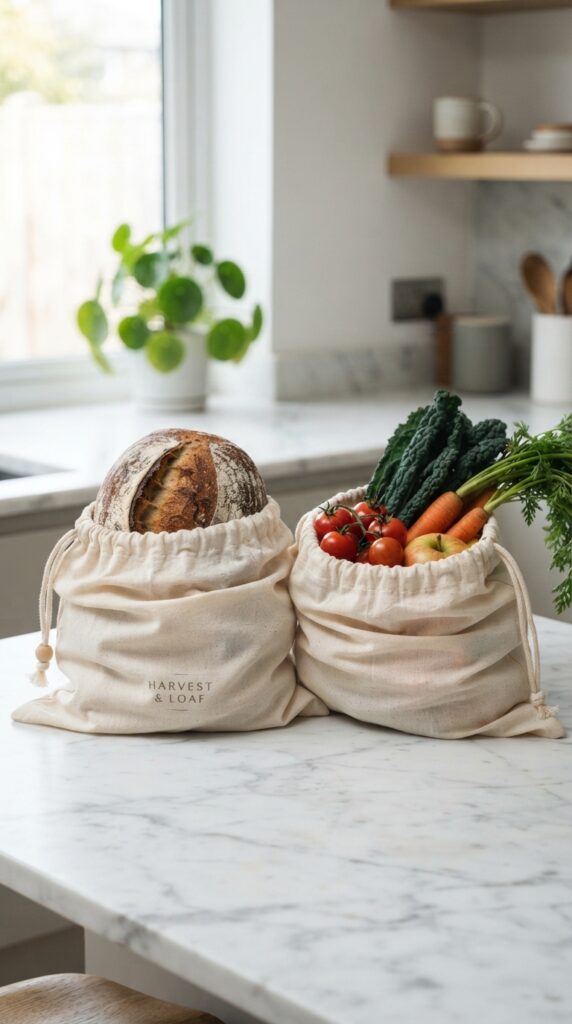
Reusable fabric bags make sense when the person receiving them can use them for something they already buy or store regularly. The important thing is not to treat every fabric bag as suitable for every food.
Breathable cotton or linen can work well for dry bread and certain produce, because air can move through the fabric instead of being trapped inside.
That can be useful for items such as bread that you don’t want sealed in a moisture-trapping container. It is not, however, a replacement for proper refrigeration or food storage when a food requires it.
Water-resistant or waterproof fabric serves a different purpose. It can help contain moisture or protect the outside of a bag, but a waterproof bag is not automatically the best place to keep fresh produce or bread. The material should match what the bag is actually intended to hold.
Washability is another important consideration. Food-storage bags can pick up crumbs, moisture and food residue, so choose a fabric that can be washed according to its care instructions.
A simple drawstring closure keeps the contents contained without making the bag difficult to open.
For a hostess gift, making two or three different-sized bags can be more useful than making one large bag.
The smaller ones might work for individual items, while a larger one could hold a loaf of bread or other dry goods. Labeling what each bag is intended for can also prevent the recipient from having to guess.
6. Small Hand-Embroidered Kitchen Towel

Personalization can make a kitchen towel feel like a gift rather than something picked up from a seasonal display. The key is keeping the design small enough that the towel still looks like something the recipient can use every day.
A simple initial, a small botanical motif or a narrow embroidered border can work better than covering the towel with a large Thanksgiving design. It also gives you more freedom with the fabric.
A neutral towel with a small embroidered detail can stay in the kitchen after Thanksgiving instead of being packed away with the holiday decorations.
There is a practical reason to keep the embroidery away from areas that receive the most wear.
A large, dense design can make the fabric stiffer and may be more difficult to wash and iron. Small motifs are easier to care for and less likely to interfere with the towel’s everyday use.
Choose a towel made from a fabric that is actually absorbent if you want it to function as a kitchen towel. Decorative towels and tea towels are not always equally useful for drying dishes or hands, so check the fabric rather than choosing solely by appearance.
For the embroidery itself, you can make the gift personal without guessing at the recipient’s taste.
Their initial, a small herb or leaf they like, or a simple motif connected to something they enjoy gives you a starting point. That is often enough, the personalization should add to the towel, not make the towel impossible to use outside Thanksgiving.
These kinds of Thanksgiving hostess gifts work particularly well because the holiday gives you a reason to make them, but the recipient doesn’t have to stop using them when Thanksgiving is over.
7. Homemade Dry Baking Mix in a Reusable Jar

Busy hosts don’t always want another dessert to deal with on Thanksgiving Day. A dry baking mix solves that by giving them something they can make later, when the kitchen is quiet and they actually feel like baking.
Choose one recipe that works well as a dry mix, such as pancakes, biscuits, muffins, or cookies.
Measure the ingredients carefully and keep anything that needs to stay separate or refrigerated out of the jar. The instructions should tell the recipient exactly what to add, how much to add, and how to prepare the mixture.
Don’t rely on a pretty label to explain the gift. Write the complete ingredient list, preparation instructions, date made, storage information, and any relevant allergen information on the jar or on a card attached to it.
For example, a mix containing wheat, milk, eggs, nuts, soy or sesame should make that clear. The FDA currently recognizes nine major food allergens, including sesame.
A wide-mouth jar with a secure lid makes the mix easy to store and use. Once it’s empty, the container can be washed and reused, which gives the gift a purpose beyond the first batch.
8. Homemade Spice Blend for Someone Who Cooks

A spice blend becomes much more useful when the recipient knows exactly what to do with it.
Instead of making a general Thanksgiving seasoning, put together a blend for a specific job: roasted vegetables, potatoes, poultry, beans, soup, or another dish the person regularly cooks.
The label should answer the questions the recipient is likely to have: What’s in it? What should I use it on? How much should I use? When was it made? How should I store it?
For example, a roasted-vegetable blend could include the herbs and spices you know work well together, with a simple suggestion such as “Start with 1–2 teaspoons per pound of vegetables and adjust to taste.”
The exact amount should come from the recipe you are using rather than being invented for the label.
Keep the ingredients completely dry. Fresh garlic, fresh herbs or other moist ingredients don’t belong in a simple dry spice blend because adding moisture changes how the mixture stores.
That little bit of information makes the gift much easier to use than a jar labelled simply “Thanksgiving seasoning.”
9. Small Batch of Homemade Flavored Salt

The easiest way to make flavored salt worth giving is to make it useful for a particular kind of cooking.
Rosemary salt is good with potatoes and roasted vegetables.
Citrus peel adds a fresh, slightly tangy flavor that works well with fish, vegetables, and salads.
Garlic and herbs make a simple blend for everyday cooking.
The important part is using ingredients that are genuinely dry.
Fresh rosemary or fresh garlic may look fine when mixed with salt, but their moisture changes the storage conditions. Salt is not a substitute for proper food preservation.
Use properly dried herbs or citrus peel, mix them with the salt, and keep the finished seasoning in a clean, completely dry container with a tight-fitting lid. Label the ingredients and date it was made.
A small jar is enough for a gift. The recipient gets something they can actually finish rather than another large container that sits in the back of the cupboard.
10. Handmade Wooden or Ceramic Spoon Rest

Cooking usually leaves one small problem behind: where do you put the spoon? A spoon rest gives the host somewhere to place it between stirring, tasting and serving without putting the utensil directly on the counter.
That makes this a better homemade gift than a decorative kitchen object with no particular use.
The material and finish deserve some thought. With wood, don’t assume that any craft paint, varnish or decorative finish is suitable for an item that will regularly come into contact with cooking utensils.
Follow the product manufacturer’s instructions for its intended use, particularly if the finished surface may touch food.
Ceramic requires the same care. A glaze that looks beautiful isn’t automatically appropriate for every purpose.
If you’re making the spoon rest yourself, use a ceramic glaze and firing process intended for the finished item’s use and follow the manufacturer’s directions.
Keep the shape fairly shallow and the base stable. The spoon rest doesn’t need to be elaborate; it simply needs to stay put when a wet or hot cooking spoon is placed on it.
That is what makes this a good hostess gift: it fixes a small kitchen annoyance without asking the host to change how they cook.
11. Small Host-Only Treat Box

Thanksgiving dinner may already have more food than the host knows what to do with, so another dessert for the table isn’t always the best gift.
A small box of treats that can be saved for later gives the host something they don’t have to serve immediately.
Shortbread, biscotti and some types of cookies work well because they can be prepared ahead and packaged individually or in a small box. The important part is knowing how the particular recipe should be stored.
A homemade biscuit or cookie containing ingredients that require refrigeration shouldn’t be treated as a shelf-stable gift simply because it is baked.
Let the recipe determine the storage instructions. If it needs refrigeration, tell the recipient. If it is suitable for room-temperature storage, include that information too, along with the date it was made and the ingredients.
Keep the box small enough that it feels like a personal treat rather than another contribution to the Thanksgiving spread.
You can also separate different flavors with parchment or small paper liners so the contents are easy to identify.
The nicest part is the timing: the host doesn’t have to put your gift on the table, find serving dishes for it or decide where it fits into dinner. They can enjoy it later.
12. Simple Fabric Wine or Bottle Bag

Carrying a bottle to someone’s home is easy enough, but the usual paper bag is quickly discarded. A fabric bottle bag turns the wrapping into something the recipient can use again.
Choose a sturdy washable fabric and make the bag according to the size of the bottle it is meant to hold.
A standard wine bottle and a tall olive-oil bottle don’t necessarily have the same proportions, so measuring the intended bottle before cutting the fabric will give you a better fit.
You don’t have to make the bag specifically for wine. A neutral fabric or simple fall print allows the recipient to reuse it for olive oil, vinegar, juice, sparkling water or another bottled gift. T
hat also makes the idea suitable for households where alcohol isn’t part of the occasion.
A drawstring or fabric tie keeps the bottle from slipping out when the bag is carried. If you’re sewing one as a gift, reinforce the bottom and the points where the handles or ties are attached because those areas carry most of the weight.
The bag can then become part of the hostess gift rather than something the host throws away after opening it.
13. Reusable Gift Bag Made From Fabric Scraps

Leftover fabric can become useful packaging instead of sitting in the scrap box waiting for a project that may never come.
The best fabric depends on what you plan to put inside.
Quilting cotton works for lighter gifts, while linen or a sturdier woven fabric is better when the bag needs to carry something heavier. Very thin fabric may look pretty but can sag or tear when filled.
Size the bag around the gift rather than making one standard size.
A bag that is only slightly larger than its contents is easier to close and looks neater. For a bag that needs to stand upright, boxed corners can give the bottom more room and help it sit flat.
A simple drawstring closure also makes the bag easier to reuse. The recipient can remove your gift, fold the fabric bag away and use it for another present later.
This is especially useful when your scraps are too small for a larger sewing project but still large enough to make a pouch or small gift bag. Combining two coordinating scraps can work too, especially for a reversible design.
14. Small Handmade Trivet

Hot serving dishes need somewhere safe to rest when they come off the stove or out of the oven, which is why a trivet can be a genuinely useful hostess gift.
The important thing is not to confuse decorative with heat-safe. A pretty piece of fabric, wood, cork or ceramic is not automatically suitable for a hot casserole dish.
For a fabric trivet, use materials intended for heat protection and follow the manufacturer’s instructions for the batting or insulating layer.
Regular quilt batting is not automatically the same as heat-resistant insulation, so don’t describe a homemade trivet as oven-safe or suitable for direct contact with a hot pan unless the materials have been specifically designed and tested for that use.
Wood, cork and ceramic have different heat-handling properties too.
Adhesives, paints and finishes can change what the finished piece is suitable for, so check the manufacturer’s instructions rather than assuming the base material makes the whole item heat-safe.
For a Thanksgiving hostess gift, a trivet is a good opportunity to make something simple and attractive without covering it in holiday wording.
A neutral pattern, geometric design or subtle autumn color can keep it useful throughout the year.
And if the materials are only suitable for warm or moderately hot dishes, say so. It is better to give the recipient an accurate limitation than to call something “heatproof” because it sounds better.
15. Personalized Grocery or Market Tote

Grocery bags get used often, which makes a simple fabric tote a useful gift rather than something that sits in a cupboard after Thanksgiving.
Start with a sturdy woven fabric that can handle some weight. Quilting cotton works for lighter shopping, but a heavier canvas or similar fabric is better if the tote will carry bottles, cans, produce, or other heavier items.
The personalization doesn’t need to be large.
An embroidered initial, a small botanical design, or a simple motif connected to the recipient’s interests is enough.
Keeping it small also means the bag still looks appropriate when they use it for something completely unrelated to Thanksgiving.
Think about the handles too. Long enough handles make the bag easier to carry over the shoulder, while reinforced stitching where the handles join the bag helps them hold up under regular use.
Before making it, consider what the person is likely to carry. Someone who visits a farmers’ market may need a deeper bag, while a lighter tote may be more useful for library books or everyday errands.
That makes the gift useful well beyond the holiday instead of turning into another piece of Thanksgiving decoration.
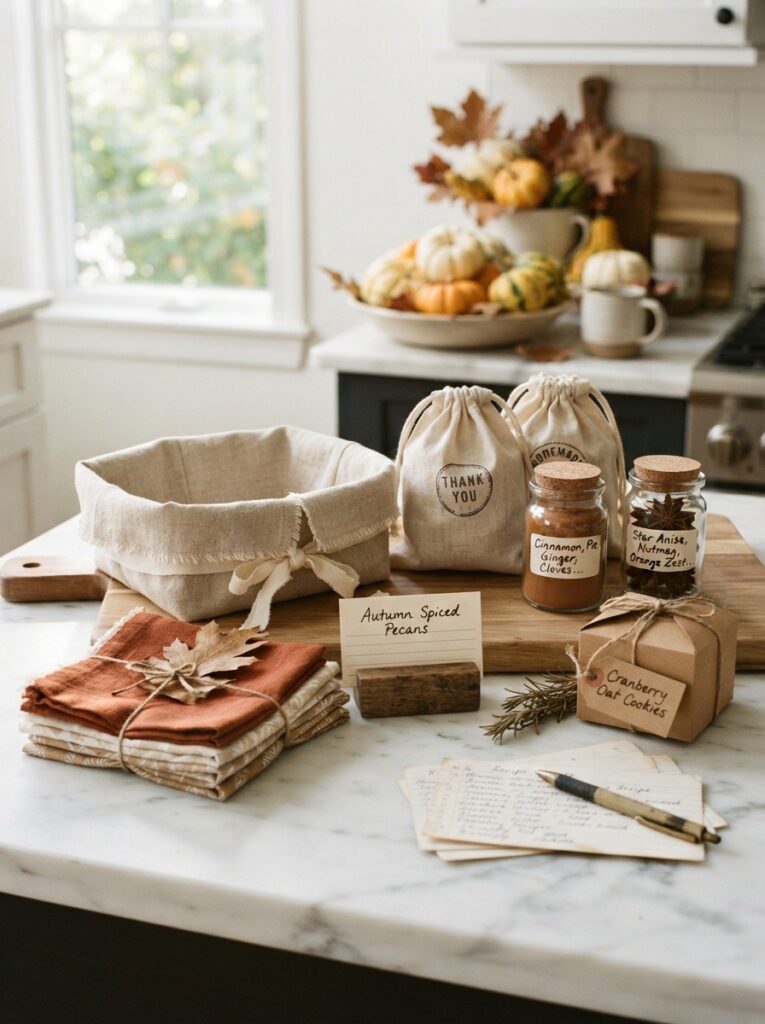
16. Small “For Later” Pantry Gift Set

Thanksgiving food usually goes straight to the table, but a small pantry gift gives the host something to enjoy after the holiday.
Instead of making several unrelated things, choose two or three small items that work together.
For example, pair a homemade spice blend with a handwritten recipe card and a reusable fabric pouch.
You could also put a dry baking mix in a reusable jar and add the recipe and instructions.
Make sure the pieces have a purpose. A spice blend becomes more useful when the recipe shows how to use it. With a baking mix, give clear instructions on what to add, how to prepare it, and how to store it.
Keep the food information clear. List the ingredients, date you made it, storage instructions, and any relevant allergen information.
Don’t assume a homemade mixture can sit at room temperature just because it looks dry. The ingredients and recipe will determine how you should store it.
Keep the packaging simple too. Use a clean reusable jar, small fabric pouch, or sturdy box.
The goal isn’t to fill a basket with random little gifts. Put together a few things the host can actually use.
This works especially well when you know what the host likes to cook or bake. Rather than giving them something that only looks festive, build the gift around something they already enjoy.
How to Choose the Right Gift for the Host

The best gift isn’t necessarily the most complicated one to make. It is the one that fits the person receiving it.
Before choosing a project, think about how the host actually lives, what they enjoy, and whether the gift will make their life easier or simply give them another thing to store.
-
Think About What the Host Already Uses
Start with the things you have seen the host use before.
Do they cook often? Bake? Entertain friends? Shop at farmers’ markets? Sew? Keep a well-used kitchen? Those details can point you toward a gift they are more likely to appreciate.
For someone who cooks regularly, a spoon rest, recipe card holder, spice blend, or useful fabric item may make more sense than a decorative object. Someone who enjoys hosting might appreciate cloth napkins or a reusable bottle bag.
You don’t have to know exactly what they need. Look for something that fits naturally into what they already do.
-
Choose Something They Can Use After Thanksgiving
Holiday-themed gifts can be fun, but they have one drawback: the recipient may only use them once a year.
If you’re putting time into making something, consider whether it can still be useful in January, March, or July.
A neutral fabric tote, embroidered kitchen towel, reusable bread liner, or simple set of napkins can work throughout the year. If you want a seasonal touch, use an autumn-inspired fabric or small design rather than covering the whole gift with Thanksgiving wording.
That gives the host more opportunities to use what you made.
-
Don’t Give the Host More Work
This is especially important when giving food.
The host may already be preparing a large meal, cleaning the house, and getting everything ready for guests.
A gift that needs immediate preparation, refrigeration, special serving dishes, or extra cooking can become another task.
Food gifts don’t necessarily need to be served that evening. A small box of treats or a dry baking mix can be given with clear storage and preparation instructions so the host can enjoy it later.
The same idea applies to non-food gifts. Something ready to use is usually easier to receive than a project that still needs assembling.
Match the Gift to the Person, Not Just the Occasion

Thanksgiving tells you why you’re giving the gift, but it doesn’t have to determine what the gift is.
Think about what the host already enjoys. Someone who loves gardening may appreciate a small garden-related gift more than another turkey-themed kitchen decoration.
Bakers might enjoy something connected to their favorite recipes, while someone who prefers a simple, uncluttered home may be happier with a small, useful item than something large or heavily decorated.
A little knowledge about the person can make a simple gift feel much more thoughtful.
-
Consider How Much Time and Skill You Have
Don’t choose a complicated project just because it looks impressive.
If you have never sewn before, there is little point in choosing a project with a difficult pattern and hoping to finish it the night before Thanksgiving. A simpler item made neatly is usually a better gift.
The same applies to food gifts, embroidery, woodworking, clay, and other crafts. Choose something you can make properly with the materials and tools you have.
Your gift doesn’t need to show how much work you were capable of doing. It should show that you thought about the person.
-
Check Whether the Gift Is Actually Safe to Use
Anything that touches food, holds hot dishes, goes in a microwave, or is used around heat needs a little more thought than an ordinary decorative craft.
Don’t assume that cotton fabric automatically makes a bowl cozy microwave-safe, or that any paint, glue, glaze, or finish is suitable for a kitchen item.
Check the instructions for the specific materials you’re using and make the finished gift according to their intended use.
Food gifts also need proper labeling and storage information, particularly when they contain common allergens or ingredients that require refrigeration.
A beautiful gift isn’t helpful if the recipient cannot safely use it.
-
Keep the Gift Within Your Means
A hostess gift is a thank-you, not a competition.
You don’t need expensive materials or a large gift basket to show appreciation. Something small that you made carefully can be enough.
Using fabric scraps, a reusable jar, ingredients already in your pantry, or supplies from another craft can also keep the cost down without making the gift feel cheap.
The amount you spend should make sense for your relationship with the host and what you can comfortably afford.
-
When in Doubt, Choose Something Simple and Useful
If you’re still unsure, choose the option with the fewest assumptions.
Something reusable, easy to store, simple to care for, and useful around the house is less likely to miss the mark than a very personal decoration or something that requires the host to find a special use for it.
You can always add a personal touch with the fabric, color, packaging, recipe, initials, or a short handwritten note.
That small detail is often enough to turn a practical gift into something that feels chosen specifically for the person.
Be Intentional With Something They Can Use After Thanksgiving
Holiday-themed gifts can be fun, but they have one drawback: the recipient may only use them once a year.
If you’re putting time into making something, consider whether it can still be useful in January, March, or July.
A neutral fabric tote, embroidered kitchen towel, reusable bread liner, or simple set of napkins can work throughout the year. If you want a seasonal touch, use an autumn-inspired fabric or small design rather than covering the whole gift with Thanksgiving wording.
That gives the host more opportunities to use what you made.
✅ Don’t Give the Host More Work
This is especially important when giving food.
The host may already be preparing a large meal, cleaning the house, and getting everything ready for guests.
A gift that needs immediate preparation, refrigeration, special serving dishes, or extra cooking can become another task.
Food gifts don’t necessarily need to be served that evening. A small box of treats or a dry baking mix can be given with clear storage and preparation instructions so the host can enjoy it later.
The same idea applies to non-food gifts. Something ready to use is usually easier to receive than a project that still needs assembling.
✅ Match the Gift to the Person, Not Just the Occasion
Thanksgiving tells you why you’re giving the gift, but it doesn’t have to determine what the gift is.
If the host loves gardening, a small useful garden-related item may mean more to them than a turkey-themed kitchen decoration.
They enjoy baking, a recipe-related gift could be a better choice. Or they prefer simple, uncluttered spaces, avoid making something large or heavily decorated.
A little knowledge about the person can make a simple gift feel much more thoughtful.
✅ Consider How Much Time and Skill You Have
Don’t choose a complicated project just because it looks impressive.
If you have never sewn before, there is little point in choosing a project with a difficult pattern and hoping to finish it the night before Thanksgiving.
A simpler item made neatly is usually a better gift.
The same applies to food gifts, embroidery, woodworking, clay, and other crafts. Choose something you can make properly with the materials and tools you have.
Your gift doesn’t need to show how much work you were capable of doing. It should show that you thought about the person.
✅ Check Whether the Gift Is Actually Safe to Use
Anything that touches food, holds hot dishes, goes in a microwave, or is used around heat needs a little more thought than an ordinary decorative craft.
Don’t assume that cotton fabric automatically makes a bowl cozy microwave-safe, or that any paint, glue, glaze, or finish is suitable for a kitchen item.
Check the instructions for the specific materials you’re using and make the finished gift according to their intended use.
Food gifts also need proper labeling and storage information, particularly when they contain common allergens or ingredients that require refrigeration.
A beautiful gift isn’t helpful if the recipient cannot safely use it.
✅ Keep the Gift Within Your Means
A hostess gift is a thank-you, not a competition.
You don’t need expensive materials or a large gift basket to show appreciation. Something small that you made carefully can be enough.
Using fabric scraps, a reusable jar, ingredients already in your pantry, or supplies from another craft can also keep the cost down without making the gift feel cheap.
The amount you spend should make sense for your relationship with the host and what you can comfortably afford.
✅ When in Doubt, Choose Something Simple and Useful
If you’re still unsure, choose the option with the fewest assumptions.
Something reusable, easy to store, simple to care for, and useful around the house is less likely to miss the mark than a very personal decoration or something that requires the host to find a special use for it.
You can always add a personal touch with the fabric, color, packaging, recipe, initials, or a short handwritten note.
That small detail is often enough to turn a practical gift into something that feels chosen specifically for the person.
Should Your Thanksgiving Gift Be for the Host or the Meal?

It helps to know whether you’re bringing something for dinner or something for the person hosting it. They are not quite the same thing.
Bringing Something for Dinner
When the host asks you to bring a pie, salad, side dish, or drink, that is your contribution to the meal. Follow what they have requested instead of showing up with another dish that may not fit the menu.
Bringing Something for the Host
Thanksgiving hostess gifts are different. They are a small thank-you for the person doing the hosting. Homemade cookies they can enjoy later, a useful kitchen item, or something reusable can work well.
So, if the host asks you to bring a pie, bring the pie. If you’d also like to thank them with something personal, that’s where a hostess gift fits in.
Emily Post recommends offering to contribute while letting the host decide what is actually needed for the meal.
When to Give the Gift

There isn’t one perfect moment to hand over a Thanksgiving hostess gift. The best time depends on what you’ve made and how busy the host is.
At the Door
Small gifts that are ready to hand over work well when you arrive. If you’ve made cookies, a fabric tote, napkins, or another easy-to-carry gift, you can give it to the host with a simple thank-you.
Don’t expect the host to stop and open it immediately. They may be greeting other guests, finishing dinner, or trying to get food onto the table.
During the Gathering
Waiting can make more sense when the host is especially busy when you arrive.
Once things have settled down, you can quietly give them the gift without taking their attention away from their guests. This also works well for something that needs a little explanation, such as a homemade baking mix or a personalized item.
After Thanksgiving
Some gifts don’t need to be handed over at the door at all.
If something is difficult to carry, needs to be finished, or you want to personalize it properly, giving it to the host afterward is perfectly reasonable. You can also send a small gift later as a thank-you for having you.
Emily Post notes that host or houseguest gifts can be given when you arrive, during the visit, or afterward, depending on the situation. The important thing is the thought behind the gift, not finding one exact moment to present it.
Conclusion
Good Thanksgiving hostess gifts don’t need to be expensive, complicated, or covered in Thanksgiving decorations. Choose something the host can actually use, enjoy, or keep.
Homemade treats, useful kitchen items, fabric projects, and small personalized gifts can all make lovely choices when they suit the person receiving them.
Before starting your next project, think about the host. Pick something useful, make it well, and add a personal touch where you can.
Enjoyed these ideas? Save this list for the next time you need a homemade gift worth giving.