
What do you give a coworker you barely know? These corporate Secret Santa gifts under $20 keep the guesswork low with 9 useful, easy-to-give picks.
Buying a Secret Santa gift for a close coworker is easy. You probably know what they like, what they joke about, or the little things they use every day. But a coworker you barely know? That $20 limit suddenly feels much harder.
You don’t want to guess their size, pick a scent they dislike, give them something too personal, or spend money on a joke that falls flat.
The safest corporate Secret Santa gifts are usually the ones that don’t require you to know much about the person in the first place.
These nine ideas keep the budget under $20 while focusing on useful, low-risk gifts that can fit different workplaces and everyday routines.
Is $20 Actually Enough for a Corporate Secret Santa Gift?
Yes, $20 can be enough for a corporate Secret Santa gift, provided it matches the spending limit your workplace set. There is no universal corporate Secret Santa budget, so the amount can vary from one office to another.
More importantly, “$20 limit” does not always mean “spend exactly $20.”
If the instructions say “under $20,” a $15 or $18 gift can still meet the requirement. If they say “$20 maximum,” the organizer may mean that the entire purchase must stay at or below $20. Tax, delivery charges, or other costs can matter too, particularly when you shop online.
Before choosing a gift, check what the exchange rules actually mean by the budget. It may refer to:
- the maximum price of the gift itself
- the total amount paid at checkout
- the amount before tax or shipping
- or an approximate spending range rather than a strict ceiling
This matters when shopping online. A gift listed at $17 might cost more than $20 after shipping and tax, so the displayed item price is not always the final amount you need to consider.
The simplest approach is to treat $20 as a ceiling unless the organizer says otherwise, then choose something comfortably within it rather than trying to spend every last dollar.
That keeps the gift within the spirit of the exchange and avoids turning Secret Santa into a competition over who spent the most.
Corporate Secret Santa Gifts for a Coworker You Barely Know
1. Compact Phone Stand for Their Desk

A compact phone stand is a good option when you know very little about the coworker but know they spend part of their day around a desk.
It gives the phone a fixed place to sit instead of leaving it flat beside the keyboard or tucked away in a bag.
A simple adjustable stand can keep a phone upright for checking notifications, viewing a recipe or reference page, taking a call, or following something on the screen while working.
Some people may also find one useful during video calls, although that depends on how they normally use their phone.
Look for a stand with an adjustable viewing angle, stable base and compact or foldable design. Case compatibility is worth checking too, since some stands have narrow slots that may not accommodate thicker phone cases.
A Price-Friendly Example
Look for a basic adjustable or foldable phone stand in the $8–$15 range. That leaves part of the $20 budget available for tax or shipping, depending on where you shop.
There is no need to choose a premium model with wireless charging or other extras; for a Secret Santa exchange, a sturdy stand that holds the phone securely and offers a comfortable viewing angle is enough.
The best part for a Secret Santa exchange is that you don’t need to know the person’s decorating style or favorite color. It is a functional item that can sit quietly on a desk without requiring much personal knowledge.
That does not mean every coworker needs one. It makes more sense for someone who regularly keeps their phone beside them while working.
If you have noticed that the recipient already uses a phone stand, however, choose a different gift rather than giving them another version of something they already own.
2. Quality Cable-Management Pouch
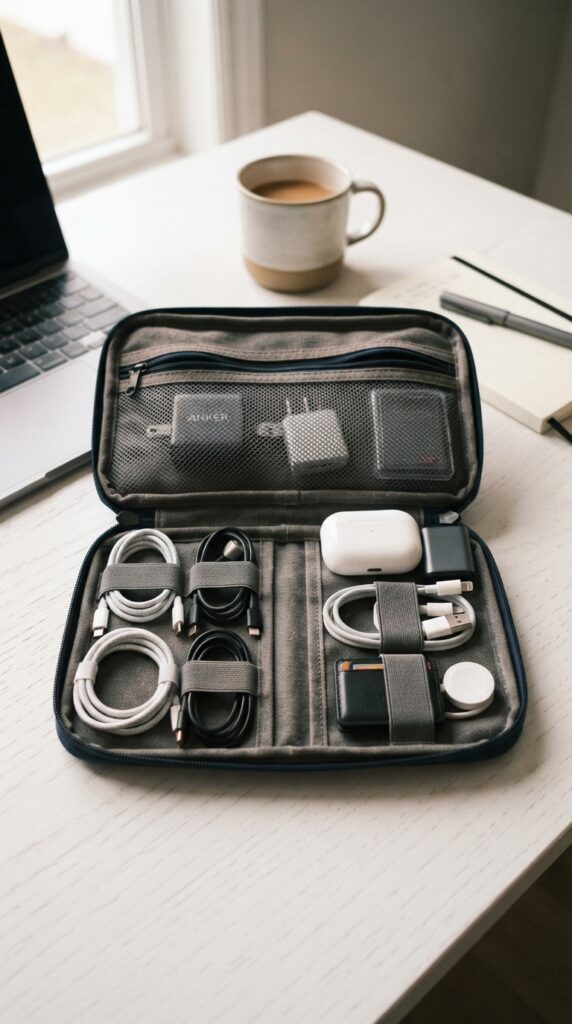
Loose charging cables have a habit of collecting at the bottom of a work bag, along with earbuds, adapters and other small tech accessories.
A compact cable-management pouch gives those items separate places instead of leaving them tangled together.
That makes it particularly useful for a coworker whose tech habits you don’t know.
You don’t have to identify their phone model or guess which accessories they use. The pouch simply helps organize the small items they already carry.
What to Look For
Choose one that is compact enough for a work bag but large enough to hold several cables without forcing them inside. Elastic loops, mesh pockets or separate compartments can keep different accessories from becoming one tangled bundle.
A secure zipper also matters, especially if the pouch will move between home, work and travel.
Forgo versions loaded with built-in electronics such as power banks or charging hubs. Those extras introduce compatibility questions that a simple storage pouch avoids.
A Price-Friendly Example
Look for a well-constructed cable-management pouch in the $10–$18 range. That keeps it comfortably within a $20 Secret Santa budget while leaving some room for tax or shipping, depending on where you shop.
It can suit office, hybrid or remote workers who regularly carry several electronic accessories.
But it isn’t automatically useful for everyone. If the recipient rarely carries cables or already has a pouch they use, another gift from the list would make more sense.
3. Screen-and-Eyewear Cleaning Kit

Smudges on a phone, laptop or pair of glasses are an everyday nuisance, but cleaning them with whatever cloth or household spray is nearby can be a poor idea.
A small screen-and-eyewear cleaning kit gives the recipient a purpose-made way to keep frequently handled surfaces clean.
This makes it one of the more neutral corporate Secret Santa gifts because you don’t need to know much about the coworker’s interests.
Someone who wears glasses may use it for their lenses, while a person who works around laptops, monitors or phones may find the screen-cleaning supplies useful.
What to Check Before Buying
Don’t assume that one cleaning product is suitable for every surface. Screens and eyeglass lenses can have different cleaning requirements, particularly when they have coatings.
Choose a product that clearly identifies the surfaces it is designed for and follow the device or eyewear manufacturer’s cleaning instructions.
A simple kit might include a suitable microfiber cloth and a cleaning solution specifically labelled for the intended surface.
Avoid kits that make broad claims about being safe for every screen, lens and coating unless the manufacturer provides clear instructions supporting those uses.
A Price-Friendly Example
A basic cleaning kit can fit comfortably within the $10–$15 range, leaving room under a $20 Secret Santa budget for tax or shipping.
You don’t need a large kit filled with unnecessary accessories; a well-made microfiber cloth and appropriately labelled cleaning solution can be more useful than a box of extras.
The appeal is its consumable utility. Instead of adding another decorative object to someone’s desk, you’re giving them something they can use up and replace when needed. It is still worth avoiding assumptions, though.
If you know the coworker already has a preferred cleaning method or doesn’t use glasses or personal electronics regularly, another gift may be a better fit.
4. Reusable Lunch or Snack Container

A container becomes more useful when its design solves an actual storage problem rather than simply looking cute.
A leak-resistant lunch container, compact stackable box or divided food container can make it easier to carry food without taking up unnecessary space.
For coworker Secret Santa gifts, this works best when you choose a straightforward design rather than something tied to a particular personality or food preference.
You don’t need to know whether the recipient loves a certain sports team, follows a particular aesthetic or spends their lunch break at their desk.
What to Look For
Pay attention to the details that affect whether the container will be pleasant to use:
- A secure seal that helps prevent leaks when the container is carried in a bag
- Easy-to-clean construction without awkward corners that trap food
- Food-contact materials clearly identified by the manufacturer
- A practical size that suits an ordinary meal or snack without becoming bulky
A divided design can be useful for keeping different foods separate, while stackable containers may make better sense for someone who carries more than one item.
The right choice depends on how the container is designed, not simply how many compartments it has.
A Price-Friendly Example
A practical reusable food container in the $10–$18 range can work within a $20 corporate Secret Santa budget.
Choose the container based on its seal, construction and size rather than paying extra for decorative features the recipient may not use.
There is one important limitation: don’t assume the coworker brings lunch from home. Some people eat at the workplace, buy lunch nearby or have a different routine altogether.
The reason this makes the list is that it can be useful without requiring personal knowledge, not because every coworker needs a lunch container.
5. High-Quality Reusable Shopping Tote That Folds Small

A reusable tote earns its place on a Secret Santa list when it is useful after the office exchange is over. A foldable version can stay in a work bag, car or drawer until it is needed for groceries, errands, commuting or carrying a few extra items.
The trick is choosing one that works as an everyday bag rather than one that is mainly a novelty gift.
Look for reinforced handles, washable fabric and enough capacity for ordinary errands without making the folded bag bulky.
The folding mechanism matters too. A tote that packs into its own small pouch or folds into a compact shape is easier to keep available than one that becomes another large item to store.
For a coworker you barely know, stick with a restrained or neutral design. Slogans, jokes and highly specific graphics can turn a practical gift into something that depends on personal taste.
A Price-Friendly Example
A sturdy foldable tote in the $8–$15 range can fit comfortably within a $20 Secret Santa budget. Spend more on construction and handles rather than decorative details.
The goal is a bag the recipient can actually fold away and reuse, not simply another branded item from the office gift exchange.
6. Small Insulated Food or Drink Carrier

For someone who carries food or drinks between home and work, the problem isn’t finding another cup.
It is keeping something they are already carrying contained and at a suitable temperature during the journey.
A compact insulated lunch bag or food carrier can handle that job without requiring you to know the coworker’s preferred coffee, favorite beverage or personal style.
Look for a size that can hold an ordinary lunch or a few snacks without becoming awkward to carry.
Check for a secure closure, easy-to-clean lining, useful insulation and a handle that can support the bag when loaded. A removable or wipe-clean interior can also make everyday maintenance easier.
A Price-Friendly Example
A simple insulated lunch bag or food carrier in the $12–$18 range can work under a $20 Secret Santa limit, although taxes and delivery may push the final cost higher.
There is no need to choose a large premium cooler when the gift is intended for ordinary workday use.
This one needs a little more judgment than some of the other Secret Santa gifts under $20.
Someone who buys lunch at work, works fully remotely or rarely carries food may have little use for it. Choose it when you have some reason to think the recipient transports meals, snacks or drinks.
7. Bookstore or General-Purpose Gift Card

When you barely know the person receiving your Secret Santa gift, choice can be more useful than another guess.
A gift card lets the recipient decide what they actually want instead of leaving you to work out their taste from a few conversations at work.
A bookstore card can work when you know the person reads, but a more general retailer or shopping card may be safer when you know almost nothing about their interests.
The important part is choosing somewhere the recipient can realistically use it.
The Gift Card Detail People Often Miss
Don’t assume that a familiar retailer works everywhere.
Gift cards can have country, currency, retailer or platform restrictions, so check the terms before buying one for an international coworker or someone who may live in a different market.
A useful gift card gives the recipient genuine purchasing choice. A poor one may lock them into a service they don’t use, require a subscription, work only in a particular country or expire under conditions they weren’t expecting.
A Price-Friendly Example
A $10–$20 gift card fits the budget, depending on the rules of the exchange. If the organizer says the gift must be under $20, a $15 card may be a safer choice than assuming you need to use the entire allowance.
For an office Secret Santa, this can be one of the least risky choices when there is no wishlist, provided gift cards are allowed and the retailer is accessible to the recipient.
8. Small Everyday Repair or Utility Kit

Some of the most useful corporate Secret Santa gifts are the ones that solve a small problem rather than announce someone’s personality.
A compact repair or utility kit can be kept in a drawer, work bag or home toolbox for those minor jobs that don’t justify buying a full set of tools.
Think of a kit with genuinely useful basics rather than a novelty gadget collection.
Depending on the design, that might include small screwdrivers, a measuring tool, tweezers or other simple tools for everyday adjustments and minor repairs.
What to Look For
The kit should contain tools the recipient could realistically use, with a compact case, secure storage and reasonable build quality.
Avoid highly specialized kits designed for one particular device or repair job. You don’t know enough about the coworker to predict that they will need one.
Size matters too. A small kit that fits neatly in a drawer or bag is more appropriate for a Secret Santa exchange than a bulky toolbox that takes up valuable space.
A Price-Friendly Example
A basic everyday utility or mini repair kit can fit into the $12–$20 range, depending on the number and quality of tools included.
For a strict $20 limit, check the final price after shipping and tax rather than relying only on the listed item price.
This is most suitable for someone who handles small fixes at home, travels, works remotely or likes keeping basic tools nearby.
You don’t need to know their hobbies for the gift to make sense; you simply need to avoid buying a kit built around a specialized task you have no reason to think they do.
The point is not that everyone needs a repair kit. It is that a practical tool can be a lower-risk gift when it solves an occasional problem without requiring you to know the person’s interests.
9. Premium Everyday Consumable With Clear Ingredients

A small food gift can be easier to enjoy than another object, but food is not automatically a safe Secret Santa gift.
Allergies, dietary restrictions, religious practices and personal preferences can all affect what someone can or wants to eat.
That doesn’t mean you have to rule out consumables completely. The safer approach is to choose a small, clearly labelled packaged item rather than putting together a basket based on assumptions about what the coworker likes.
Depending on the workplace and what you know about the recipient, this could be packaged chocolate, biscuits, tea, coffee or hot chocolate.
Read the Label Before You Buy
Ingredient and allergen information matters more than the packaging.
Check the product label for ingredients and clearly declared allergens, and don’t describe something as suitable for a particular diet unless the manufacturer supports that claim.
It is also worth checking whether the product contains alcohol or other ingredients that could conflict with the recipient’s known preferences or the workplace’s gift policy.
For packaged foods, look at the expiry or best-before information and the condition of the packaging. Individually packaged items can also be easier for the recipient to store or share, although you should never assume they will want to share their gift.
A Price-Friendly Example
A small premium chocolate bar, tea selection, coffee pack or biscuit box in the $8–$15 range can leave room within a $20 Secret Santa budget for tax or shipping.
You don’t need a large hamper to make the gift feel considered; one well-presented, quality item can be enough.
The safest choice is not necessarily the food that seems most universally popular. It is the item you can give without making an unsupported assumption about the person’s diet or preferences.
If you know nothing about their food choices and the workplace has no guidance, one of the non-food gifts on this list may be the better decision.
How to Choose Between the 9 When You Know Almost Nothing About Them
Nine options can create a different problem: you still have to decide which one makes the most sense for this particular coworker.
Start with what you have actually noticed, rather than trying to invent a personality profile from a name pulled out of a Secret Santa draw.
Nothing useful to go on?
Stick with a practical, non-food gift. A compact phone stand, cable-management pouch or screen-cleaning kit requires less personal information than something based on taste, hobbies or diet.
Their commute tells you something
A foldable shopping tote can earn its keep outside the office, while a small insulated food carrier makes more sense for someone who regularly takes lunch, snacks or drinks from home.
Their desk is surrounded by devices
The cable-management pouch becomes more relevant when you regularly see someone carrying chargers, earbuds or adapters. A phone stand is another possibility for someone who keeps their phone beside their workstation.
You have noticed they wear glasses
That small detail makes a screen-and-eyewear cleaning kit less of a guess. Just make sure the cleaning product is labelled for the relevant lenses or surfaces.
You know where they shop, but not what they like
A gift card can solve the preference problem altogether. Choose a retailer that operates in the recipient’s country or market and check the card’s terms before buying.
Food is one of the few things you know they enjoy
A clearly labelled chocolate, tea, coffee or biscuit gift can work, provided you have no reason to believe there are dietary, religious or allergy-related concerns. When you don’t know those details, a non-food gift is the safer route.
The goal isn’t to find the perfect gift for a stranger. It is to find something useful without making assumptions you don’t have enough information to make.
What Not to Buy for a Coworker You Barely Know
The hardest part of choosing corporate Secret Santa gifts isn’t finding something under $20. It is knowing where a harmless-looking gift can cross into personal territory.
When you barely know the recipient, the safest approach is to avoid gifts that require assumptions about their body, beliefs, lifestyle or sense of humor.
That doesn’t make these items universally bad gifts; they simply carry more guesswork than you need for an office exchange.
-
Personal-care products can be more personal than they look
Perfume, skincare, grooming products and similar items involve preferences that aren’t always obvious. Fragrance can also be an issue for people who avoid scented products or have sensitivities.
A gift that seems thoughtful to one person can therefore feel surprisingly personal to a coworker you hardly know.
Unless you have a specific wishlist or know the recipient’s preference, a practical office or everyday-use item is usually easier to get right.
-
Alcohol isn’t a neutral Secret Santa gift
Wine, spirits and other alcoholic drinks can create problems that have nothing to do with price.
The recipient may not drink for personal, cultural or religious reasons, and some workplaces may have their own rules about alcohol in workplace gift exchanges.
That makes alcohol a poor default for office Secret Santa gifts, particularly when you have little information about the person.
-
Clothing introduces sizing and style problems
A scarf or other loose accessory might seem harmless, but fitted clothing requires more information than you may realize. You need an idea of the person’s size, preferred fit and style, and even an accurate size does not tell you whether they would actually wear it.
With a $20 Secret Santa budget, there is little reason to take that gamble when plenty of non-sized gifts are available.
-
Political or religious gifts can send a message you didn’t intend
A workplace gift exchange is usually a poor setting for making assumptions about someone’s political views or religious beliefs.
A mug, book, ornament or novelty item connected to either can feel less like a gift and more like a statement about the recipient.
Unless the exchange specifically has a theme that makes such a gift appropriate, neutral choices are safer.
-
Avoid jokes about the person
Humor can work well between coworkers who know each other, but a Secret Santa recipient you barely know is a different situation.
Gifts that joke about someone’s age, appearance, relationship status, job performance or personality can become uncomfortable when opened in front of colleagues.
A funny gift does not need to make the recipient the joke.
-
Strong scents deserve extra caution
Candles, perfumes, air fresheners and heavily fragranced gift sets often appear on lists of “cozy” coworker Secret Santa gifts, but scent is highly subjective. Someone may dislike a particular fragrance, avoid scented products altogether or simply have no use for them.
A neutral, unscented alternative removes that guesswork.
The common thread is simple: the less you know about the coworker, the fewer personal assumptions your gift should require.
That is a more useful rule than trying to create a universal list of forbidden Secret Santa gifts.
Check the Secret Santa Rules Before You Buy
A gift that works perfectly well in one office may not fit another workplace’s Secret Santa rules. Before spending the $20, check the instructions for the exchange.
Look for the agreed spending limit, whether gift cards or food are allowed, whether alcohol is prohibited, and whether the gifts are meant to stay anonymous. A wishlist can also make the choice much easier, so use one if the organizer provides it.
Some companies also have broader workplace gift policies, particularly around alcohol, expensive gifts or gifts that could create uncomfortable situations between employees.
That is why calling any item “100% office-safe” can be misleading. The workplace rules and the context of the exchange matter just as much as the gift itself.
What if the Secret Santa exchange is anonymous?
An anonymous exchange changes the buying strategy because you cannot simply ask the recipient what they want.
If the organizer provides a wishlist, use it. Wishlists can reduce unwanted gifts and make anonymous Secret Santa exchanges easier to navigate.
No wishlist? Go back to the main test for corporate Secret Santa gifts: choose something that remains useful even when your knowledge of the person is limited. Practical, neutral items are usually easier to get right than gifts based on personal taste, size or hobbies.
Conclusion
A barely-known coworker does not need a highly personalized gift. The smarter choice is something that respects privacy, preference, budget and workplace boundaries while still giving them something they can genuinely use.
That is the real goal of corporate Secret Santa gifts: make a thoughtful choice without pretending you know the person better than you do.
Still shopping for the holiday? Browse our Christmas gift ideas for more inspiration before you finish your list.