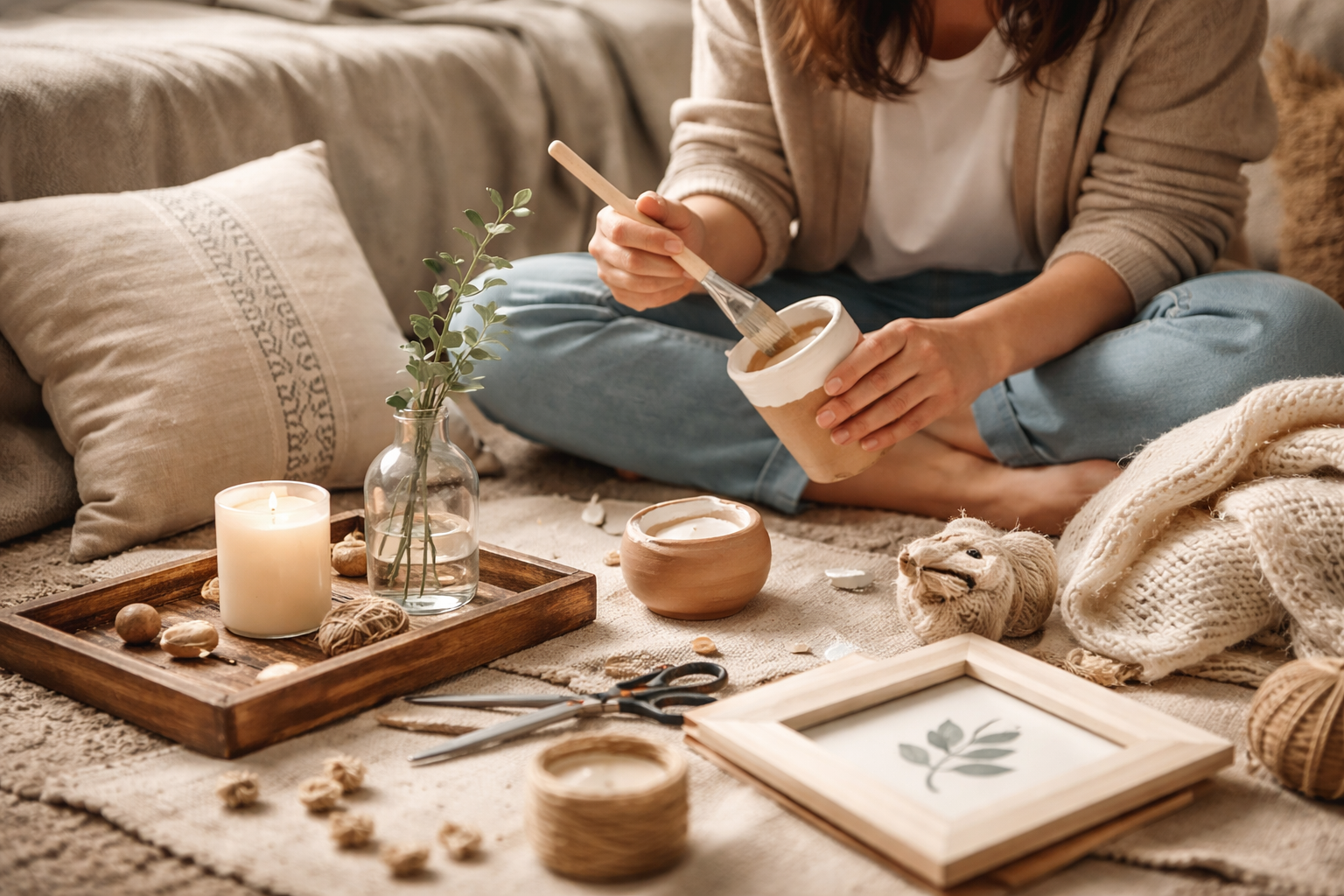
DIY Projects for People Who Don’t Feel Crafty at All
Think you’re not crafty? Try these DIY projects for people who don’t feel crafty at all, simple, fun, and surprisingly easy.
Most DIY posts make you feel like you need hours, fancy tools, or some hidden “talent” to make anything work. But the truth is, you don’t need to be naturally crafty to create something simple and nice.
This guide is for anyone who has felt intimidated by glue, scissors, or paint, even if you’ve never done a DIY project in your life. By the end, you’ll know how to pick projects that are achievable, fun, and don’t require perfection.
We’ll cover: how to choose beginner-friendly projects, tools and materials that actually help (not stress you out), and step-by-step examples that you can complete without frustration.
If DIY has ever made you doubt yourself, this post is meant to take that pressure off.
This guide talks on: Low-Cost DIY Crafts to Make and Sell From Home
Not Naturally Crafty? That’s Normal — Here’s Why
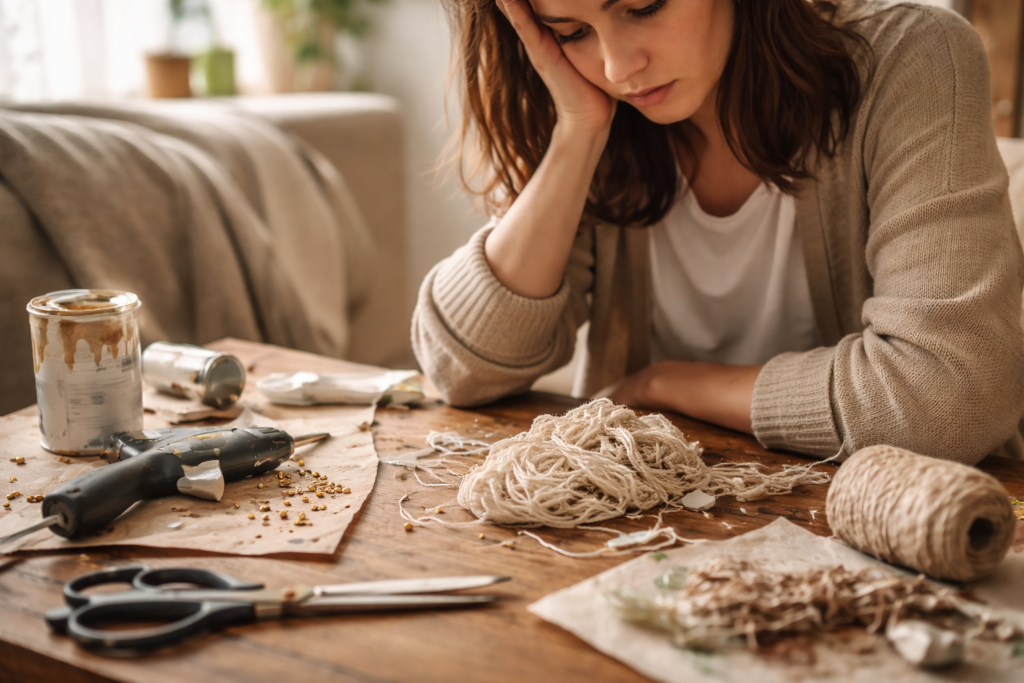
Feeling like you’re “not crafty” doesn’t usually have anything to do with skill. Most people who say it have tried DIY before and left frustrated.
Maybe you were a kid trying a school project and got corrected, rushed, or laughed at when it didn’t turn out right. Those moments stick. They teach your brain that creativity comes with failure, and that lesson doesn’t just vanish when you grow up.
When you see that, it’s easy to shut down before you even start, not because you can’t do it, but because the process triggers old frustration.
The truth is, feeling “not crafty” is mostly emotional, not skill-based. Your hesitation is normal. It doesn’t mean you’re bad at creating, it means past experiences and overwhelming instructions have made you cautious. That’s actually a smart reaction, not a flaw.
Understanding this is the first step. Once you know your “not crafty” feelings are valid, you can start picking DIY projects that are small, and finishable, without stress or judgment.
Here’s another helpful read: 15 Genius Ways to Upcycle Old Clothes Into Trendy New Outfits
The Real Barriers No One Names
Most DIY tutorials look simple at first glance, but for new crafters or anyone who doesn’t feel “crafty,” they can be confusing and frustrating, even discouraging.
Here’s what usually trips you up:
- Skipped steps: Instructions often say things like “just secure it” or “trim as needed” without showing exactly how. If you don’t already know, you can get stuck.
- Hidden tools: Some projects quietly assume you own a glue gun, rotary cutter, or drill. Most beginners don’t. Or probably don’t have all.
- Expensive “simple” supplies: You think you’re buying a few materials, but the total ends up costing more than just buying the finished item.
- Time estimates that lie: A project labeled 15 minutes can easily take an hour. That frustration builds fast, because it’s not expected
Here’s the truth from experience: when a DIY project leaves you frustrated, it’s not because you’re lazy or untalented. It’s because some tutorial doesn’t actually work for beginners.
That’s why beginner-friendly DIY projects, simple craft ideas, and DIY hacks for non-crafty people exist. They’re made so you can actually finish, feel accomplished, and enjoy the process, without stress, confusion, or wasted money.
Also read: Clothing Alterations I Stopped Paying a Tailor For (DIY Made Easy)
What Makes a DIY Actually Beginner-Safe
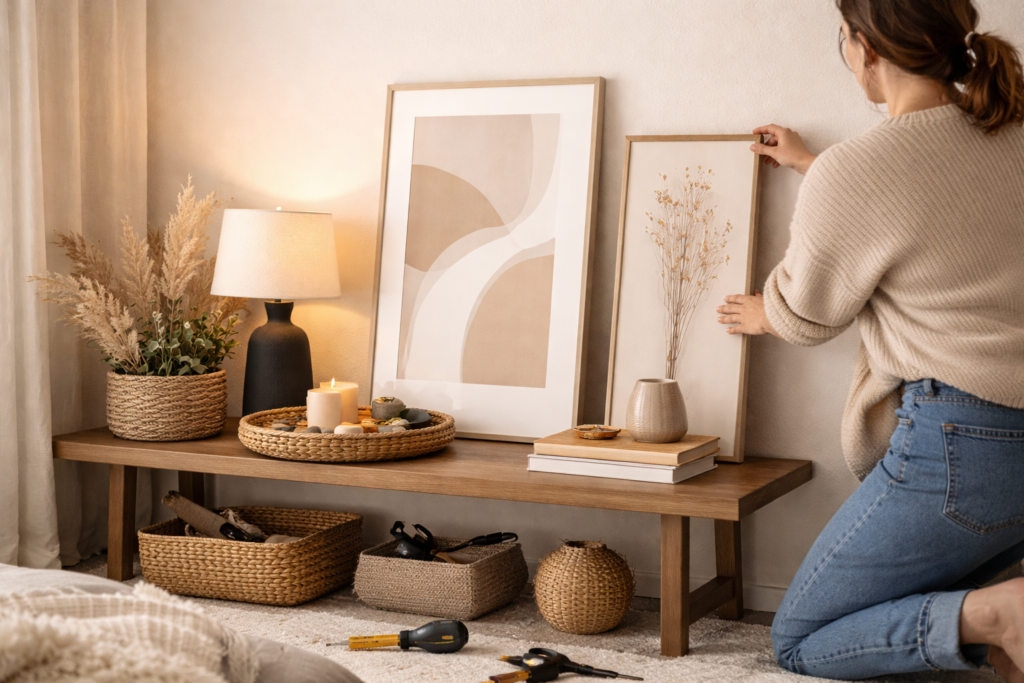
I know it can be confusing when a project is labeled “beginner-friendly.” Sometimes it still looks complicated, and that can make anyone hesitate. That doesn’t mean you can’t do it, it just means not every “easy” project is actually beginner-safe.
Here’s the thing: a DIY project is really beginner-safe when it’s made for someone who’s new, hesitant, or just a little unsure. That means:
- Uses things you already have, or just a couple of cheap supplies: You don’t need a long list of tools or fancy materials. Simple, easy stuff is enough to get you started and finished.
- You can start and stop anytime: Feeling tired or distracted? That’s fine. You can put it down and nothing gets ruined. There’s no pressure to do it all at once.
- Doesn’t need perfect lines or measurements: Crooked edges, uneven folds, or a little mess? Totally okay. It won’t break the project, I promise.
- Looks good enough even if it’s not perfect: The goal isn’t greatly perfect at the first trial. Even messy or slightly off projects should still feel useful or look nice enough to enjoy.
- Can be done in one sitting: Quick wins build confidence. You don’t need to spend hours or drag it over multiple days to get the project completed.
Here’s the most important thing: beginner-safe DIY isn’t about lowering the bar. It’s about removing pressure and risk so you can actually enjoy making something.
Know that messy, uneven, imperfect results aren’t failures, they’re proof that you tried, learned, and can actually do this. And that’s exactly how beginners like you and me start to feel confident.
Read up: Quick and Soft Valentine’s Gifts You Can Sew in a Few Hours That Melt Hearts
How to Choose DIY Projects That Won’t Overwhelm You
Before you dive into a long list of beginner craft ideas or simple DIY crafts, it helps to know how to filter projects so you don’t feel stuck or frustrated. Choosing the right projects is just as important as the project itself.
Here are some practical rules:
- If it needs measuring, skip it: Precise measurements can be stressful if you’re not confident with tools. Look for projects that use approximate sizes or things you already have at home.
- If it requires drying overnight, skip it: Multi-day projects often lose momentum. Easy DIY projects for beginners should be finishable in one sitting.
- If it needs exact alignment, skip it: Crooked lines or uneven placements shouldn’t ruin the project. Beginner-safe DIY doesn’t rely on perfection.
- If the tutorial video is sped up, be cautious: Many DIY tutorials speed through steps, making it hard to follow along. Simple DIY crafts or DIY hacks for non-crafty people should be easy to follow at a natural pace.
The key idea here is: you can learn to pick projects that actually work for you. Once you know the red flags, you can confidently choose beginner craft ideas and simple DIY projects that won’t overwhelm, waste your supplies, or make you feel like you can’t do it.
You might like these posts: DIY Clothes That Never Fit? My Brother Ruined His Clothes—Until He Tried These 7 Tailoring Hacks
DIY Projects for People Who Don’t Feel Crafty at All
1. No-Measure Fabric Table Mat (or Scarf Refresh)
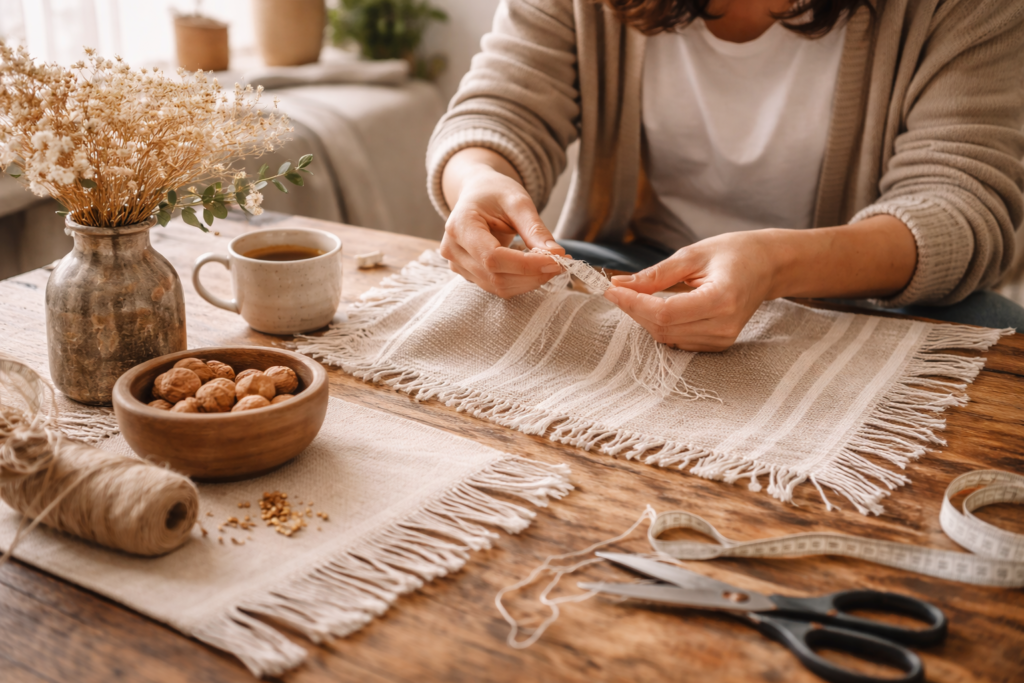
Sometimes, the hardest part of DIY isn’t folding, cutting, or gluing , it’s worrying you’ll ruin something before you even start.
That’s why this project works so well for beginners: it removes the “measuring and perfect lines” pressure entirely. You can take any old scarf or thin fabric and turn it into something useful and decorative in minutes.
-
- What you need: Old scarf, thin fabric, or cotton wrap; fabric tape or iron-on hem tape (optional)
- Time it takes: 10–15 minutes
- Where to use it: Dining table, tray, shelf, or side table
- What you need: Old scarf, thin fabric, or cotton wrap; fabric tape or iron-on hem tape (optional)
How to do it:
- Grab your scarf or piece of fabric. Don’t worry about size or straight edges.
- Fold or layer it to fit your table, tray, or shelf — uneven edges are fine.
- Use fabric tape or iron-on hem tape if you want the edges to stay in place, but it’s optional.
Why it works:
Measuring and perfect cuts often make DIY feel stressful. This project skips all of that. Even if your edges are uneven, it looks intentional, and you finish quickly.
It’s a small win that builds confidence, plus, it instantly refreshes a space without needing fancy tools or long hours.
If this helped, try this next: Spring DIY Projects You Can Start, Stop, and Pick Up Again Without Losing Progress
2. Glass Jar Reset (Not Decorating)
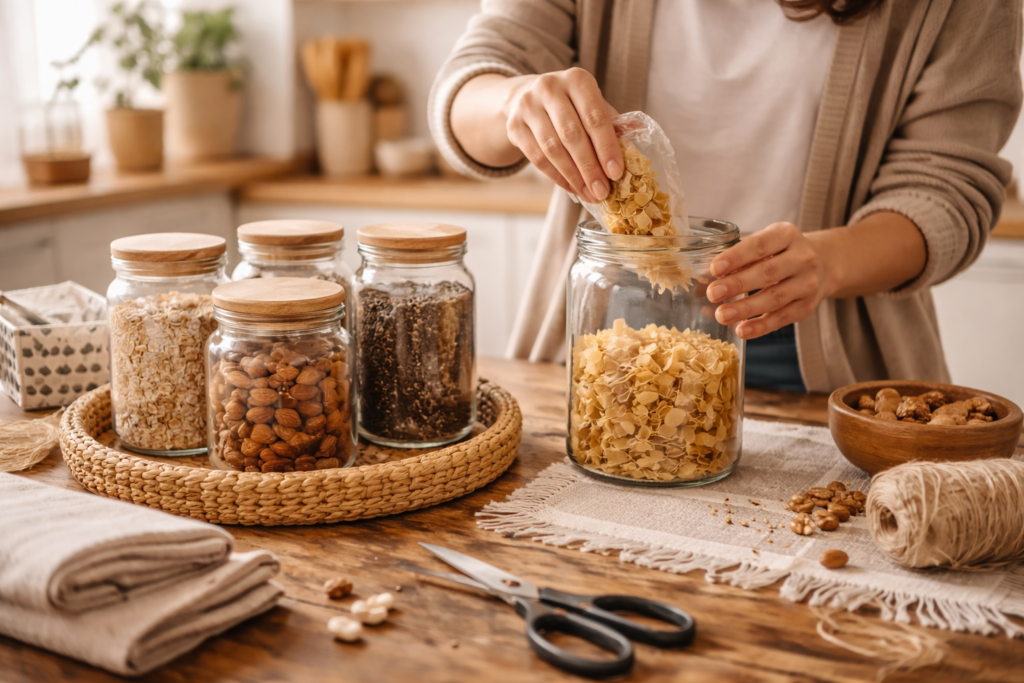
If DIY feels overwhelming, sometimes the easiest wins come from reassigning things you already have, instead of trying to make them look perfect. This project isn’t about turning a jar into something perfect, but about giving it a new, useful purpose. That takes the pressure off and makes finishing easy.
-
- What you need: Any clean glass jar; optional: a piece of twine or ribbon
- Time it takes: 5–10 minutes
- Where to use it: Kitchen counter, bathroom counter, bedside table, or pantry
- What you need: Any clean glass jar; optional: a piece of twine or ribbon
How to do it:
- Grab any jar you have and give it a quick clean.
- Choose how you want to use it:
- Utensil holder in the kitchen
- Makeup brush cup
- Bedside jar for small clutter (keys, pens, earbuds)
- Pantry container for dry goods
- Optional: wrap twine once around the neck for a simple decorative touch, no, no perfection needed.
How this project actually helps you:
You’re not crafting something new or forcing it to look perfect. You’re simply giving the jar a new role that’s practical. That small shift, reusing what you already have, builds confidence and shows that DIY doesn’t have to be complicated.
Read next: DIY Valentine Gifts That Don’t Feel Cheap
3. One-Cut Pillow Cover (Envelope Style)
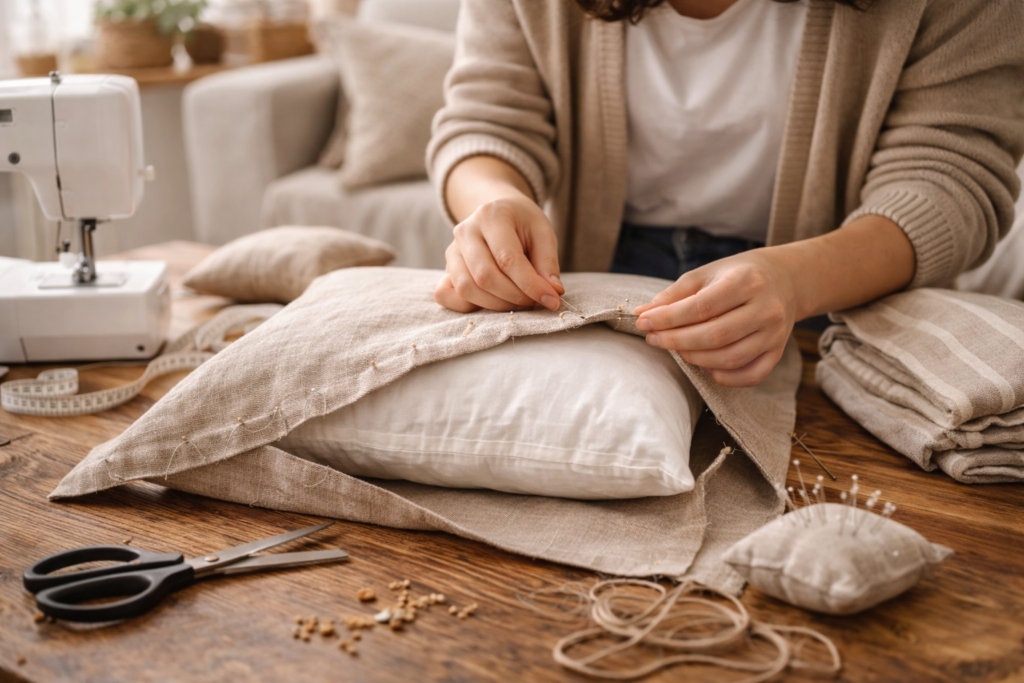
Sewing can feel intimidating, but this project keeps it simple. No zippers, no straight seams, and no pressure, just a fast way to give a pillow a fresh cover. Uneven edges don’t matter, and mistakes won’t ruin the final result. That’s what makes it perfect for beginners.
- What you need: A square of fabric slightly bigger than your pillow; fabric tape or safety pins (optional)
- Time it takes: 10–15 minutes
- Where to use it: Living room, bedroom, office chair, or couch
How to do it:
-
- Lay your fabric flat.
- Place the pillow on top and fold the fabric around it, like wrapping a gift.
- Secure the edges inside with fabric tape or safety pins, no sewing experience required.
Why even beginners can do this confidently:
Many sewing tutorials assume confidence and precision. This project works even if you hesitate or make small mistakes. Uneven edges are fine, and you finish quickly. It’s a beginner-friendly DIY that gives a real, satisfying result without stress.
4. Framed Paper Wall Art
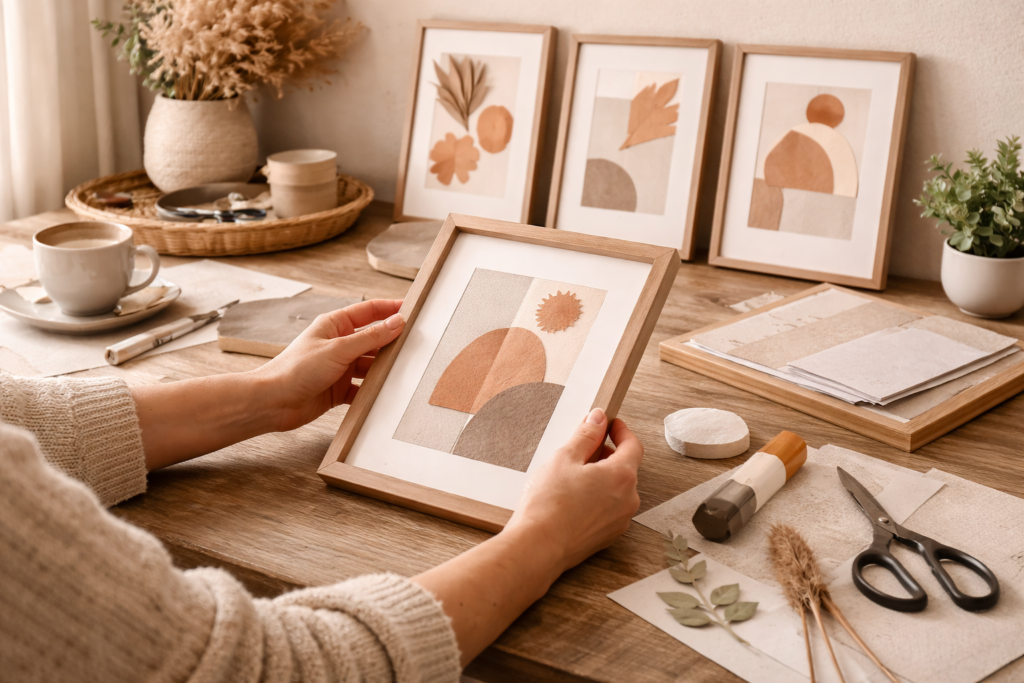
Sometimes, the easiest DIY projects are the ones where most of the work is already done, and all you have to do is make a choice.
This project is exactly that: the frame does the heavy lifting. Your job is simply picking what looks good and putting it in place. That makes it perfect for beginners or anyone who feels hesitant about creating from scratch.
-
- What you need: Frame(s) you already have; paper options like wrapping paper, old book pages, grocery bag paper, or printable quotes
- Time it takes: 5–10 minutes per frame
- Where to use it: Walls in your living room, bedroom, office, or even a small gallery corner
- What you need: Frame(s) you already have; paper options like wrapping paper, old book pages, grocery bag paper, or printable quotes
How to do it:
-
-
Pick a frame and the paper you want to display.
- Cut the paper to roughly fit the frame (no precision needed).
- Place it in the frame and hang or display wherever you like.
-
What makes this project beginner-friendly:
You don’t need crafting skills, measuring, or fancy tools. Choosing and placing the paper is enough to create a polished, finished look. Small imperfections don’t matter, and the result instantly refreshes a wall or space, a quick win that actually feels like an accomplishment.
5. No-Glue Wall Lean (Temporary Wall Styling)
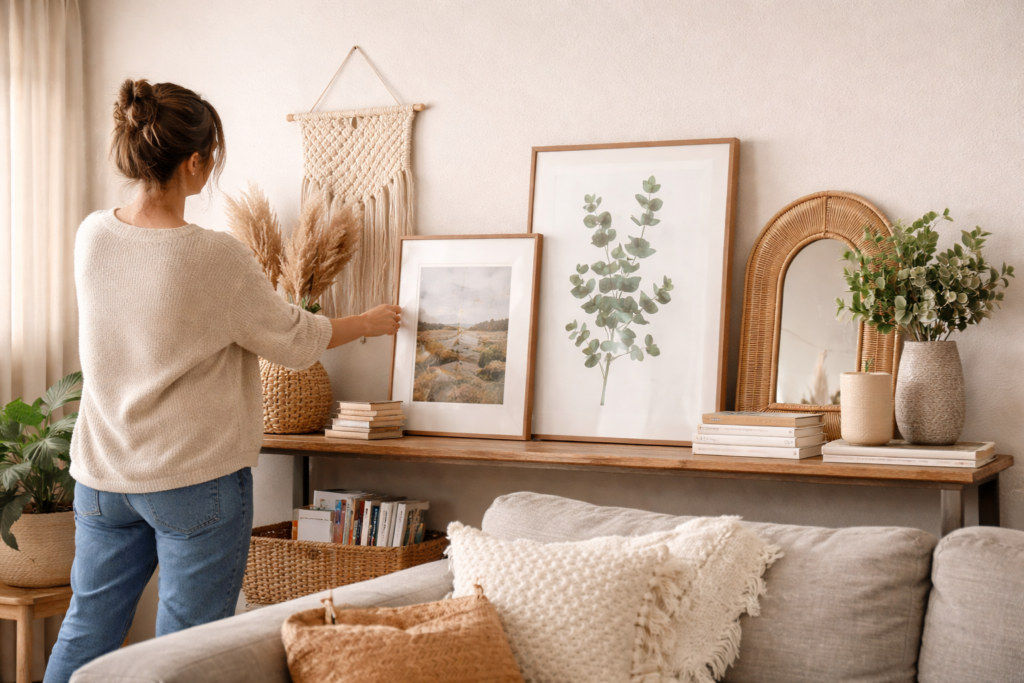
Decorating walls can feel stressful, especially if you’re worried about making mistakes or committing forever. This project takes all that pressure away. You don’t need nails, glue, or perfect placement, just lean things against the wall and let them work for you.
- What you need: Art, boards, trays, or fabric you already own
- Time it takes: 5–10 minutes
- Where to use it: Living room, bedroom, entryway, or anywhere you want a quick refresh
How to do it:
- Lean your items against the wall. You can mix art, trays, boards, or even fabric.
- Stack 2–3 items together for interest, no perfection needed.
- Adjust or move pieces around whenever you want; there’s no “forever” commitment.
What makes this project beginner-friendly:
You don’t need tools, precise measurements, or a permanent plan. The items themselves do most of the work, you just choose and place.
Small shifts or uneven angles don’t matter. It’s a low-pressure, quick way to style a wall and see results immediately, which is perfect for hesitant or non-crafty crafters.
6. Candle + Tray Grouping
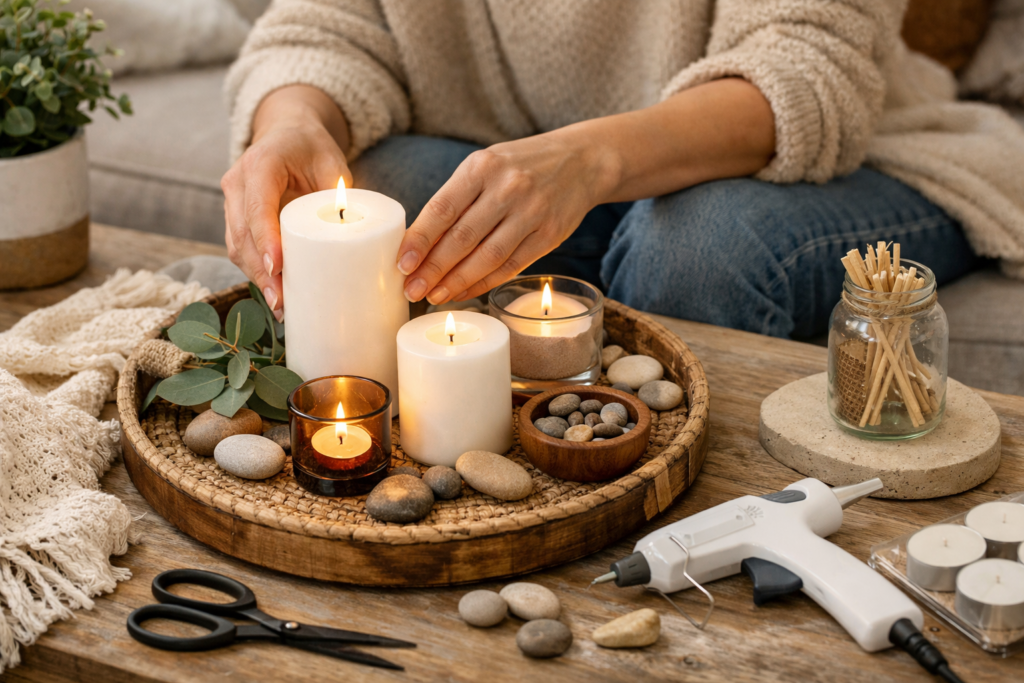
The easiest and most satisfying DIY often isn’t about making something new, it’s about arranging what you already have. With this simple setup, you can create a polished, finished look in minutes without stress or perfection.
- What you need: One candle, one tray or plate, optional small object (stone, book, matchbox)
- Time it takes: 5 minutes
- Where to use it: Coffee table, bedside table, shelf, or entryway
How to do it:
- Place your tray on a surface.
- Add one candle on top.
- Include one small object for interest, that’s it. Simple, fast, and satisfying.
What makes this project beginner-friendly:
Many DIY projects for people who don’t feel crafty rely on arrangement instead of creation. You don’t need tools, measuring, or crafting skills. Focusing on grouping instead of making allows you to finish quickly and feel accomplished.
You can bookmark this for later: DIY Bridal Feather Hand Fan Tutorial
The Permission Most People Need
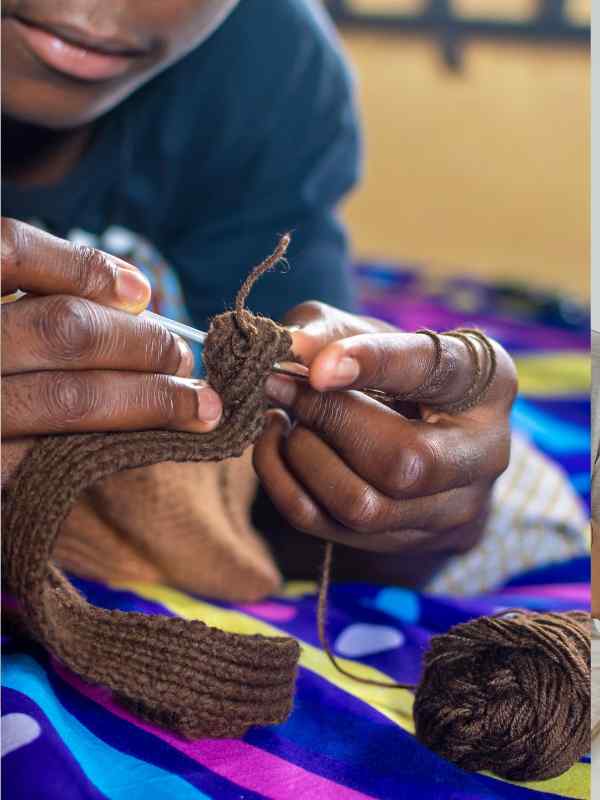
You don’t have to turn DIY into a big commitment, and you don’t have to finish, display, share, or even do it again. Just trying is enough.
- You don’t have to finish: Stopping halfway is perfectly fine. The value comes from trying, not completing.
- You don’t have to display it: DIY can be just for your own satisfaction, not for anyone else.
- You don’t have to share it: There’s no pressure to post on social media or get approval. Work at your pace.
- You don’t have to do it again: One project can be enough. You don’t need to become “the DIY person.”
How this helps you enjoy DIY:
Many DIY projects for people who don’t feel crafty never get started because the pressure to be perfect or consistent feels something you cant keep up with.
Giving yourself permission to experiment without expectations removes that stress and makes DIY approachable, fun, and filling. Even a small, simple project counts, it’s a win for your confidence and creativity.
While you are still here: Understanding Fabrics for Sewing: Choosing the Right Material for Every Project
What Success Looks Like for Non-Crafty People
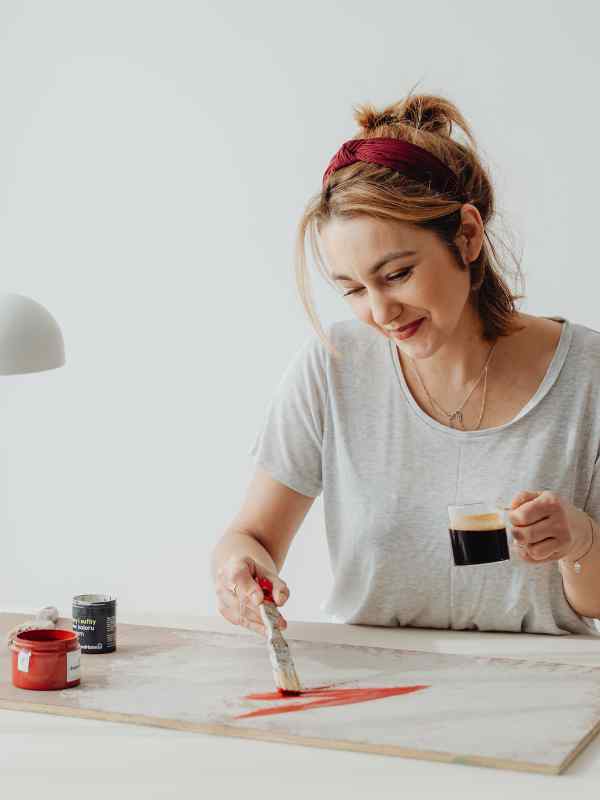
Most people think success in DIY is about making something perfect. That’s exactly what trips beginners upthe fear that it has to “look right” or “match someone else’s example.”
Here’s the truth: success isn’t about how it looks when you’re done. It’s about how it feels to create.
Here’s what counts as a real win:
- You tried something without getting frustrated.
- You didn’t quit halfway out of shame.
- You didn’t regret starting, even if it ended up uneven or a little rough around the edges.
- You feel like you could try another small project.
See that? That’s the victory. Not the straight lines, perfect finish.anyone else’s idea of “right.” The real win is in showing up, finishing something, and realizing you can do this, even if it’s a little crooked or imperfect.
That’s why these DIY Projects for people who don’t feel crafty exist. They’re built to give you small, tangible wins without stress or pressure. Each tiny success quietly tells: you’re capable, you can start, you can finish.
And that… that feeling? That’s exactly what keeps you coming back for more, without fear, without judgment, just creating for yourself.
Mistakes to Avoid When You’re New to DIY
Starting your first DIY projects can be exciting, but it’s easy to make small mistakes that slow you down or cause unnecessary frustration. The good news is that most of these mistakes are easy to avoid, and knowing them ahead of time can save both time and materials.
Here are some common pitfalls and how to prevent them:
-
Skipping planning or measurements – Even simple projects benefit from a quick plan. Take a minute to measure, sketch, or lay out your materials before you start. This prevents wasted supplies and keeps your project looking neat.
-
Using the wrong adhesive or tools – Not all glues or scissors work the same for every material. Before you begin, check that your tools are suitable. Using the right adhesive and cutting tools reduces mistakes and makes your project easier to finish.
-
Trying too many techniques at once – It’s tempting to add multiple techniques or decorations at once, but this can get overwhelming. Start with one approach, finish it, then add details if needed. This builds confidence and prevents frustration.
-
Ignoring cleanup while working – Mess can make a project harder than it needs to be. Keep a small trash bag nearby and clean as you go. This keeps your workspace organized and prevents accidental damage to your project.
-
Expecting perfection on the first try – DIY is about learning and experimenting. Mistakes are normal, and small imperfections are part of the process. Focus on progress, not perfection.
Tips to stay organized and save materials:
-
Gather all your supplies before you start.
-
Work on a flat, protected surface.
-
Keep scraps and leftover materials, they can be reused in another project.
-
Take your time and check your work step by step.
By being aware of these common mistakes, you can enjoy the process more, complete projects faster, and feel proud of what you create, even as a beginner.
A Note for the Hesitant Creator
Ever notice how the smallest things can surprise you? A pillow folded a little off, a tray stacked unevenly, a candle that leans slightly , and suddenly your space feels new. That’s the quiet magic of DIY for people who don’t feel crafty.
You don’t have to finish everything, don’t have to make it perfect, and you don’t even have to show it to anyone. Just trying, arranging, and finishing something is enough. That little act, awkward, uneven, imperfect, proves you can start, you can finish, and you can enjoy the process.
This is what most people miss: DIY isn’t about skill. It’s about moments where you feel capable, creative, and in control, even if no one else notices.
That being said!
Thanks for sticking with us through this guide on DIY Projects for People Who Don’t Feel Crafty, remember, small wins are still wins.
